No Time to Talk About Time?
If so… why do we talk about it all day?
“I don’t have time.”
“Time flies.”
“I need more time.”
And yet, if you actually stop for a second and think about it seriously… things start to fall apart.
We’re obsessed with something we can’t even properly explain.
We say we don’t have time… as if it were something you could lose from your pocket.

So, What Is Time?
What exactly is this thing we keep saying we’re running out of?
Is it something happening outside of us?
Something we measure with clocks?
Or something we’re constantly interpreting without even realizing it?
Because this is where the problem begins:
We use time all the time…
but we almost never stop to understand what the hell it actually is.
Breaking Down the Idea of “Time”
When we try to define time, we usually look for something solid—something we can point to.
But time doesn’t play that game.
It’s not an object.
It’s not a substance.
It’s not a “thing” in the universe like a rock or a mountain.
It seems more like an invisible structure that organizes everything else.
And that raises a better question:
If it’s not a thing… then what is it?
And even worse—how is it possible that we organize our entire lives around something we can’t see, touch, or even clearly define?
Time as Experience
One way to approach it is to look at the most basic level: how we experience it.
Time doesn’t show up as an abstract idea. It shows up directly as experience:
- remembering something → “past”
- reading this right now → “present”
- imagining what comes next → “future”
But here’s the strange part:
These don’t exist at the same level in your mind.
The past feels like memory.
The future feels like anticipation.
And the present… feels like the only thing that’s actually happening.
Which leads to an important idea:
👉 Time isn’t just something external. It’s also a way the mind organizes reality.

Time as the Order of Change
There’s another, more mechanical way to define it: Time is what allows us to say that something changes.
Without time, there is no “before” and “after.”
There are only disconnected states.
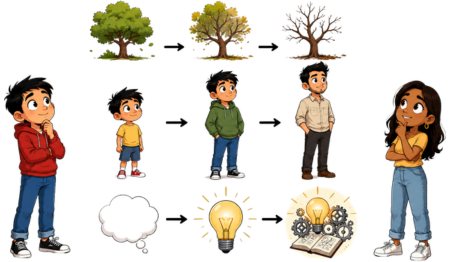
A leaf falling.
A body aging.
An idea appearing.
All of these only make sense if there’s an order.
In that sense, time doesn’t “flow” like a river.
Time is the way we describe change.
Time as Part of the Universe
From physics, things get even stranger.
Time is not separate from space.
They form a single structure: spacetime.
That means time isn’t a universal background that’s the same for everyone.
It can change depending on things like speed and gravity.
Put simply:
👉 Not all clocks experience the same time.
At this level, time isn’t absolute. It’s relative. And what’s the problem with that?

The Problem with an Obvious Question
Everyone uses time, but almost no one can explain it. We treat it as if it were completely clear.
We organize our lives around schedules, deadlines, and calendars.
But the moment someone asks you to define it… things break.
Because saying “time is what a clock measures” sounds fine—until you think about it.
A clock doesn’t create time. It only measures it.
And measuring something is not the same as understanding it.

The Strangest Part
Time is not something you can point to.
It’s not an object.
It’s not “out there” in any simple way.
And yet, we treat it as if it were one of the most solid things in existence.
It’s like living inside something we take for granted… until we try to look at it directly.

The Time We Use Is a Tool
Here’s an important shift:
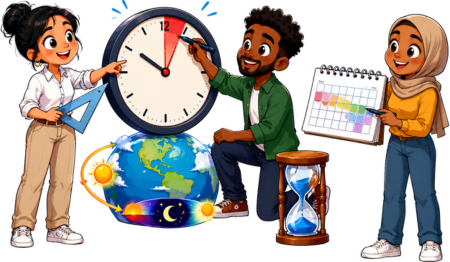
The time we use every day—seconds, minutes, hours—doesn’t exist as a natural thing in the universe.
It’s something we created to navigate something much more complex.
A minute is not a piece of reality.
It’s a division we invented.
They’re based on real cycles, yes—but the way we divide and use them is human.
It’s Like a Map
A map is not the territory.
But if you forget that, you start confusing the drawing with reality.
The same thing happens with time.
We mix two levels:
Time as something related to change.
And time as the system we use to measure it.
And once those get mixed… we stop noticing the difference.
If time is just a way of organizing change… then what we call “running out of time” might not be about time at all.

Does Time Exist, or Are We Inventing It?
This is where things get uncomfortable.
Some say time is real—like space. A dimension everything moves through.
Others say the opposite:
That time isn’t “out there,” but something the mind uses to organize perception.
That what’s real is change… and the rest is interpretation.

What If You’re Seeing It Backwards?
Think about a movie.
The whole film exists at once, but you experience it frame by frame.
Your brain connects those frames and creates motion.
So where is the movement?
On the screen… or in your perception?
Time might work the same way.

Physics Doesn’t Simplify It—It breaks It
For a long time, we thought time was stable. The same for everyone.
But it’s not.
Time changes. Not just in your head—in reality.
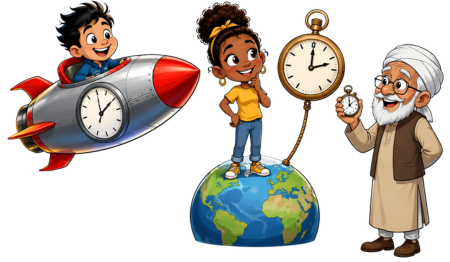
It depends on how fast you’re moving.
It depends on gravity.
This isn’t theory. It’s measured. It’s used.
Even Clocks Don’t Agree
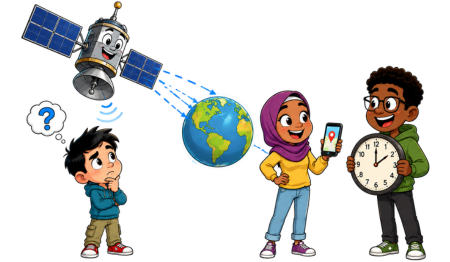
GPS satellites have to adjust their clocks constantly because time passes differently up there.
Which means:
Even clocks don’t agree.
So now the question shifts:
👉 How can something so unstable be what we use to organize reality?
The Time That Actually Matters ….
The One You Feel!
Now bring it back to something closer.
There’s a kind of time that doesn’t appear in clocks or formulas, but defines how we live: psychological time.
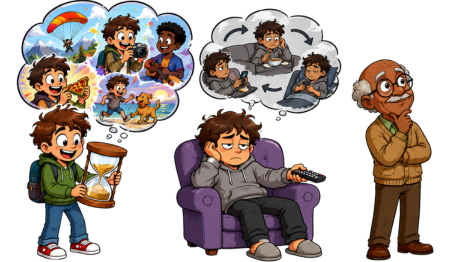
It’s what makes two hours feel completely different. A boring meeting drags. A great conversation disappears.
And here’s the key:
The clock doesn’t change. Your experience does.
Your brain doesn’t measure time consistently. It interprets it.
Attention, emotion, and novelty shape how time feels.

The Time You Remember
It also changes when you look back.
New experiences feel longer in memory because your brain records more detail.
Repetitive days compress.
That’s why time seems to speed up as you get older.
Not because time changes… but because experience becomes more uniform.
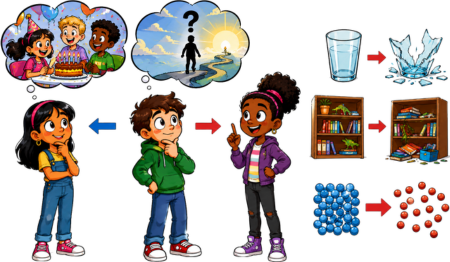
The Direction of Time
We experience time moving in one direction.
We remember the past, not the future.
This is linked to something called entropy: things tend toward disorder.
A glass breaks, but doesn’t unbreak.
But here’s the nuance:
Time doesn’t push things forward.
Change has a direction—and time is how we describe it.
Where It Becomes Personal
This is where it stops being abstract.
Time doesn’t just describe reality. It shapes your decisions.
Because it’s limited, you have to choose.
And this is where we say:
“I don’t have time.”

The Trap of “I don’t Have Time”
Most of the time, that’s not a description.
It’s avoidance.
The time is there.
What’s unclear is how it’s being used.
“I don’t have time” often means:
“I’m not willing to use my time for that.”

Being Busy Is not the Same as Moving Forward
You can fill your schedule and still go nowhere.
Being busy is easy.
Using time well is hard.
The problem is not time.
It’s direction.

So… What Is Time?
After all this, the answer isn’t clean.
Time isn’t a thing.
It’s not just what clocks measure.
It’s not just what you feel.
It’s all of that, at once.
It’s how the universe changes.
How your mind organizes that change.
And the tool you created to navigate it.
It’s not stable.
It’s not simple.
And it’s not as clear as we think.
But it’s what you use to shape your life.
And maybe that’s the point:
You don’t need to fully understand time.
But you do need to understand how you’re using it.
Because in the end, you’re not losing time.
You’re choosing what to do with it.