The Assumption We Never Question
We think of time as fixed, universal, and measurable.
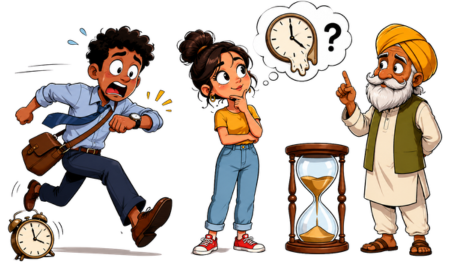
Hours, minutes, seconds—neatly divided, perfectly organized, and somehow powerful enough to ruin your morning because you are “late” by three minutes.
It feels objective. Almost inevitable—
as if this is simply what time is. But it isn’t.
And more importantly, it never was.
We organize our lives around this structure without asking where it came from—or why it feels so unquestionable.
As if time needed no interpretation.
Only measurement.
Time Was Never Universal
Ancient cultures didn’t experience time as a sequence of precise units stretching endlessly forward. That idea would have felt… strange. Unnecessary, even.
Time was something closer. More immediate.
It moved with the seasons, with daylight and darkness, with the rhythms that actually mattered—harvests, migrations, survival.
We didn’t measure time. We responded to it.
We have created clocks so precise that they can measure a fraction of a second—yet somehow we still lose entire weekends wondering where the time went.

Which Sounds Primitive—Until It Doesn’t
Which sounds rudimentary… until we remember something slightly embarrassing about humans: we have a habit of calling our own habits “reality.”
Because the moment we step outside of it—even briefly—it becomes obvious that time isn’t a neutral backdrop we all share.
It’s a framework.
Not because it’s the only possible way to experience time—but because it’s the system we inherited.
One we rarely question.
One that quietly shapes how we live without ever asking for permission.
So the question isn’t just how time is measured. It’s why we’re so convinced that our way is the default.
A Pattern We Keep Repeating
This is not only about time.
Throughout history, humans have often mistaken their own perspective for reality itself.
We assume the way we experience the world is simply the way the world is.
But history keeps challenging that assumption.
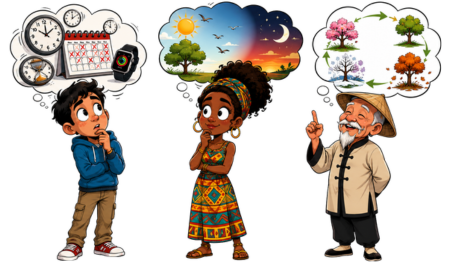
Different civilizations have looked at the same sky, the same seasons, and the same passing years—and created completely different ideas about what time meant.
Ancient People Followed the Sun & Seasons
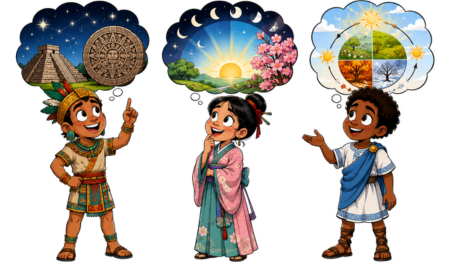
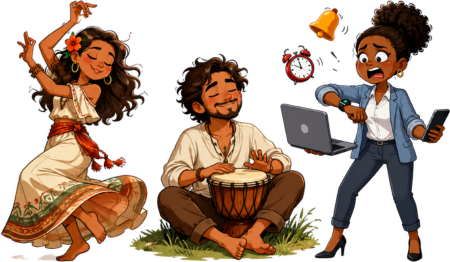
We follow calendars, alarms, notifications, and a tiny glowing rectangle that tells us we are already late.
The question, then, is not only how people measured time.
It is why humans, across civilizations, created such different ways of experiencing it.

From Measured Time to Lived Time
Today, we treat time as something to manage. We schedule it, divide it, measure it, and somehow still feel like we never have enough of it.
But this approach is relatively new.
For many ancient cultures, time was not something you controlled. It was something you moved with.
Instead of breaking it into units, they followed patterns. Instead of chasing it, they aligned with it.

Just a Subtle Difference
That difference seems subtle, but it changed everything.
Time went from something humans experienced as part of life to something they felt responsible for controlling—measuring it, scheduling it, and somehow still complaining that there is never enough of it.
And before that shift, time looked very different.

Time as Part of Nature
Before mechanical clocks existed, time was inseparable from the natural world.
People didn’t check the time. They noticed it.
They relied on recurring cycles to orient themselves: the rising and setting of the sun, the phases of the moon, and the changing of the seasons.
Morning wasn’t defined by a number on a clock, but by light appearing on the horizon.
Night wasn’t a fixed hour, but the quiet arrival of darkness.

Time Wasn’t Reduced to Numbers
It was experienced as rhythm—and life adjusted to that rhythm rather than resisting it.
Which sounds simple.
Until you realize we replaced all of that with alarms, notifications, and a schedule that still somehow doesn’t feel like enough.
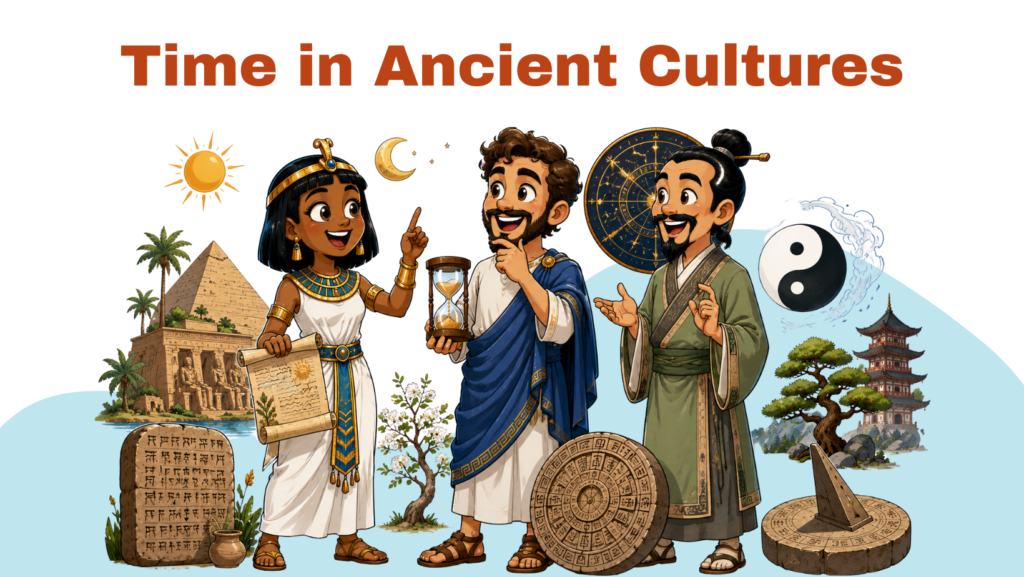
Ancient Egypt: Order & the Rhythm of the Nile
In ancient Egypt, time was not just something that passed. It was something that had to be maintained.
At the center of this idea was maat—a concept of balance, harmony, and order that governed both the universe and human life.
Time, in this sense, wasn’t neutral. It was part of a system that could remain stable… or fall into chaos.
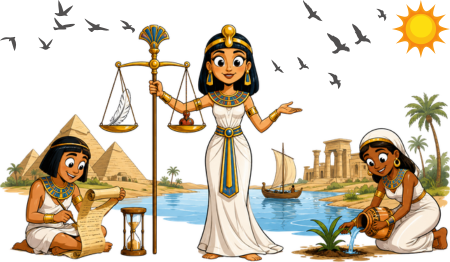
The Nile River Made this Visible
Each year, it flooded in a predictable cycle, shaping agriculture, the economy, and daily life. When the flood arrived as expected, order was preserved. When it didn’t, uncertainty followed.
But the Egyptians didn’t see this as simple repetition.
Each cycle was a form of renewal—something that had to happen for the world to continue.

Beyond Cycles: Time Without an End
But Egyptian time wasn’t only about cycles.
They also understood time in another way—one that didn’t move in repeating patterns, but existed beyond them.
One form of time was cyclical, tied to nature and everyday life.
The other was eternal, connected to the gods and the afterlife.
From this perspective, time didn’t really end.
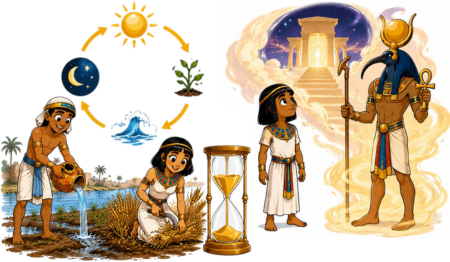
Time Shifted!
Death wasn’t treated as a final moment, but as a transition into another state within a larger, ongoing order.
Which, in a way, is a very different relationship with time than the one we have now.
We tend to see time as something we’re running out of. They saw it as something that never really ran out at all.

Ancient Mesopotamia: Measuring the Heavens
In ancient Mesopotamia, time began to look a little different.
It was still connected to nature, but something had changed. Humans were no longer just experiencing time—they were starting to take notes on it.
Because apparently observing the sky was not enough. We eventually decided it needed a system.
Living between the Tigris and Euphrates rivers, Mesopotamian societies depended on seasonal cycles much like Egypt. But instead of focusing on maintaining cosmic order, they became increasingly focused on predicting those cycles.
They observed the movement of the sun, the moon, and the stars not just to experience time, but to keep track of it.
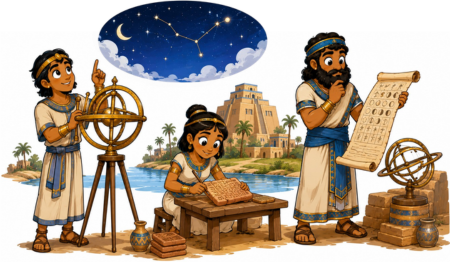
The Sky Became a Kind of Clock
—which is a strange idea when you think about it.
Mesopotamian societies looked at something enormous, mysterious, and completely beyond their control… and decided: “We should probably organize this.”
Taking something vast and distant and deciding it can be measured… and then trusting it enough to organize life around it.
And somehow, thousands of years later, we are still doing the same thing. Except now our clocks are on our phones, our wrists, our cars, and occasionally yelling at us because we are five minutes late.

Time Takes Shape
Over time, this made time more defined.
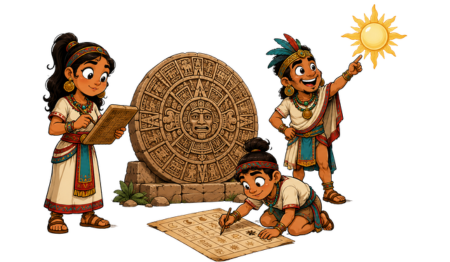
Calendars began to take shape, and days, months, and years were no longer just experienced but organized and recorded.
Time was still tied to nature, but it was now being translated into something structured—something people could plan around and anticipate.
Which Feels Familiar
Because this is where time starts to shift from something humans moved with to something they tried to stay ahead of. Not just noticing change, but expecting it—and slowly building systems around that expectation.
And if history has taught us anything, it’s that humans love turning things into systems. Then, a few thousand years later, we complain about the systems we created.
Does it still look familiar to you? At least, it should.
The System We Still Use
This shift didn’t end there.
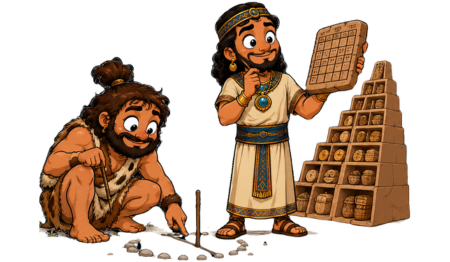
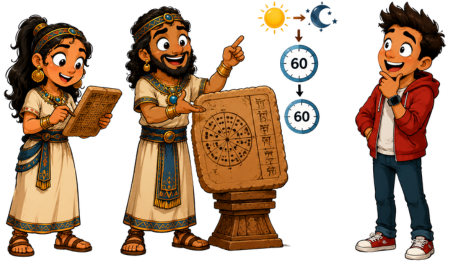
The system they developed carried forward, shaping how time is still measured today. The base-60 system, created in Mesopotamia, is the reason hours are divided into 60 minutes and minutes into 60 seconds.
It feels natural, like it couldn’t have been designed any other way.
But it was.
This Is Just the Version that Lasted
And like most things we inherit, we rarely question it—we just keep using it, as if it had always been there. Then, it just becomes normal.
The irony is that many of these systems were created to help humans understand time.
But over time, those same systems began shaping how humans experience it.
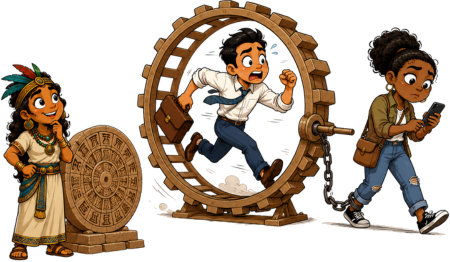
We created ways to measure time—and eventually found ourselves being measured by them.
Time as Meaning, Not Just Measurement
For many ancient societies, time was not just a practical tool. It carried symbolic and spiritual significance.
Calendars were not only used to organize activities. They identified moments that held meaning—times for rituals, transitions, and alignment with larger forces.
Observing the sky was not limited to scientific curiosity. It was a way of interpreting patterns and understanding one’s place within a broader system.
This highlights a key contrast with the present. Today, we primarily use time to organize our lives. In the past, time also helped people understand their lives.
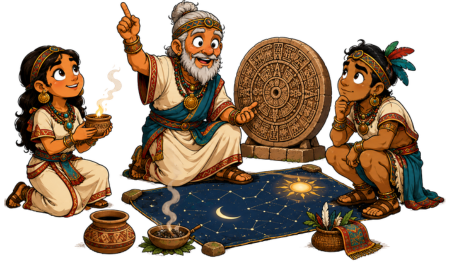
Ancient Greece: When Time Becomes an Idea
At some point, experiencing time and measuring it stopped being enough.
People began asking a different kind of question—not just how time works, but what it actually is.
This is where ancient Greece stands out. Time was no longer treated only as something practical. It became something to think about, analyze, and question.

Not All Time Is the Same
The Greeks didn’t settle on a single definition.
Instead, they described different kinds of time.
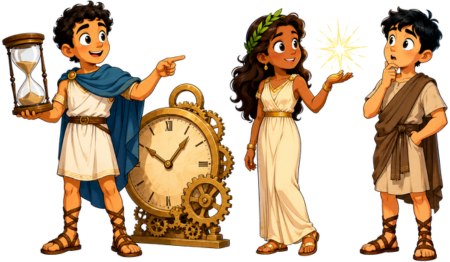
One of them, Chronos, refers to measurable, sequential time—the kind that moves forward in a clear, ordered way. It’s the version of time we still rely on today.
But they also described something else: Kairos.
Kairos is not about duration or measurement. It refers to the right moment—the point in time when something meaningful happens or when action matters most.
This introduced a simple but important idea: time isn’t only about how much passes. It’s also about what that time means.
When Time Becomes Uncertain
Once time is understood in more than one way, it becomes harder to treat it as something obvious.
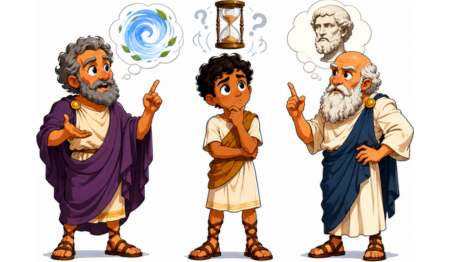
Some philosophers focused on change, arguing that everything is constantly in motion and nothing stays the same.
Others argued the opposite—that change might not be as real as it seems.
At that point, time was no longer just experienced or measured. It became something debated, something interpreted, and something that no longer had a single clear definition.
Ancient India: Cycles of Time
In ancient India, the idea of time expands to a scale that is difficult to fully grasp.
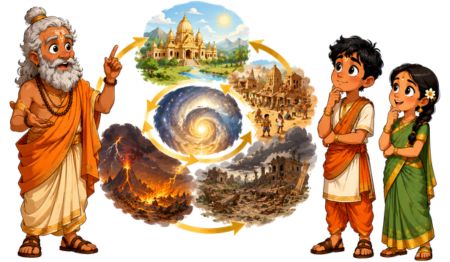
It isn’t linear, and it isn’t finite. Instead, time is understood as a series of vast, repeating cycles known as yugas.
Each cycle moves through phases of creation, development, decline, and destruction—before starting again.
Time doesn’t move forward toward a single endpoint. It repeats, over and over, in patterns far larger than everyday life.
Time Without an Ending
These cycles are not small.
They stretch across such immense periods that an individual human life becomes almost insignificant in comparison.
And that changes the perspective entirely.
Time is no longer something you are running out of. There is no final moment everything is leading toward.
It continues. It transforms. It repeats.
At that scale, time stops feeling limited—and starts feeling like something that was never meant to end at all.
But not every culture responded to the mystery of time by looking beyond human existence.
Some looked at something closer: the relationship between humans, nature, and the changing world around them.

Ancient China: Balance and Alignment
In ancient China, time was understood through a different question.
Not “How do we measure it?”
Not “How do we control it?”
But rather: “How do we move with it?”
Time was seen as part of a larger system of constant change. The world was always shifting, but that change was not random. It followed patterns.
The seasons changed. Nature changed. People changed.
The goal was not to fight those changes, but to understand them.

Finding Balance in Change
This idea appears in concepts like yin and yang.
They are often presented as opposites: light and darkness, activity and rest, growth and decline.
But the important idea is that these forces are not enemies.
They depend on each other.
One cannot exist without the other.
And that created a very different way of looking at time.
Change was not something that needed to be stopped.
It was something that needed to be balanced.

Moving With Time
Compared with modern life, the difference is interesting.
Today, we often treat time like something we have to defeat.
We plan it, divide it, save it, and complain when we lose it.
Ancient Chinese thought approached time differently.
The goal was not to control every moment.
It was to recognize patterns, adapt, and find the right moment to act.
Which is probably why thousands of years later, humans are still trying to schedule every second of the day… and still somehow feel behind.

Time as Something to Interpret
But this reveals something important about ancient views of time. Time was not just something happening in the background. It was something people paid attention to.
Natural cycles were not simply observed. They were interpreted.
The seasons changed.
The environment changed.
Life changed with them.
Knowing when to act mattered just as much as knowing what action to take.

Not a Machine Counting
For many ancient cultures, time was not a machine counting down somewhere in the background.
It was something people had to understand. They looked for patterns, changes, and signs around them.
Which is interesting, because today we have incredibly accurate clocks…
and we still ask ourselves where the day went.
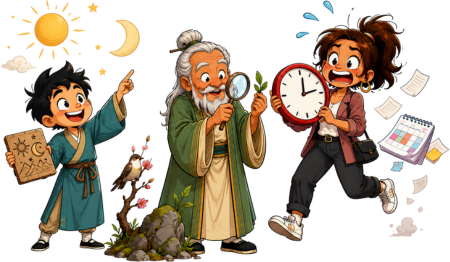
Time and Control
But eventually, humans started doing what humans usually do. We turned something natural into a system. Calendars became tools for planning, organizing, and predicting.
They helped societies coordinate agriculture, economies, and daily life. And slowly, the relationship changed.
We moved from asking:
“How do we live with time?”
to asking:
“How can we make time work for us?”
A very human question. Because humans are very good at creating systems. Then, sooner or later, we complain about those same systems.
We create schedules to organize our lives… and then complain that our schedules are too busy.

A Modern Tension
Today, we can measure time with incredible precision.
We have clocks in our phones, watches on our wrists, reminders for things we forget, and notifications reminding us about other notifications.
And somehow, after all that control…
we still feel like we are running out of time.
That is the modern paradox. The more precisely we measure time, the more pressure we seem to feel from it. The more control we gain over time, the less it feels like we actually have.