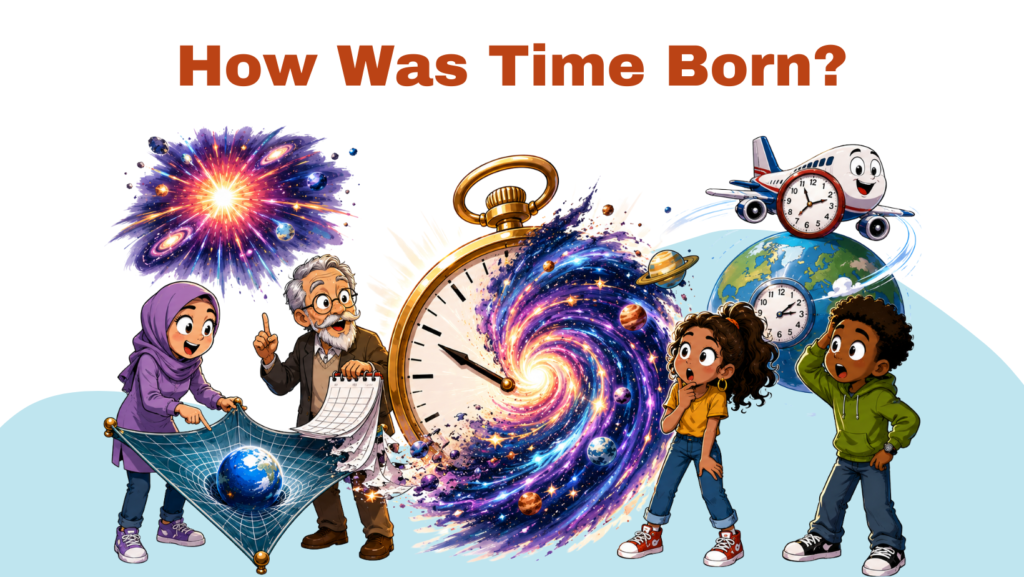
The question You’ll Never Have Time to Answer
Why?
Because the moment you ask it, it stops making sense.
Asking how was time born sounds like a simple question—almost harmless at first.
It feels like something you could answer if you just thought about it long enough.
Time is everywhere, after all. We measure it, track it, depend on it. It structures our days, defines our routines, and quietly shapes everything we experience.
It feels obvious.
And That’s Exactly the Problem
That familiarity is deceptive.
It gives the illusion that time is something simple—something we already understand.
But the moment you try to define it clearly, that certainty starts to slip.
Because the moment you try to answer the question seriously, something strange happens.
The question itself begins to fall apart.

How Time Works… Or Doesn’t!
We rely on time without thinking about it.
Seconds pass. Minutes add up. The past stays behind us, the future lies ahead.
It all seems perfectly clear.
But that clarity comes from habit—not understanding.
Because the moment we stop and question it, that sense of certainty begins to slip.
And what once felt obvious starts to feel far less solid.
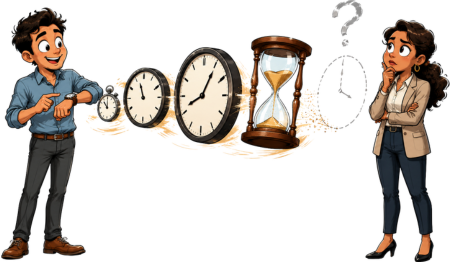
When You Look Closer
Because the moment we stop using time and try to examine it directly, something begins to shift. What once felt solid starts to feel less certain. Does time actually “move,” or do we just experience change?
Is the present a real moment, or just a boundary we imagine between past and future?
And most importantly:
Is time the same everywhere—or does it depend on how and where you exist?
These questions don’t just complicate time. They begin to unravel it.
And as strange as that sounds, physics reveals something even more unsettling:
Time is not the same for everyone.

The Hidden Assumption Behind the Question
When we ask ask how was time born, we’re already assuming something without realizing it.
We assume that time had a beginning.
We imagine it like everything else we know—something that started at a specific moment, something that came into existence the way objects do. A process. An event. A point in a timeline.

The Question Breaks Itself
But here’s the problem:
If time had a beginning… when did that beginning happen?
The question collapses immediately.
Because “when” only makes sense if time already exists.
So asking when time began is like asking what’s north of the North Pole. The structure of the question breaks the moment you push it far enough.
And that’s the first sign that we may not be dealing with a normal kind of problem.

Before Time… Was There a “Before”?
It’s natural to imagine a kind of “before.”
Before the universe.
Before everything.
Before time itself.
But this intuition might be misleading.
Because “before” is a time-based concept. It only works if time already exists.
Without time, there is no sequence. No earlier or later. No transition from one state to another.
So when we try to imagine what existed before time, we’re using tools that don’t apply to the situation.

The Limits of the Question
The deeper issue might not even be time itself—but the language we use to describe it.
Every question we ask is built on time: before, after, cause, beginning. Our entire way of thinking depends on sequence.
So when we ask how was time born, we may already be trapped.
We’re trying to explain something outside time using concepts that only make sense inside it.
And if that’s true, then the real problem isn’t answering the question—
it’s whether the question ever made sense in the first place.

Time Feels Obvious—But It Isn’t
In everyday life, time feels straightforward.
Seconds pass. Days move forward. The past is behind us, the future ahead. Everything seems to move in a single direction.
We don’t question it because we experience it constantly.
But physics tells a very different story.
At a fundamental level, time is not as stable, simple, or universal as it appears.

Time Is Not the Same for Everyone
One of the most surprising discoveries in physics is that time does not pass at the same rate for everyone.
According to relativity, time depends on motion and gravity.
Clocks tick at different speeds depending on how fast they are moving and how close they are to massive objects. Two people can experience time differently—and both can be correct.

A Simple Way To Visualize It
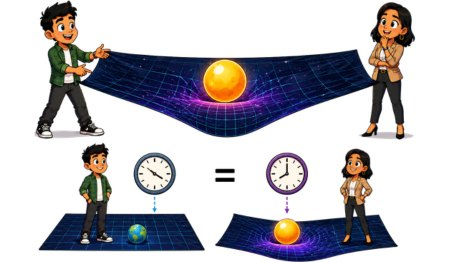
A useful way to picture this is to imagine space-time as a stretched fabric.
Not just lying flat—but pulled tight, like a sheet held at its four corners. Stable. Balanced.
Now place something heavy on it—a bowling ball, for example.
The surface doesn’t just hold it. It bends.
The fabric stretches under the weight, creating a curve that wasn’t there before.
If you roll a smaller ball across that surface, it won’t move in a straight line anymore. It follows the curve.
Not because something is pulling it, but because the surface itself has changed shape.
That’s roughly what happens with planets and stars. They don’t just sit in space—they reshape it.

Space And Time Together
So far, this picture explains how gravity shapes space.
But it leaves something important out.
Because that “fabric” isn’t just space.
It’s space and time woven together.
Which means when something bends the fabric, it’s not only changing how things move through space—
it’s also changing how time passes.
Not in an obvious way. Not something you can feel directly.
But enough to be measured. Enough to matter.
Another Way To Think About It
Imagine a shirt.
If you pull it lightly, it stretches but still looks normal. Push it further, and it starts to deform. The shape changes.
Or throw it in a dryer. Heat and motion shrink it, warp it slightly. Same material—different behavior.

What This Means For Time
Time works in a similar way.
Under normal conditions, it feels stable—like that fabric pulled tight.
But under extreme conditions, it shifts. High speed and strong gravity are enough to stretch or compress it.
You don’t feel it happening. But it’s there.
And it’s measurable.

The Experiment That Changed Everything
This might sound like one of those ideas that only works on paper.
It’s not.
In 1971, two physicists — Joseph Hafele and Richard Keating — decided to test Einstein’s theory of relativity in the real world.
Not with equations. With actual clocks.
And not just any clocks — atomic clocks, precise enough to measure time down to billionths of a second.

Taking Time on a Flight
The plan was simple.
Slightly insane, but simple.
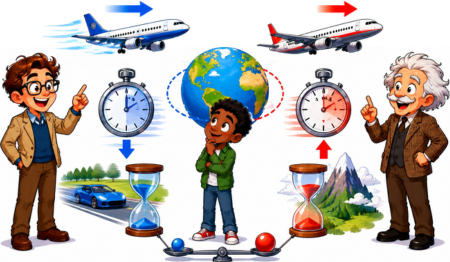
They took four of these atomic clocks and put them on commercial airplanes. Then they flew them around the Earth — once eastward, once westward.
At the same time, identical clocks stayed on the ground at the U.S. Naval Observatory. Those acted as the control.
So now you have two sets of time:
- clocks flying around the planet at high speed and altitude
- clocks sitting still on Earth
If time is absolute, they should all match at the end.
They didn’t.

The Weird Part
When the planes landed and the clocks were compared, the differences were tiny — nanoseconds.
But here’s the thing.
They weren’t random.
They matched Einstein’s predictions almost perfectly.
Which is… a bit unsettling.
Because time didn’t just “tick differently” by accident.
It behaved exactly the way relativity says it should.

What Was Actually Happening
Two effects were at play.
First: motion.
The faster something moves, the slower time passes for it relative to something at rest. This comes from Einstein’s special relativity.
So the clocks on the planes — moving at high speed — should fall slightly behind.
Second: gravity.
This is from general relativity. The stronger the gravitational field, the slower time passes.
Up in the air, farther from Earth’s center, gravity is slightly weaker.
Which means time actually moves a bit faster.
So now you have a strange combination:
- motion trying to slow time down
- weaker gravity trying to speed it up
And depending on the direction of the flight — eastward or westward — these effects don’t cancel out the same way.
They shift.
And It Actually Matters
The result?
Time is not universal.
It doesn’t pass at the same rate for everyone. Not on airplanes. Not on Earth. Not anywhere.
It depends on how fast you’re moving.
It depends on where you are in a gravitational field.
And this isn’t some weird edge case from the 70s.
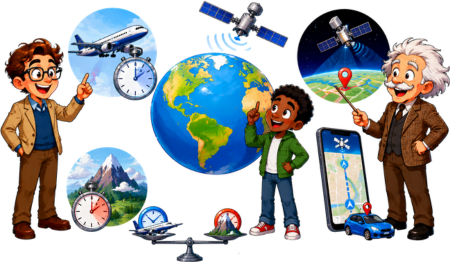
Modern GPS satellites have to account for this constantly.
Their clocks tick at a different rate than clocks on Earth, and if you don’t correct for that, your location would drift by kilometers every day.
So yes — this is real.
The Part That Stays With You
What Hafele and Keating showed wasn’t just that Einstein was right.
It’s that time isn’t this clean, universal thing we imagine.
It stretches.
It shifts.
It depends on perspective.
And once you see that…
you can’t really go back to thinking of time as something simple.

Why Don’t We Feel It?
And yet, none of this matches our everyday experience.
When you get on a plane, you don’t feel time slowing down. A pilot who spends thousands of hours in the air doesn’t feel like they are aging differently from someone on the ground. From the inside, everything feels completely normal.
So where’s the difference?

Why Your Watch Doesn’t Notice
Part of the answer is scale.
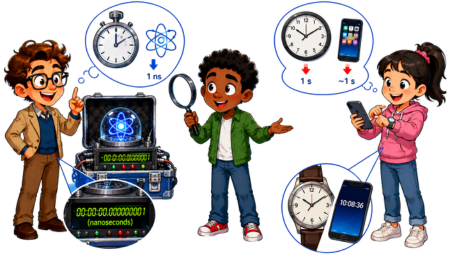
The changes predicted by relativity are real, but they are incredibly small—fractions of a second. The kind of difference you only detect with highly precise instruments.
Your phone doesn’t measure time at that level. Neither does your watch.
They’re designed to keep practical time, not perfect time. So even if tiny differences are happening, your devices simply smooth them out. To you, everything stays consistent.
What About Pilots And Flight Attendants?
This is where it gets interesting.
If time really does pass differently at high speeds and altitudes, then what about people who spend their lives there? Do they age differently?
In a strict physical sense, yes.
A pilot or a flight attendant is technically experiencing time at a slightly different rate than someone on the ground. Their biological processes follow that same timeline.
But the difference is so small that it never becomes noticeable in any practical way. They don’t feel younger, and they don’t experience longer days. Nothing about their perception changes.

What We Actually Experience
And this is the key point.
We don’t directly experience time itself.
What we experience is change—events unfolding, one after another, in a continuous flow. As long as that sequence remains coherent, time feels stable and predictable.
Even if, underneath, it isn’t.

The Question That Remains
So we end up in a strange place.
Physically, time is flexible. It stretches and shifts depending on motion and gravity.
But subjectively, it feels constant.
And that raises a deeper question:
Is time something that exists independently of us…
or is part of what we call “time” shaped by how we experience the world?
So are we saying that time doesn’t really flow?

Does Time Really Flow?
We often talk about time as if it flows.
We say it passes, moves forward, carries us along—like a current we’re all inside of.
But does time actually flow?
Or is that just how it feels from the inside?
What we experience as time is really change—events unfolding, one after another.
Memory gives us a sense of the past, and anticipation gives us a sense of the future.
That alone can create the feeling that something is moving forward.

A Universe That Doesn’t Move
But physics doesn’t necessarily require time itself to “move.”
Some models describe the universe as a kind of block, where past, present, and future all exist equally. In that view, nothing is flowing forward. Nothing is passing.
Everything simply is.
If that’s true, then the sensation of time flowing might not come from time itself.
It might come from us.
From the way consciousness processes information, remembers what has happened, and continuously builds the feeling of a present moment.

Why Does Time Have A Direction?
Even if time doesn’t actually “flow” the way we imagine, there’s another layer that makes it even more puzzling.
It doesn’t just feel like it moves—it feels like it moves in one direction.
We remember the past, but not the future.
We grow older, not younger.
A glass falls and shatters—but it never reassembles itself and jumps back onto the table.
Everything seems to follow a single arrow.
This idea is often called the “arrow of time.”
But where does that direction come from?

The Arrow of Time and Entropy
In physics, there’s a concept called entropy. It describes how systems tend to move from order to disorder over time.
A whole glass is more ordered than shattered pieces on the floor.
An intact egg is more ordered than a scrambled one.
While the laws of physics don’t forbid things from going backward, the number of ways for something to be disordered is vastly greater than the number of ways for it to be perfectly ordered again.
That’s why a broken glass doesn’t fix itself.
Not because it’s impossible—but because it’s overwhelmingly unlikely.
This gradual increase in disorder gives time its direction.
It separates what we call the past from what we call the future.

Why We Remember the Past, Not the Future
The past feels fixed because it has already happened. It has left traces—memories, physical records, changes in the world.
The future hasn’t done that yet.
It isn’t organized into a single outcome. It exists as many possibilities.
Our brains rely on stored information to build a sense of time.
That’s why we can remember the past, but not the future.
Not necessarily because time itself is moving forward—but because information only flows one way.

A Different Way to Imagine Time
So what if time isn’t something that flows at all?
One way to think about it is like a book.
Every page exists. The beginning, the middle, and the end are all part of the same object.
But when you read it, you experience it one page at a time.
You can move forward easily—but going backward doesn’t feel the same. The story has already unfolded.
Or like a movie that already exists in full.
Every frame is there. Nothing is actually moving.
But as you watch it, it feels like everything is happening in sequence.
From this perspective, it might not be time that’s moving.
It might be us—our perception—moving through something that is already there.
And the increase of entropy, combined with how our brains process information, may be what creates the powerful feeling that time is flowing forward.

The Beginning of the Universe
If we follow modern cosmology, time doesn’t really exist on its own.
It doesn’t “sit” somewhere waiting for the universe to start.
It starts with the universe.
At the Big Bang, space and time show up together. Not like two ingredients. More like… the same thing refusing to be separated.
Which is already where things get awkward.
Because we love calling it an “explosion.”
But explosions happen in time.
This one is apparently the explosion that also invents time.
So yes—time begins… by doing the one thing that would make “before” impossible.
And then we confidently ask what happened before it.
As if we didn’t just remove the stage and keep asking where the play was performed.

Where Intuition Gives Up Quietly
This is where intuition usually leaves the room without saying goodbye.
We think in sequences. That’s our comfort zone.
First this, then that, then obviously something else after that.
Very clean. Very human. Very wrong, in this case.
Because sequence already assumes time.
No time → no “then.”
No time → no “before.”
No time → no neat chain of cause and effect holding reality together like a story with good editing.
So when we ask how time began, we’re doing something a bit strange.
We’re using time-shaped thinking to explain why time exists at all.
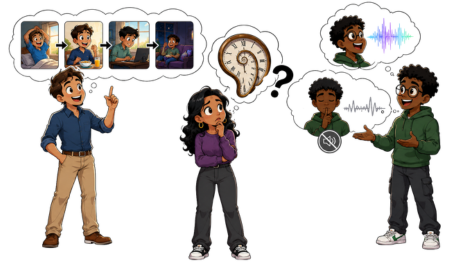
It’s like trying to define silence using sound.
Technically possible. Philosophically… suspicious.
Maybe Time Isn’t What We Think It Is
Some theories get a bit more uncomfortable here.
They suggest time isn’t fundamental at all.
Which is a polite way of saying: time might not be “a thing.”
More like something that happens when reality gets complicated enough.
Temperature is a good example.
It feels real. Solid. Measurable. You can argue about it at dinner.
But it isn’t fundamental. It’s what you get when particles decide to move in large groups and behave statistically instead of individually.
No motion → no temperature. Simple.
Time might be similar.
Not a substance. Not a hidden river.
Just what emerges when change becomes too complex to ignore.
A kind of accounting system the universe didn’t ask for—but ended up needing.

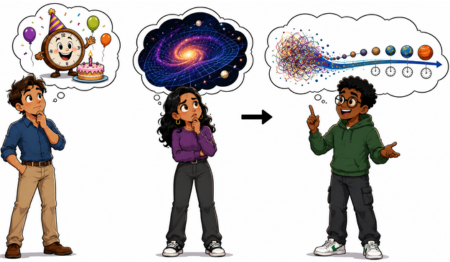
So Maybe We Asked It Wrong
At some point, the question quietly stops cooperating.
We started with: How was time born?
As if time had a birthday.
As if there was a moment the universe looked around and said: “right, let’s introduce time now.”
But the deeper we go, the less that image survives contact with physics.
Time starts to look less like an object…
and more like a framework we project onto change so it doesn’t overwhelm us.
A way to say: this happened, not everything at once.
So maybe time wasn’t born.
Maybe it’s what appears when the universe stops being simple enough to describe without ordering it.
So… What’s the Answer?
We don’t really have one.
Not in the satisfying sense we want.
We have models. Very good ones. Very precise ones.
But when we push them all the way back—to where “beginning” is supposed to be—they start to lose grip.
Which is usually where we pretend the question is bad.
But maybe it’s the opposite.
Maybe that’s the moment the question finally becomes honest.

A Better Question (Annoyingly)
Instead of asking how time began…
we might ask:
what kind of reality makes time necessary?
what conditions produce something like “past” and “future”?
why does experience split the world into “before” and “after” in the first place?
Less dramatic questions. Less cinematic.
But closer to something real.
Unfortunately.

Final Thought (Slightly Uncooperative One)
Time feels like the most obvious thing in the world.
Everything depends on it. Everything obeys it. Everything complains about it.
And yet the moment we try to pin it down, it refuses to behave like anything we can actually hold.
So maybe the real split isn’t between past and future.
Maybe it’s between:
the universe as it is…
and the story we tell so we don’t collapse under how strange it is.
And time is just part of that story.
A very convincing one.
But still… a story.