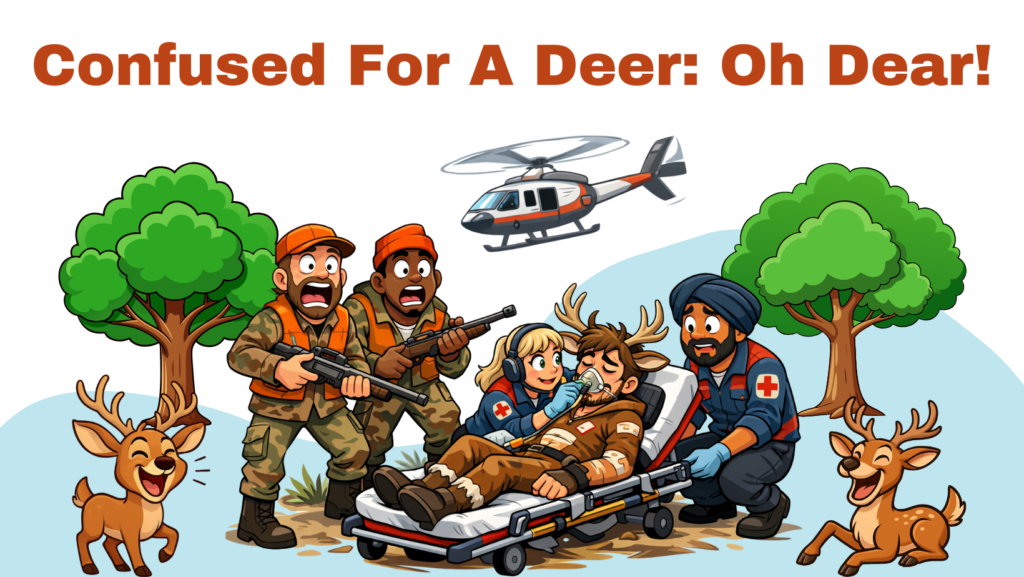
Hunters Shoot “Trans-species” Man!
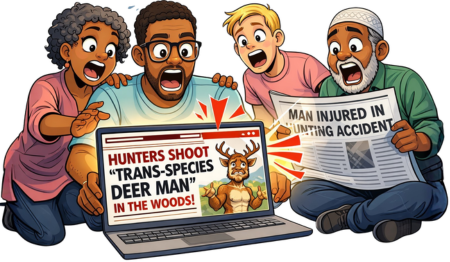
Moments of terror reportedly unfolded in a rural area of South Carolina when a man who identified as a deer was allegedly shot by two hunters who mistook him for an actual animal during a hunting trip.
The deer — sorry, the injured man — was later identified as William Tenenbaum, 31, who was airlifted by helicopter in an emergency evacuation and taken to Allendale County Hospital, where he remains in critical condition, according to medical sources.
A Hunting Accident, a Mistaken Identity… or Something Stranger?
We don’t know yet.
But one thing seems clear:
Don’t dare dress like a deer in the woods. Not the safest choice these days.
Can’t Be a Deer No More?
“Jeez… times are changing,” one witness reportedly said after the incident.
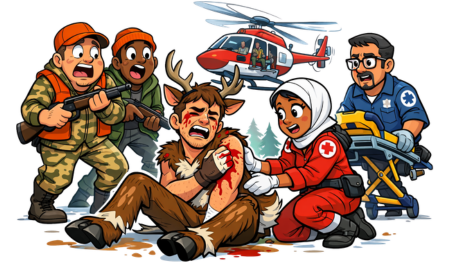
Residents in the area say they heard gunshots echoing through the woods before word began to spread that the hunters had not shot a deer after all.
They had shot a man.
Emergency services were called shortly afterward, and witnesses described a chaotic scene as rescuers attempted to stabilize the victim before airlifting him to the hospital.
Although, depending on how one defines identity… that distinction may be open to debate.

Between Myth, Performance… and Fake News
A bizarre case from the American South seems to reopen a strange debate about identity, reality, and the idea of being “trans-species.”
But wait a moment. Something feels off.
Where’s the catch?
No catch. He didn’t get caught. He was shot.
That part is clear, right?
The story sounds so absurd that it almost feels unbelievable.
Even Kafka or Camus might have hesitated before writing something like this.
And yet the story has all the classic ingredients of a tragic headline:
- Violence
- A fatal mistake
- Medical emergency
- Emotional shock
In other words… It looks exactly like real news.
From Satire to Something Uncomfortable
There is just one small detail that changes everything.
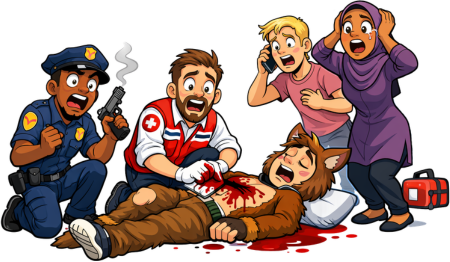
None of this actually happened.
The story originally appeared a few years ago on World News Daily Report, a well-known satire website that openly states on its homepage that its content is fictional.
The “Deer Man” case is a hoax — a carefully constructed parody designed to look like real journalism so that readers would share it quickly.
And it worked.
The story circulated widely online, convincing many readers that it might actually be real. But this is where the conversation becomes interesting: while the story itself is fictional, the phenomenon it touches on is not entirely imaginary.

The Trans-Species Phenomenon
In different parts of the world, some people have begun identifying not only outside traditional gender categories but even outside the human species itself.
Not as a metaphor.
Not as a temporary costume.
But as part of their identity.
Several examples have attracted media attention in recent years:
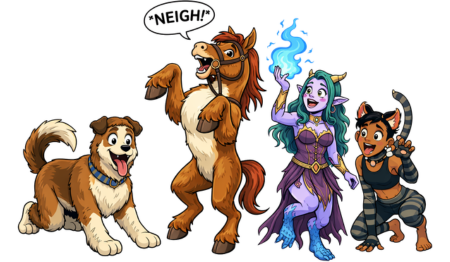
- People in Japan who identify as human dogs.
- The so-called “horse woman” in Norway.
- Online communities known as otherkin, where individuals identify as non-human beings — sometimes animals, sometimes mythological creatures.
- Viral internet figures who publicly present themselves as animals online.
Each of these cases raises questions about identity, the body, performance, community, and the influence of the internet.
Identity, Performance… or Something Else?
One of the most common mistakes is to assume that every trans-species identity must automatically be a clinical disorder.
Reality is rarely that simple.
What we see in these cases is often a complex intersection of several elements:
- Personal identity
- Physical performance
- Online culture
- Community belonging
- Personal narrative
- And sometimes, mental health
Not everything is pathology.
Not everything is theater.
Not everything is a joke.
Understanding these cases requires a broader cultural perspective.
Preferably before someone shows up in the woods wearing antlers.
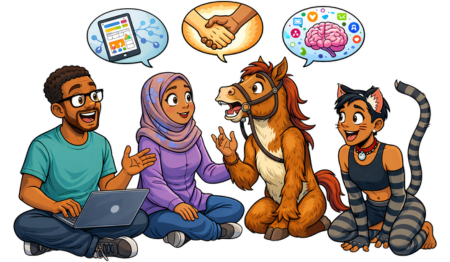
The Question That Brings Us Here
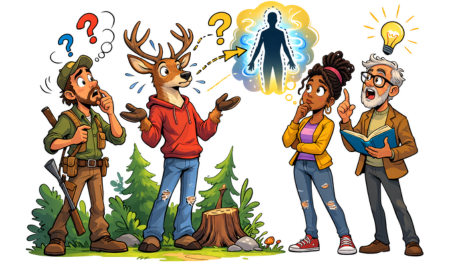
And so we return to the beginning: a man in the woods, hunters, and a deer that might not be a deer. Oh dear!
The story is fake, but the question it raises is very real.
Where does personal identity end, and where does shared physical reality begin?
How far can identity stretch before the world — biological, legal, and social — draws a line?
That question is exactly what we will explore in this conversation.
When Language Begins to Shift
At the center of this debate is a simple but powerful verb: to identify.
In everyday language, identifying something usually means recognizing what it already is. We identify a person in a photograph. We identify a bird in the forest. We identify a suspect in a police investigation.
But in recent years the verb has begun to take on a slightly different meaning.
Instead of describing recognition, it sometimes describes declaration.
To say “I identify as…” no longer simply describes what someone is. It describes how someone defines themselves.

From Description to Declaration
This shift may seem subtle, but it changes the role of language itself.
Identity becomes something that is not only discovered, but also expressed — and sometimes negotiated.
In that sense, the phrase “identified as a deer” sounds absurd not only because of the animal involved, but because it pushes this linguistic shift to its extreme.
The sentence forces us to confront a deeper question: when language changes the way we describe identity, how far can that change go?
And that is precisely where satire, culture, and serious philosophical questions begin to overlap.
Why Did So Many People Believe the Story?
If the Deer Man story was satire, why did so many readers believe it?
Part of the answer lies in how modern media works. Online headlines are designed to trigger fast reactions — shock, outrage, disbelief — and readers often share stories before checking where they came from.
But there is another reason: The story didn’t feel completely impossible.
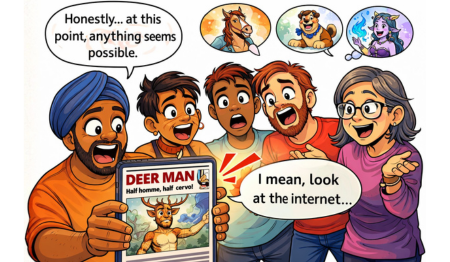
In recent years the internet has been full of strange identity stories, unusual performances, and viral personalities. When readers saw the headline, many reacted with a familiar modern response:
“Honestly… at this point, anything seems possible.”
That reaction tells us something interesting. It says less about the story itself and more about the cultural moment we live in.
The Internet and the Expansion of Identity
The internet has dramatically changed the way people construct identity.
Online spaces allow individuals to experiment with ideas about who they are. Communities can form around interests, aesthetics, beliefs, and sometimes even imaginative identities. Some people participate playfully, while others take these identities very seriously.
Digital culture encourages experimentation, allowing individuals to create narratives about themselves and find communities that share them.
As a result, the line between identity, performance, and storytelling can sometimes become difficult to see. And that ambiguity is exactly what makes stories like the Deer Man parody feel strangely believable.

Humans Have Always Wanted to Be Animals
The idea of humans identifying with animals is not entirely new.
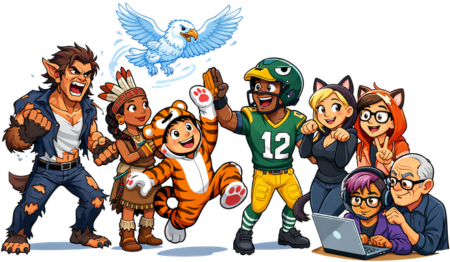
Throughout history, cultures around the world have imagined humans transforming into animals. In mythology we find werewolves, shapeshifters, and animal spirits.
In some Indigenous traditions, animals represent spiritual guides or symbolic identities.
Even modern culture reflects this fascination. Sports teams are named after animals, mascots wear animal costumes, and cartoon animals behave like humans.
The boundary between humans and animals has long fascinated the human imagination.
What may be new is not the idea itself, but the way the internet now allows people to build identities around it publicly.

When Satire Escapes Into Reality
Satire has always depended on exaggeration.
Writers take something real, push it a little further, and trust that readers will recognize the joke.
But the internet has changed that dynamic.
In a world of viral headlines, algorithm-driven feeds, and endless scrolling, satire sometimes escapes its original context. A story written as parody can begin circulating as if it were genuine news.
The Deer Man story is a good example.
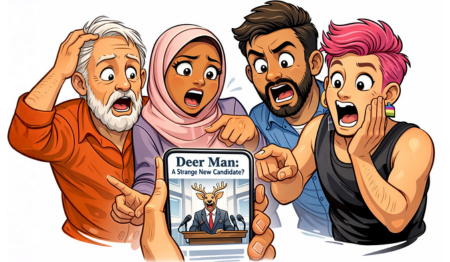
Originally published as satire, it was copied, reposted, and shared across social media until many readers encountered it without the original disclaimer. By the time it reached them, it looked like just another strange headline in an already strange news cycle.
When Plausibility Replaces Truth
And once a story enters that environment, something interesting happens. People stop asking whether it is true.
Instead, they ask whether it sounds plausible.
In an age where reality already produces headlines that feel surreal, satire no longer needs to exaggerate very much to become believable.
Sometimes it only needs a pair of antlers and a walk in the woods.
Why Extreme Examples Matter
Philosophers often use extreme examples to test ideas. These examples are not meant to represent everyday life. Instead, they help reveal the limits of concepts by pushing them to places where contradictions begin to appear.
In that sense, the Deer Man story functions in a similar way. It pushes the idea of identity to an extreme point where certain tensions become visible:
- If identity is completely self-defined, could someone identify as another species?
- If identity is purely biological, where does culture fit in?
Extreme cases like this force us to think more carefully about the assumptions we usually take for granted. And sometimes the most absurd stories turn out to be the most useful thought experiments.
Even if they start with a man wearing antlers in the woods.