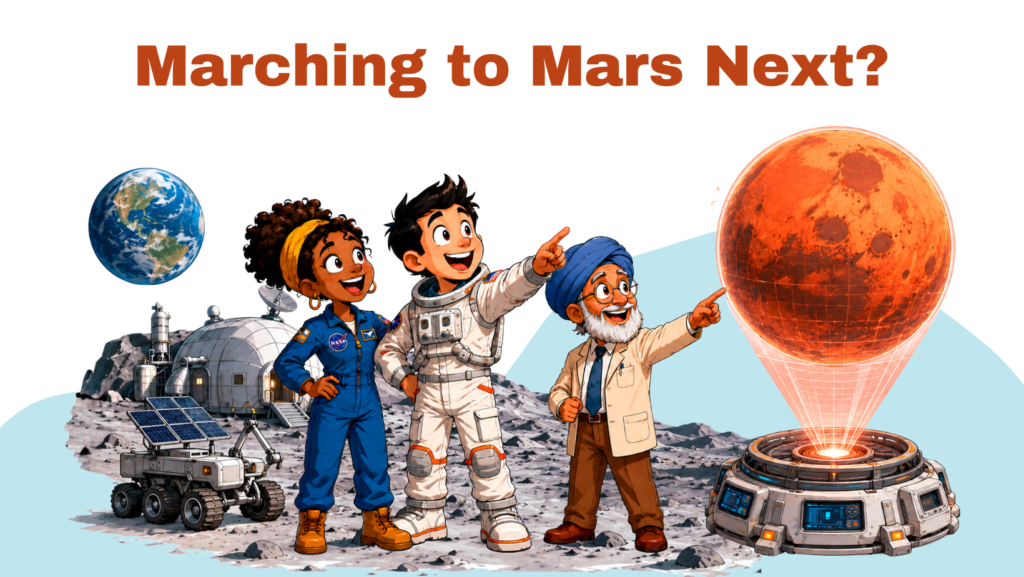
Heading to Mars?
The idea sounds almost too easy when you say it fast: leave Earth, cross space, arrive at Mars. Simple. Linear. Almost polite.
We’ve orbited Earth. We’ve stepped on the Moon. We’ve even sent machines all the way to the Red Planet. So in theory, Mars should just be the next logical address.
So what could possibly go wrong?
Well… quite a lot.
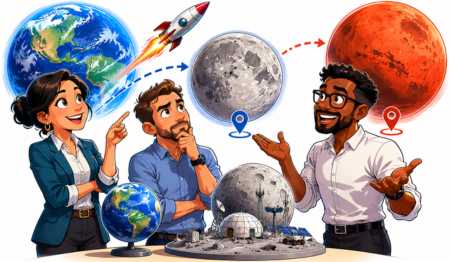
What’s Wrong with the Moon-first Logic
And this is where a proposal shows up that sounds almost responsible: before going to Mars, why not stop at the Moon?
Use it as a pit stop. A testing ground. A cosmic gas station with ambition.
On paper, it feels smart. Controlled. Safe. The kind of idea that wins meetings.
But the moment you actually sit with it, it starts multiplying questions instead of solving them.
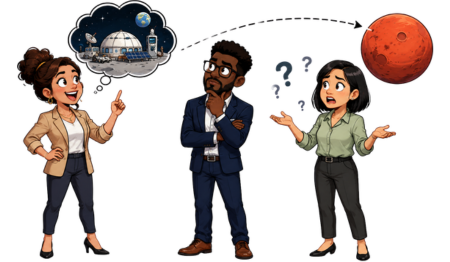
The Idea Seems Good…
Until you start asking questions.
Going to Mars has started to feel like a natural next step. After decades in Earth orbit and a long list of robotic missions, we are no longer asking if it will ever be possible, but how and when. The conversation has shifted. This is no longer science fiction. This is planning.
And once something enters that phase, certain ideas begin to feel almost inevitable.
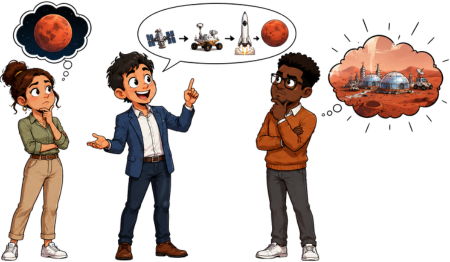
A Solution that Sounds Too Reasonable
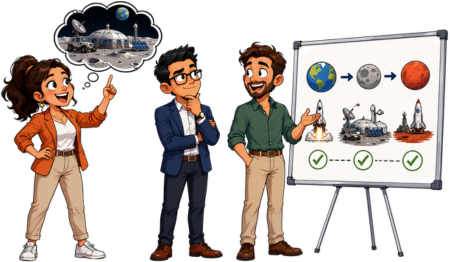
One of the most repeated proposals is simple: use the Moon as an intermediate point. Stop there, prepare the mission better, build something that supports the next leap.
At first, the logic is hard to resist. If the goal is difficult, more preparation should help. If the journey is long, breaking it into stages sounds reasonable. Nobody really argues with that at the abstract level, because it feels structured, controlled, almost obvious.
Then You Ask What that Actually Means
The problem starts when we stop speaking in abstractions and ask what “passing through the Moon” really implies.
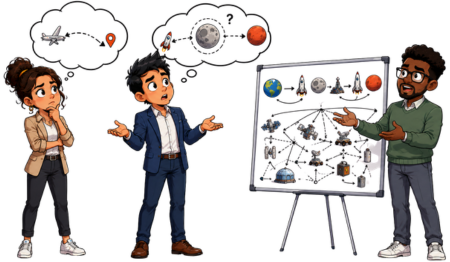
Because this is not a technical stop, like changing planes at an airport. It is not a quick pause or a simple transition. What we are really talking about is introducing a completely new system into another system that is already extremely complex.
And that is where things stop being simple.
So… Why Bring The Moon Into The Equation?
Because this is not just a debate about routes in space. It’s not like opening Google Maps and choosing “toll road” or “no toll road.”
We are talking about something harder to map: how we solve problems that, honestly, don’t come with clean solutions.
And that’s where the Moon enters the conversation.
At first glance, it sounds almost obvious. A logical middle point. A place to pause, test, adjust, and continue.

Never Assume on the Moon!
But that’s exactly where the assumption starts to slip.
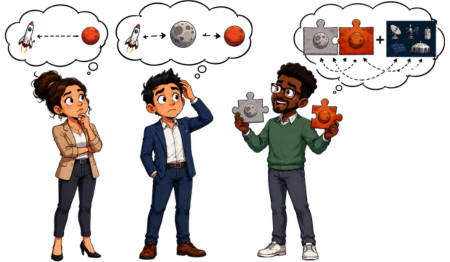
Because “passing through the Moon” is not a simple stopover.
It’s closer to taking one difficult problem… and splitting it into two, while quietly adding extra layers of coordination on top.
Nothing disappears. It just gets redistributed.
The Promise Of The Moon
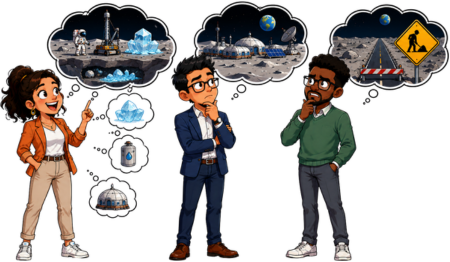
Then there is the more attractive argument: lunar resources.
Ice. Fuel. Infrastructure built outside Earth. A whole system that sounds like it belongs slightly ahead of us in time.
In theory, it makes sense.
In practice, there’s a gap that doesn’t shrink just because the idea is elegant.
Between “sounds good” and “works in reality,” there is usually something inconvenient: decades of development we still don’t fully have.
Time Doesn’t Care About Plans
And then there is time.
That uncomfortable factor no one gets to negotiate with.
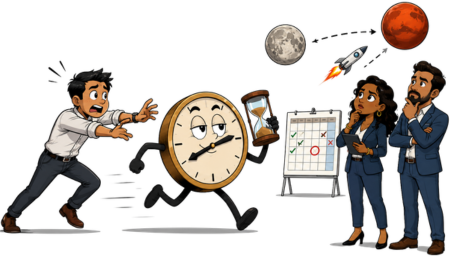
You don’t simply choose when to go to Mars. There are specific launch windows. Miss them, and the mission doesn’t fail immediately—it just waits. Sometimes years.
And adding the Moon into that sequence doesn’t simplify anything.
It sharpens the timing problem. It tightens the margins. It makes the system more delicate, not less.
It’s Not Just The Route… It’s The System
Because of course, it’s not really a debate about “Moon or no Moon.”
It’s a systems problem.
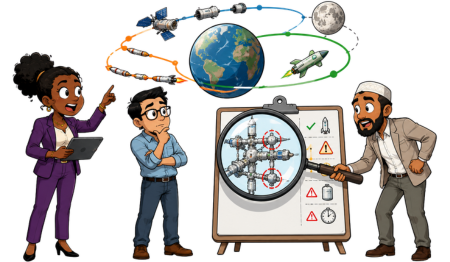
You can assemble missions in orbit. You can launch in stages. You can go direct. Each option has its advantages… and a long list of complications that rarely survive contact with the polished version of the plan.
Nothing is clean. It just looks clean—until you zoom in.
The Human Problem Nobody Can Engineer Away
And then there are humans.
That small detail that quietly breaks every perfect diagram.
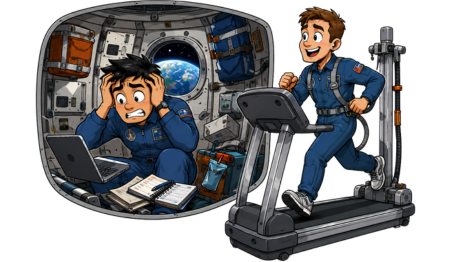
Because designing a mission on paper is one thing. Keeping people functional for months in space, isolated, far from Earth, with almost no margin for error—that’s something else entirely.
At that point, the question is no longer just technical. It becomes biological, psychological, and operational all at once.
And none of those categories are particularly forgiving when they overlap.
So What Are We Actually Choosing?
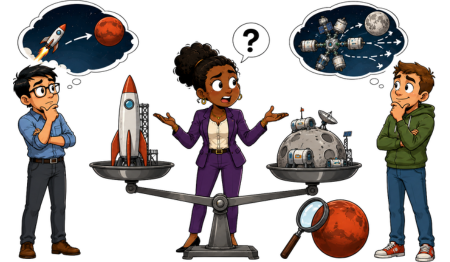
In the end, what looked like a simple architectural decision starts to reveal itself for what it is: a preference between types of complexity.
You can have something more direct but unforgiving. Or something more distributed, but increasingly tangled.
Neither version removes the difficulty. It just changes where it shows up.
So we come back to the original question.
Heading to Mars?
Maybe.
But before getting too excited, it might be worth asking whether passing through the Moon is a brilliant strategy… or just a complication with very good marketing.
Not Mars
The biggest problem isn’t where we think.
It’s easy to assume the real challenge is Mars: the distance, the trip, the conditions. That’s where everyone looks.
But the real struggle starts much earlier.
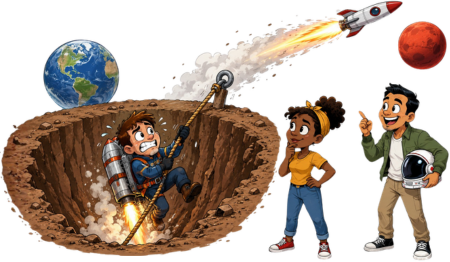
Getting off Earth is brutally expensive. Its gravity is so strong that a huge chunk of fuel is gone before you’re even really on your way.
Think of it like trying to leave a deep hole.
Most of your effort goes into just climbing out.
And that changes everything.
Because if the hardest part is the start, then maybe Mars isn’t the main problem after all.
Maybe it’s just getting away from Earth.
The Elegant Solution
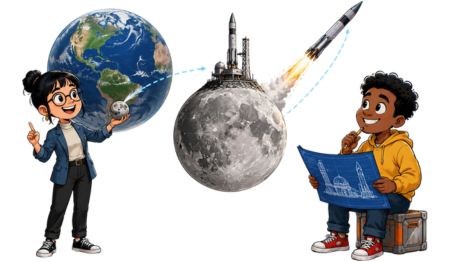
And this is where the Moon starts to look like a clever shortcut.
Lower gravity. No atmosphere. Easier launches.
So the idea almost sells itself: send things to the Moon first, take off from there, and avoid hauling everything out of Earth in one go.
It sounds organized. Efficient. Smarter.
Like breaking a long trip into smaller steps.
On paper, it makes a lot of sense.
But paper does not build bases.
From Stopover To Infrastructure
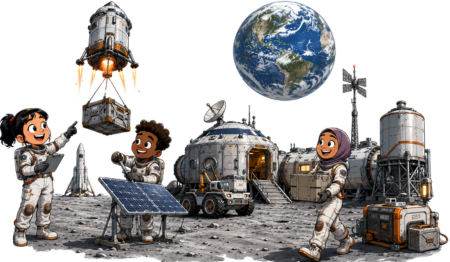
This is where things get complicated. The problem isn’t the Moon itself. It’s what using it actually requires. For the Moon to work as a platform, you can’t just land and leave. You have to stay.
That means bringing equipment, building facilities, generating power, maintaining systems… maybe even supporting people for long periods.
So what sounds like a quick stop starts to look like something else entirely.
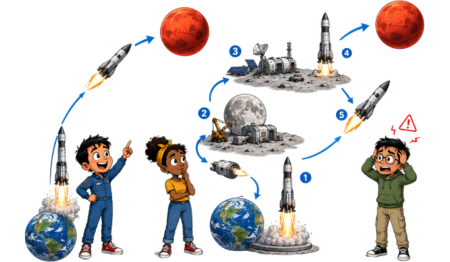
Another project. A full one. And that’s where the logic begins to slip. Because now we’re not comparing “direct travel” with “a stop.”
We’re comparing one complex mission with a chain of missions, each one depending on the last, each one adding its own risks and costs.
Complexity Matters
This is the part that rarely gets explained well.
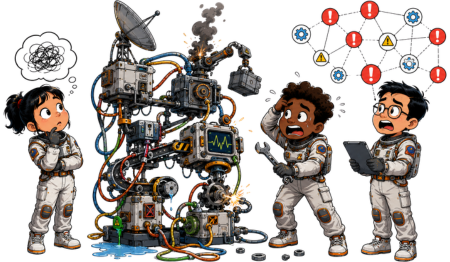
In engineering, complexity is not a small detail. It’s where things start to break.
Every new piece you add is another thing that can fail. Every dependency is another place where something can go wrong.
It adds up quickly.
From One Mission To Many
And this is where the structure changes.
Going straight to Mars is incredibly hard, but the path is clear: launch, travel, arrive.
Difficult, but contained.
Bring the Moon into the plan, and that structure turns into a chain.
Now you have to send materials, coordinate multiple missions, build infrastructure, make sure it works… and only then move on to Mars.
This isn’t just more steps. It’s a different kind of problem.
Because once everything is connected, a failure in one part doesn’t stay there. It affects everything else.
The Promise of Lunar Resources
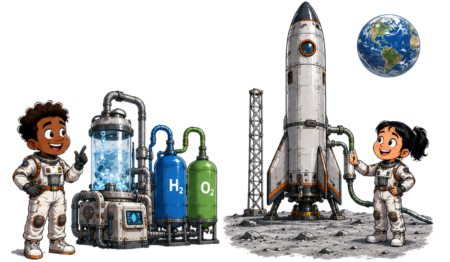
One of the most attractive arguments for the Moon is the use of its resources, especially ice. The idea of extracting water, splitting it into hydrogen and oxygen, and using it as fuel has a powerful logic: it could reduce dependence on Earth launches.
At a conceptual level, it sounds like the perfect workaround. Instead of carrying everything from Earth, you refuel along the way. Simple. Efficient. Almost inevitable.
From Possibility to Reality
However, there is a significant gap between theoretical possibility and practical implementation. Extracting, processing, and storing resources on the Moon requires technologies that have not yet been demonstrated at scale in that environment.
It is not just about knowing the resource exists, but about being able to use it reliably and continuously.
Therefore, basing an entire mission architecture on that capability means accepting an additional level of uncertainty. It is not a solution available today; it is a capability that still needs to be developed.