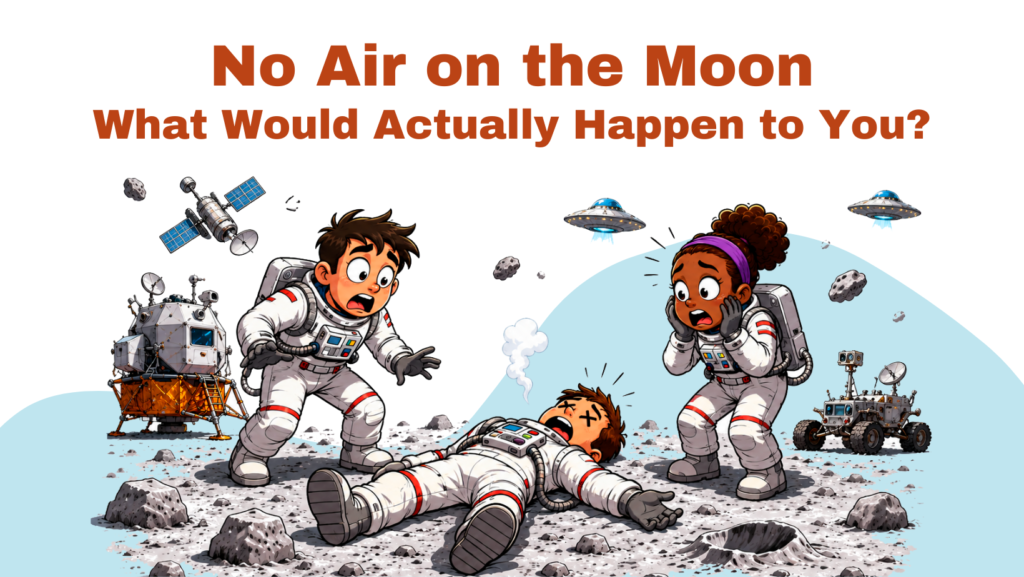
How Long Would You Really Last?
It sounds like the kind of question that should have a clean, reassuring answer. Something simple. A number you could repeat with confidence, as if survival in a vacuum were just a matter of counting seconds.
It isn’t that cooperative.
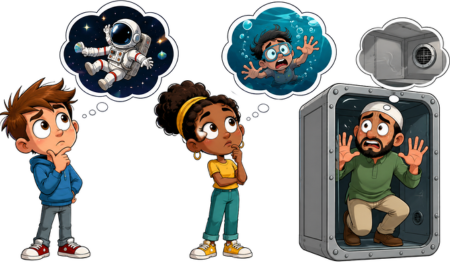
People tend to imagine this scenario in familiar terms, like running out of air underwater or being trapped somewhere without ventilation. Situations where the problem is obvious and the solution, at least in theory, is to get back to where breathing works.
The Problem With That Question
The Moon is less accommodating than that.
What you lose is not just oxygen, but the conditions that make breathing meaningful in the first place. Which means the question is slightly misplaced. It assumes there is a stable window of “lasting” to measure.
There isn’t, at least not in the way most people expect.
You would have enough time to realize that something is wrong, which is helpful in a purely observational sense, but not enough time to do anything with that information.
A Silence That Doesn’t Feel Right
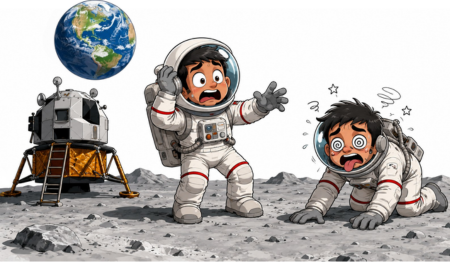
Standing on the surface of the Moon sounds, at first, like a quiet kind of experience. There is no wind to interrupt you, no background noise, no movement in the distance. The landscape is still in a way that feels almost artificial, as if everything has been paused.
It’s the kind of silence that feels impressive for about three seconds… and then starts to feel like a problem.
The silence isn’t really the problem. It is not even the isolation.
It is the absence of something so ordinary that it rarely earns a second thought: air.

What You’re Actually Losing
The truth is less convenient.
Removing air does not just remove oxygen. It removes pressure, stability, thermal balance, and protection. It removes the environment your body depends on to function at all.
Once that system disappears, everything else begins to fail in ways that are neither dramatic nor negotiable.
So the better question is not simply how long you could survive on the Moon.
It is what actually happens when the conditions that make survival possible are no longer there.
What Air Actually Does (That You Never Notice)
To understand what happens on the Moon, it helps to look at what air is doing for you here, beyond the obvious act of breathing.
Most of it goes unnoticed. Which is exactly why it gets underestimated.
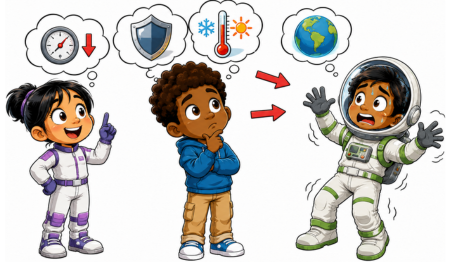
Air is not just supplying oxygen. It is maintaining pressure, moderating temperature, and acting as a layer of protection against radiation. These functions operate together, continuously, without drawing attention to themselves.
And because they are always there, they are easy to ignore — right up until they are gone.

Pressure: The Part You Never Feel — Until It’s Gone
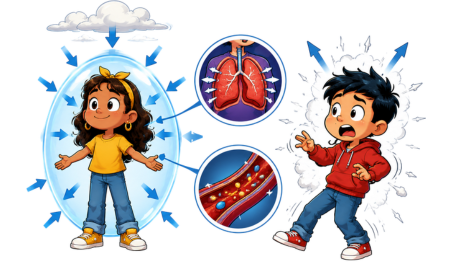
Air is not just something you inhale. It is something that presses on you.
At sea level, the atmosphere applies a constant force to your body. Your internal pressure balances it so perfectly that you never notice it happening. It feels like nothing, which makes it easy to assume it is nothing.
It isn’t.
That balance keeps gases in your lungs behaving the way they should. It keeps fluids in your body stable. It allows your body to function without having to compensate for its own environment.
Remove that pressure, and the system does not gradually adapt. It stops working the way it was designed to.
Temperature: Why Things Don’t Instantly Get Worse
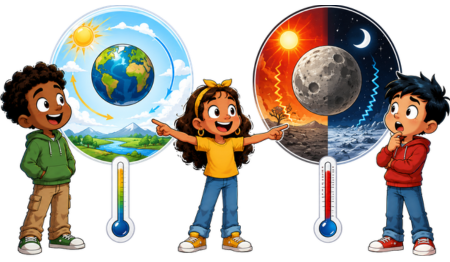
Air also controls how heat moves.
On Earth, temperature changes feel gradual. Heat is transferred through the atmosphere, spread out, redistributed. Even extreme environments still operate within a range that changes over time, not all at once.
That moderation is not accidental. It is a direct result of having an atmosphere.
Without it, heat does not behave the same way. It is no longer buffered or delayed. It becomes inconsistent, uneven, and far less predictable.
The difference between day and night stops being a shift. It becomes a contrast.
Protection: The Shield You Forgot Was There
Air is also doing something less visible.
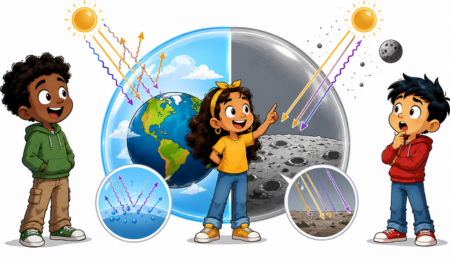
It absorbs and scatters radiation from space. Ultraviolet radiation from the Sun. High-energy particles that would otherwise reach the surface without resistance.
Most of that never reaches you. Not because it isn’t there, but because the atmosphere is in the way.
Remove that layer, and the environment does not immediately look different.
But it is.
What Happens When It’s Gone
All of these roles operate continuously. They do not require your attention, and they do not announce themselves.
They simply exist in the background, creating the conditions that make everything else feel normal.
Which leads to a very convenient assumption: that air is optional.
It isn’t.
Because when those conditions disappear, the effects are immediate.
Even if they are not always visible in the way people expect.

What “No Atmosphere” Really Means
Saying that the Moon has no air is a simplification. More precisely, it has no atmosphere in the sense that Earth does. There is no substantial layer of gases surrounding it, no pressure system, and no mechanism for regulating temperature or filtering radiation.
This absence changes everything. The Moon is not simply a place where breathing is difficult; it is a place where the basic assumptions of how matter behaves around the human body no longer hold.
Why The Human Body Isn’t Built for This
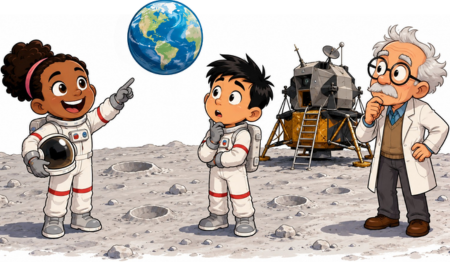
The human body is adapted to a narrow range of conditions, including specific pressure levels, temperature ranges, and chemical balances. On Earth, these conditions are always present. They do not need to be maintained or even noticed, which is why they are so easy to take for granted.
Remove that context, and the body does not adapt. It reacts, briefly and unsuccessfully.

The Sequence of Events: What Actually Happens
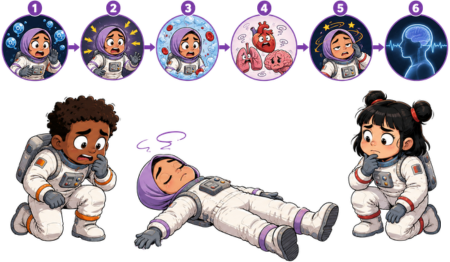
If a person is suddenly exposed to the lunar surface without protection, several systems begin failing almost immediately. They overlap, but they still follow a rough order. Not because the body is organized — but because physics is.
Oxygen loss comes first. Pressure disappears at the same time. Fluids stop behaving normally. And as those changes spread, the body stops functioning as a coordinated system at all.
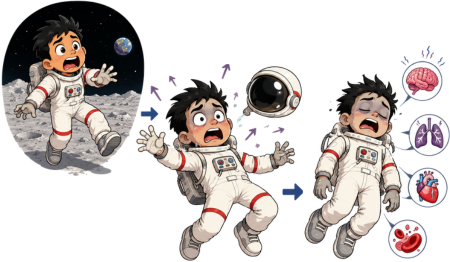
Loss of Oxygen and Consciousness
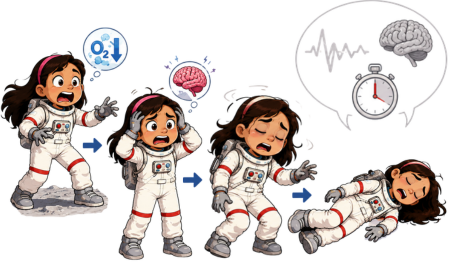
The first thing to go is oxygen.
Once it stops entering the bloodstream, the brain doesn’t negotiate. It just starts shutting down. Consciousness fades quickly. Well under a minute in most estimates.
That number matters less than people think.
Because after that point, you are no longer “experiencing” anything. You are just watching a system fail in real time — briefly.
There is no adaptation phase. No learning curve. No warning system that buys you extra time.
Just a very short delay before everything else follows.
Pressure Loss starts Doing Damage Immediately
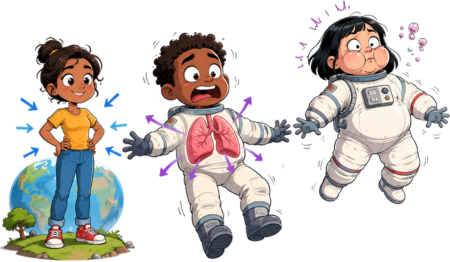
At the same time, pressure stops being a factor.
On Earth, your body is held in a constant balance between internal and external pressure. You never notice it because it is always there. That’s exactly the problem.
In a vacuum, that balance disappears instantly.
Gases expand. Especially in the lungs. This is why holding your breath is not just useless — it makes things worse. The air inside has nowhere to go but outward against tissue that was never designed for that situation.
And no — the body does not explode. That idea belongs to movies, not biology.
What actually happens is less dramatic, and more uncomfortable in a mechanical sense: swelling, strain, and systems losing coordination.
Fluids stop Behaving Normally
ReaThen liquids stop following normal rules.
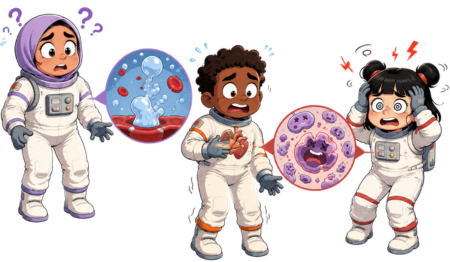
Lower pressure means lower boiling point. At extremes, fluids inside the body can begin forming vapor pockets. Not a “boiling body” in a cinematic sense — more like internal instability spreading where it shouldn’t exist.
Circulation gets disrupted. Cellular function becomes harder to maintain.
This is where the situation stops being about one problem and becomes about multiple systems failing at once.
Not a Collapse — a Breakdown
What happens overall is not a single moment of failure.
It is a sequence.
Oxygen goes first. Pressure immediately changes how the body holds itself together. Fluids lose stability. Systems that depend on each other start dropping in order.
Nothing “breaks” in a dramatic way. It just stops being functional.
Consciousness disappears early. After that, the rest continues without anyone there to register it.
Which is, in a way, the most important detail.
The body doesn’t fight this.
It simply doesn’t have a version of itself built for it.
Temperature on the Moon: Extremes Without Moderation
Even if oxygen and pressure were somehow handled through technology, the Moon still has other problems waiting.
Temperature is one of them.
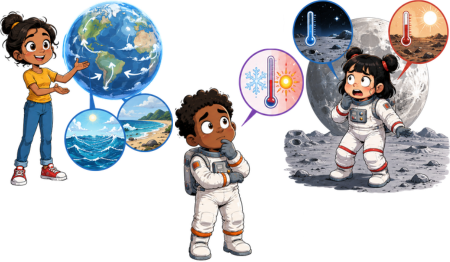
On Earth, temperature is never really working alone. The atmosphere and large bodies of water constantly interfere, absorbing heat, redistributing it, smoothing out the swings. What you experience as “normal weather” is actually a long process of buffering and delay.
The Moon doesn’t do buffering.
There is no atmosphere to slow anything down, no system to soften the shift. So the surface reacts directly to what it receives.
No Buffer, No Delay
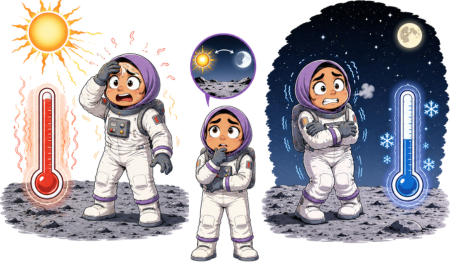
Sunlight hits one side, and temperatures rise fast. Once that light disappears, everything drops just as quickly.
Not gradually. Not gently.
Just a direct shift in conditions with nothing in between.
There is no transition phase the way Earth gives you. No atmosphere absorbing the change, no water holding heat in place, no system evening things out over time.
Any system designed for human life has to replace that missing stability entirely. The Moon doesn’t offer any version of it.
Radiation: The Constant Background Threat
Radiation is one of those problems that doesn’t announce itself.
On Earth, you are protected by two systems that work quietly in the background. The atmosphere absorbs and scatters a large portion of incoming radiation. The magnetic field deflects charged particles before they ever reach the surface. Most of the time, neither of them is something you think about — which is usually how effective protection works.
The important detail is not that radiation exists.
It’s that most of it never reaches you in the first place.

No Protection, No Filter
The Moon does not have that arrangement.
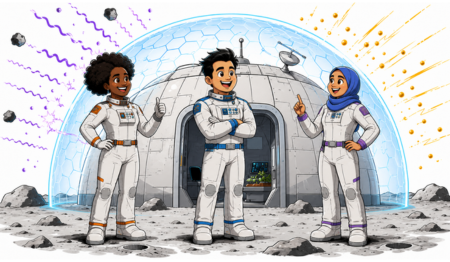
There is no meaningful atmosphere to absorb incoming radiation, and no global magnetic field redirecting charged particles away from the surface.
Solar radiation and cosmic rays reach the ground more directly, with far less interference than on Earth. Nothing is filtering them, slowing them down, or redirecting them before impact.
This is not the kind of environment that corrects itself in the background. What arrives, arrives directly.

The Slow Nature of The Damage
This is not the kind of problem that produces an immediate reaction. It doesn’t shut anything down in a visible or sudden way.
It works in accumulation.
Cells are affected over time. Biological systems operate under conditions they were never designed to handle continuously.

Shielding Is Not Optional
The damage does not present itself as a single event — it builds gradually, without clear signals at the beginning.
Which is why shielding is not optional.
It is the minimum requirement for long-term survival in that environment.
Exposure to high levels of radiation can damage cells, increase the risk of cancer, and interfere with biological processes. For any long-term human presence on the Moon, shielding from radiation is not optional. It is a requirement.
Could Humans Live on The Moon?
In a natural sense, the answer is no.
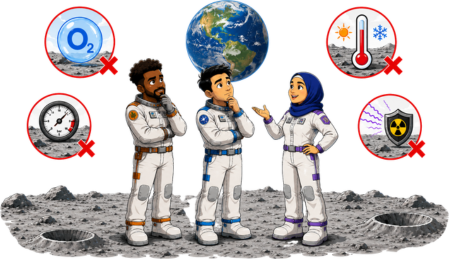
There is nothing about the lunar environment that supports human life without intervention. No breathable air, no stable atmospheric pressure, no natural temperature regulation, and no protection from radiation. From a biological standpoint, it is simply not a compatible environment.
That, however, is not the same as saying it is impossible. It only means the problem is not about adaptation. It is about replacement.
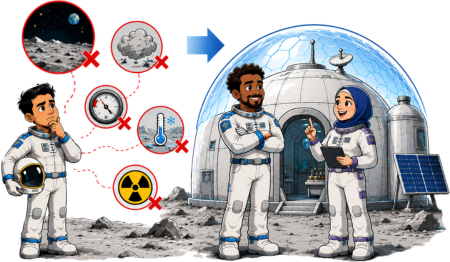
Replacing The Conditions of Earth
Humans would not adapt themselves to the Moon. Instead, they would have to recreate the conditions they normally receive from Earth.
Breathable air would need to be supplied and continuously maintained. Internal pressure would have to be stabilized. Temperature would require constant control, and radiation would need reliable shielding. None of these elements can be left to the environment, because the environment provides none of them.
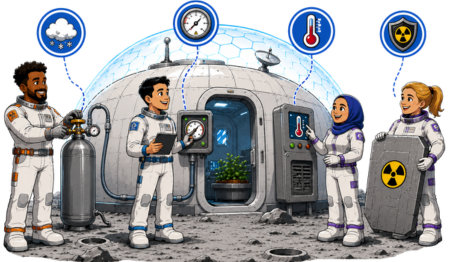
Living Inside a Constructed System
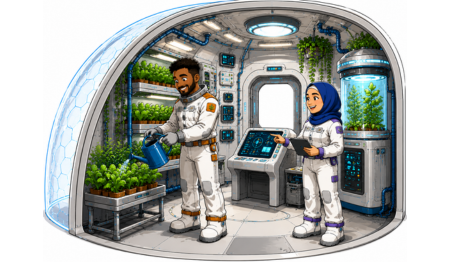
In practice, this leads to enclosed habitats — engineered systems designed to function as artificial ecosystems. These structures do not “use” the Moon in the way Earth environments are used. They replace it.
The result is that the Moon stops acting as an environment altogether. It becomes a physical location beneath a controlled system, while human life exists entirely inside that system, not within the Moon itself.
Earth: The System You Don’t Notice
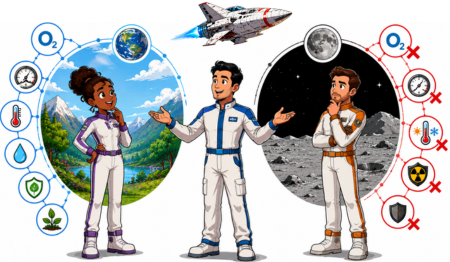
Comparing Earth and the Moon highlights how dependent life is on specific conditions. On Earth, these conditions exist naturally and continuously, forming a stable background that rarely draws attention.
They are so consistent that they become easy to ignore.
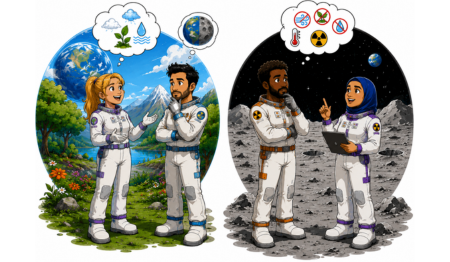
The Moon: Not Harsher, Just Absent
On the Moon, none of these conditions are present by default. There is no breathable atmosphere, no stable pressure, no moderated temperature, and no meaningful protection from radiation.
This is not a difference of degree. It is a difference of kind.
The Moon is not a harsher version of Earth; it is a place where the systems that make Earth habitable are simply not there.
The Larger Lesson: Life Depends on Systems
The most important takeaway is not about the Moon itself. It is about the nature of life.
Life does not depend on a single factor. It depends on a network of conditions that support each other. Oxygen matters, but so does pressure. Temperature matters, but so does protection from radiation. Each element is part of a system.
When that system is intact, life feels stable and predictable. When it is removed, the stability disappears immediately.
The Moon makes this visible. It shows what happens when the background conditions of life are no longer present. It turns something invisible into something undeniable.
So What Was The Real Question?
At the beginning, the question was how long a person could survive on the Moon without protection. In practical terms, the answer is not very long. Consciousness would be lost quickly, and the body would not be able to function under those conditions.
But the more important question is why.
The answer is not simply the absence of oxygen. It is the absence of an entire system that the human body depends on.
Once that system is gone, the outcome is not something that unfolds gradually or allows for adjustment.
It is immediate, consistent, and final.