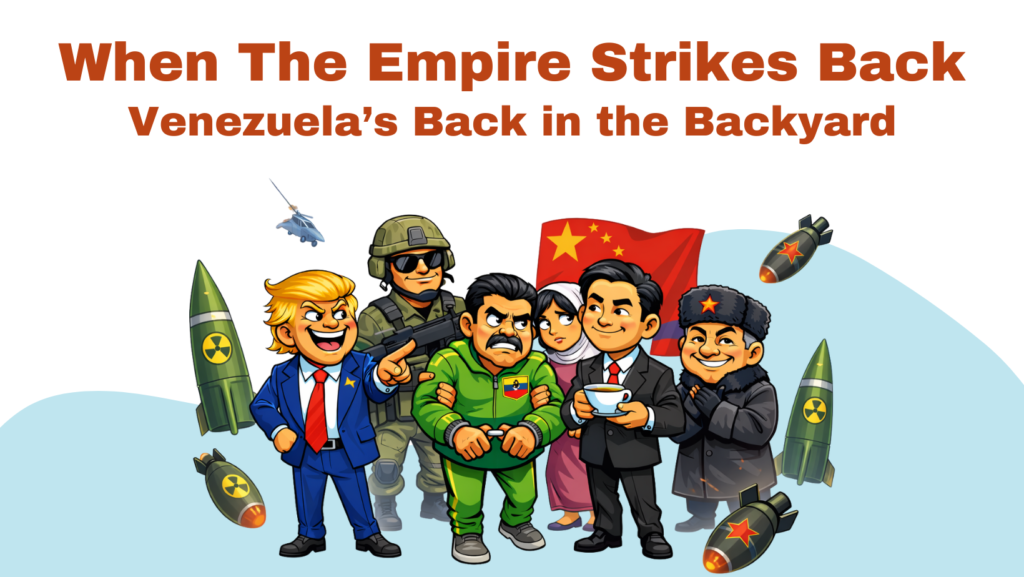
Venezuela: Third Strike Out!
Yes! The Empire Strikes Back! No, not the movie.
Although honestly, at this point, the script writers should sue Washington for plagiarism.
Because this is what the Empire always does when it feels ignored, questioned, or — worst of all — disrespected:
it doesn’t argue, it doesn’t negotiate, it strikes back.Not with clarity.
Not with humility.
But with “concern,” “stability,” and a PowerPoint about freedom.
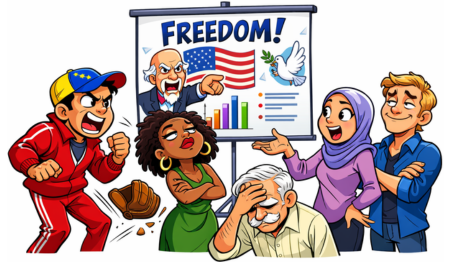
Not an Invasion! It’s Liberation!
They won’t call it an invasion.
They won’t call it control.
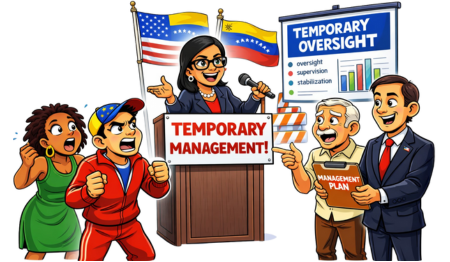
They’ll call it temporary management, like Venezuela is a malfunctioning Airbnb.
“Just until things are safe.”
“Just until democracy works.”
“Just until we’re done.”
Funny how “just until” never comes with a date — and somehow, that never changes.
The Empire doesn’t wait for answers anyway.
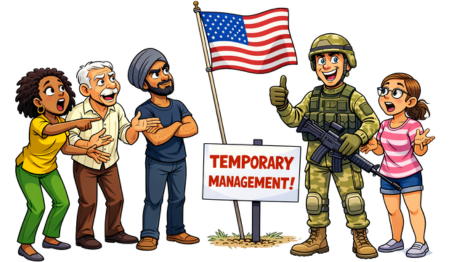
Don’t Ask! Don’t Tell!
The Empire doesn’t ask questions … and doesn’t tell you what it wants. It just takes it, period!
“What do Venezuelans want?”
When asked by a reporter, Marco Rubio replied:
“Who cares!”
The Empire asks better questions, like:
- Who controls the oil?
- Who controls the ports?
- Who controls the narrative before breakfast?
And when things get messy — when oil tankers go dark, when presidents vanish into courtrooms, when Latin America rolls its eyes — the Empire doesn’t panic.
It escalates.Because empires don’t de-escalate.
They rebrand.
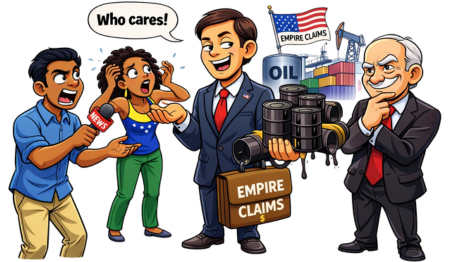
The Wildest Part?
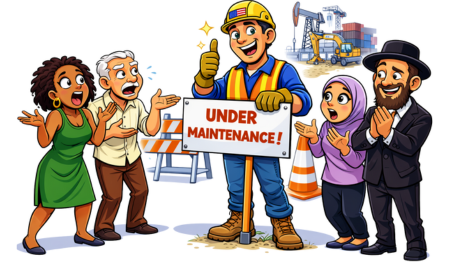
This isn’t even presented as drama anymore. It’s sold as maintenance.
Like:
“Sorry for the noise, folks, we’re just fixing a country.”
And somewhere between the press conference and the sanctions package, people are supposed to forget that countries are not software updates and people are not collateral bugs.
That’s the real plot twist.
Not that the Empire struck back —
but that it expected applause.
And now what?
Venezuela’s Back Into the Herd
So here we are again.
Back to the same question, just with less innocence than last time.
Not “Would the U.S. invade Venezuela?” — that was a Phase 1 question, back when speculation still passed for analysis.
The real question now is simpler and more uncomfortable:
what do we call it when an empire doesn’t invade, but still decides who runs the house?
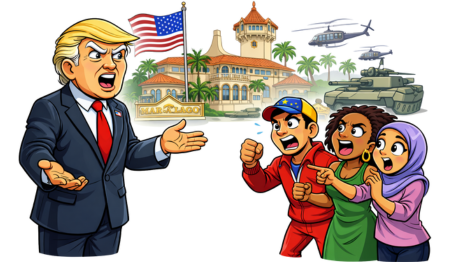
On January 3, 2026, speaking from Mar-a-Lago, President Donald J. Trump was clear on the matter.
“We aren’t invading Venezuela,” he said. “We are liberating this nation.”Operation Absolute Resolve began at 2:00 a.m. local time.
The name, at least, leaves little room for doubt.
This Is Not Control, Just Concern
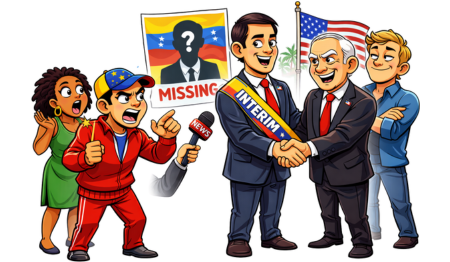
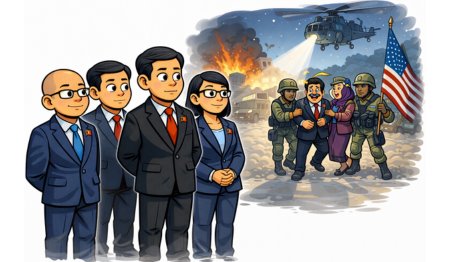
Because no matter what language gets recycled at press conferences, the story has already moved on. Presidents don’t just “lose power” anymore — they vanish, and someone else quietly negotiates in their place.
Interim leaders pop up overnight, practicing sovereignty like an accent, while quietly negotiating with the same power that made them interim in the first place.
And somehow, everyone involved keeps a straight face while insisting this isn’t control — it’s just concern.
The Empire Never Says “Take Over”
It says things that mean exactly that, just wrapped in better grammar.
What’s striking — and painfully familiar for Latin America — is how quickly the whole thing is framed as management.
Venezuela becomes a problem to be fixed, an unstable system needing oversight, a country temporarily placed in adult supervision.
The language is clean. Technocratic. Responsible. And somehow, always temporary — even though “temporary” has been the longest-running policy in the region.
Delcy Rodríguez, Venezuela’s interim president, reassured the public:
“This is only meant to be temporary. It will be so for a very long time.”
Temporary — a word that, in the region, has always demanded patience.
Oil is Not Coil
It doesn’t bind or stabilize; it only makes power move faster.
Where is the oil?
Oil — the supposed reason for all this order — behaves like the least obedient character in the story.
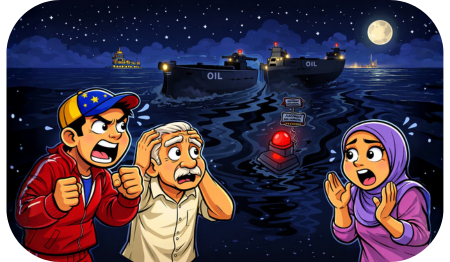
Tankers slip out quietly, transponders off, sanctions blinking uselessly into the dark. The very resource meant to justify control refuses to cooperate. It’s almost poetic: oil going rogue while everyone else pretends there’s a plan.
The Biggest Barrel in the Room
Venezuela doesn’t just have oil.
It has more oil than anyone else.
Roughly 300 billion barrels sit underground — about one out of every five proven barrels on the planet. More than Saudi Arabia. More than Iran. More than Canada.
On paper, Venezuela is the world’s largest oil holder.
That fact alone has been enough to keep it permanently interesting.

Oil as Potential, Not Power
In practice, Venezuela barely pumps enough to matter.
That contradiction is the point. The reserves are enormous, the production is anemic, and yet the oil never stops being invoked — not as energy, but as potential. As leverage. As something that could reshape markets if placed in the right hands, under the right supervision, with the right kind of concern.
So when oil is mentioned, it isn’t because it’s flowing.
It’s because it’s waiting.
Waiting to be stabilized.
Waiting to be managed.
Waiting to justify why this country keeps ending up on someone else’s agenda.
Which is why the numbers matter — not because Venezuela is powering the world, but because it doesn’t have to be. The barrel is big enough to haunt policy long before it ever leaves the ground.
It Was Never Just About Oil
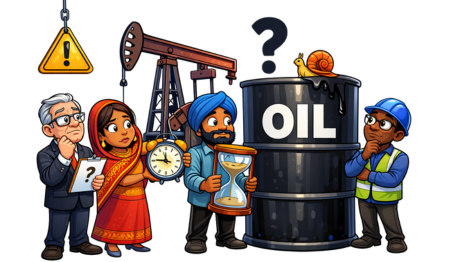
Oil gets the headlines because oil is loud. It spills, it burns, it explodes, it smells like geopolitics. Venezuela happens to sit on more of it than anyone else, which makes it convenient shorthand for everything that follows. Say “oil,” and suddenly interventions sound technical instead of intentional.
But oil was never alone in the room.
Let’s see what else was sitting there….

Our Old Good Friend Gold
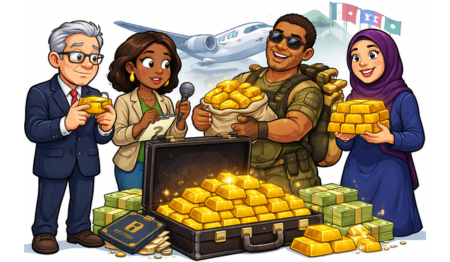
Under the same soil that refuses to behave sits gold — the old-fashioned kind of power. Heavy. Portable. Sanction-proof until it isn’t.
Venezuelan gold has already lived a strange international life: frozen, disputed, flown out quietly, argued over in foreign courts by people who insist they’re only protecting democracy.
How Rare Are Rare Earths?
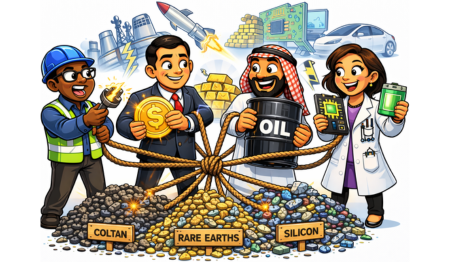
Then there’s the quieter stuff. The minerals that don’t photograph well but keep phones vibrating, missiles calibrated, and electric cars pretending they’re clean.
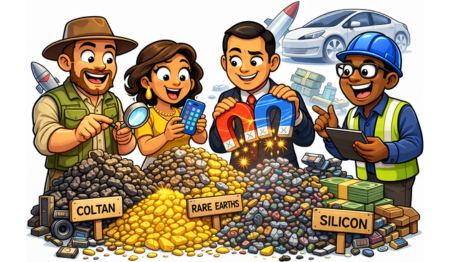
Coltan, rare earths, things that matter more in supply chains than in speeches. The kind of resources everyone claims not to care about while making sure someone else doesn’t get too comfortable controlling them.
Suddenly, Venezuela stops looking like a mismanaged petrostate and starts looking like a storage unit full of things the future needs.
Control Is Broader Than a Barrel
Seen this way, the choreography makes more sense. Oil ties you to yesterday’s energy markets. Gold ties you to finance and sanctions. Rare earths tie you to tomorrow — to semiconductors, batteries, defense systems, and whatever comes next that still hasn’t been named in a press release.
This is why the language is always so careful. Why no one says “resources,” only “stability.” Why no one says “access,” only “concern.” Venezuela isn’t just about keeping the lights on — it’s about deciding who gets to wire the next room.
And that’s why the story keeps moving, even when the oil doesn’t.
The Performance Continues
Inside Venezuela, the performance continues. Condemnation paired with cooperation. Sovereignty paired carefully with negotiation.
A dance where no one wants to admit who’s leading and who’s following.
Outside, Latin America watches with that familiar mix of fatigue and déjà vu.
We’ve seen this episode before. Different decade, same tone. Same promises. Same insistence that this time it’s about democracy, stability, safety — pick your favorite export.

Who’s The Boss?
And through all of this, real people remain what they’ve always been in imperial storytelling: background noise.
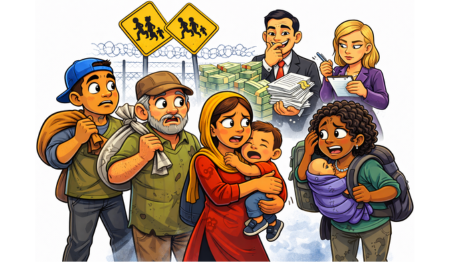
Migration becomes a policy problem instead of a human one.
Suffering gets acknowledged but never centered. The narrative moves fast because slowing down might force someone to ask the wrong question — not “who’s in charge?” but “who pays for this?”
“The Empire Strikes Back”
That’s why calling it “The Empire Strikes Back” isn’t exaggeration. It’s description. Empires don’t like uncertainty.
They don’t like being ignored.
And they really don’t like when the world starts acting as if they’re no longer the main character. So they strike back — not only with bombs, but also with courts, sanctions, leverage, and language that turns intervention into responsibility.
Nothing about this feels new.
What feels new is how openly ordinary it’s all being treated.
And maybe that’s the most honest part of the saga so far.
Let’s rewind a bit what happened just hours before the capture of the century…
A Meeting, On Schedule
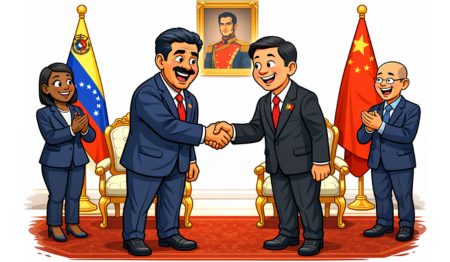
On January 2, 2026, Nicolás Maduro received Qi Xiaoqi, Special Envoy of President Xi Jinping, at the presidential palace in Caracas.
Flags were placed. Smiles were exchanged. The choreography of relevance was observed.
The photographs exist. Official. Balanced. Properly captioned.
This was diplomacy as it is meant to look: formal, calm, and confident enough to suggest continuity.
Nothing in the room indicated urgency.Except maybe the last smile.
A final mal augurio, as they’d mutter in Caracas pavoso (bad omen) —
because you don’t shake hands with the future only to be seized by someone else’s plans.
Hours Later…
… Maduro was no longer hosting meetings.
The capture announcement came after the handshake — close enough in time to make the sequence uncomfortable, but not close enough to interrupt it. The meeting didn’t delay anything. It didn’t complicate anything. It didn’t even register.
If diplomacy once functioned as deterrence, here it worked more like a timestamp.
The image survives as documentation of a moment when sovereignty was still being performed — just before it stopped mattering. Recognition, it turns out, is no longer protection.
It’s a record of what was happening shortly before it became irrelevant.
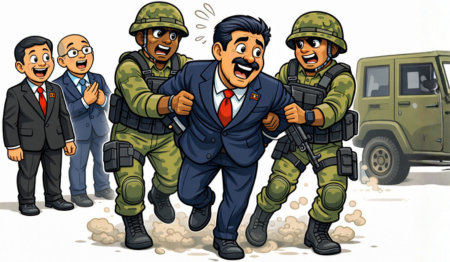
China Yells Calmly Enough
Hours after the handshakes and polite photos, China’s diplomats stepped in — not with tanks, not with fireworks, but with carefully polished words that carried weight.
Officially, Beijing called the U.S. action illegal and a violation of sovereignty. They demanded Maduro’s immediate release and insisted on his safety — along with his wife’s.
No screaming. No dramatic shows. Just a quiet insistence that nobody gets to act as world policeman, and that sovereignty is not optional. The message was clear: watch carefully, take notes, and remember who still has friends in Beijing.
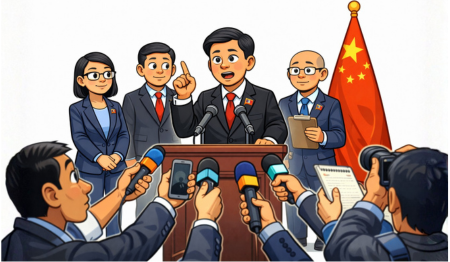
Sovereignty, Stability & Calculations
China didn’t stop at statements. They doubled down on dialogue, law, and multilateralism — phrases that sound boring until you realize what they really mean: don’t mess with us, or the world will notice.
The subtext was unmistakable: China has economic and strategic interests in Venezuela, and this “temporary management” is exactly the kind of action that gets their attention.
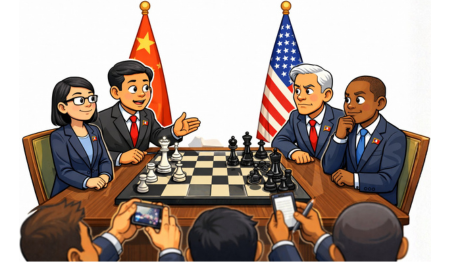
Think of it like this: the U.S. just shook the chessboard in Caracas, and China calmly whispered across the table:
“Remember the rules… and maybe don’t break them again.”
No military moves. No sanctions. No speeches threatening revenge. Just the sharp, quiet certainty of a power that knows the game is bigger than today’s headlines.
And in true KDF fashion, the irony cuts deep: the Empire strikes back with spectacle, and China responds with a velvet glove that feels heavier than any boot.
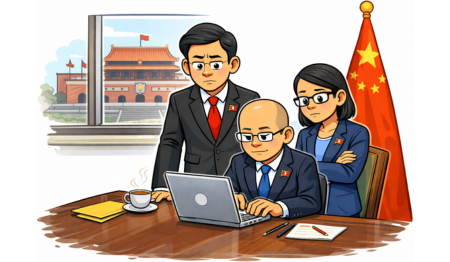
The Dragon’s Memo: Quietly Unimpressed
Inside Beijing, somewhere between the Great Hall of the People and a very serious conference room, someone typed the words that would be released to the world.
“Step carefully,” the memo seemed to say.
“We notice. We remember. We are watching.”
No emojis. No exclamation points. Just strategic patience — like a cat watching a mouse try to juggle chainsaws.
Who Runs the House?
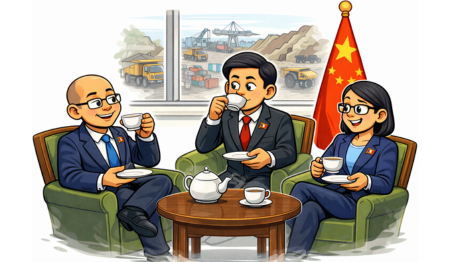
China’s diplomats probably sipped tea and exchanged glances that said everything the public couldn’t:
“So, the Empire thinks it can decide who runs the house… How quaint.”
The message was clear to anyone paying attention: sovereignty is not a suggestion. The economy, the ports, the contracts, the mining operations — all of it is under careful scrutiny. One wrong move, and the “temporary” management suddenly looks less temporary.
The Subtext Everyone Missed
What Beijing really wants the world to hear is not in the press release. It’s between the lines:
- Respect existing agreements — or face long-term consequences.
- Don’t treat Venezuela like a sandbox.
- Remember that influence is more than guns and speeches; it’s patience, capital, and memory.
And yet, KDF readers know the irony: the Empire stages a grand “liberation,” complete with photos, midnight operations, and declarations of freedom… and China responds like it’s just another Tuesday.
No drama. No spectacle. Just a calm, steady reminder that not everyone plays by the Empire’s script — and some of the quietest voices carry the heaviest weight.
China Watches, Calculating
…Nothing in the room indicated urgency.
Except maybe the last smile.
Behind closed doors in Beijing, the whispers were sharper.
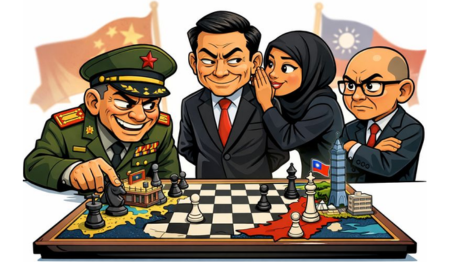
“This could have been leverage,” someone muttered, fingering the chessboard that stretches from Caracas to Taipei.
If the U.S. can move decisively here, what stops them elsewhere? Taiwan suddenly isn’t just a distant issue — it’s a reminder that power can appear overnight, and timing is everything.
The meeting with Maduro? Useful optics, a photo op in the papers, a “look, we’re still relevant” moment.
But the lesson? That global games aren’t polite, and sometimes even the best-laid diplomatic gestures can look like a bad omen.
Russia Watches, Grinning
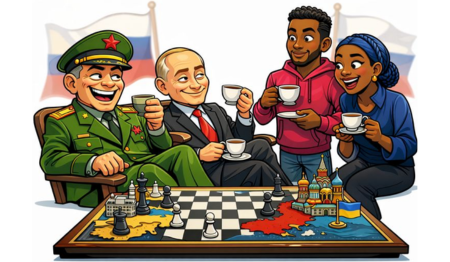
While Beijing calculated, Moscow leaned back, smirking. Nothing official, of course — just a few carefully worded statements about “sovereignty” and “stability.”
But everyone reading between the lines knew: the Kremlin saw the show for what it was. If the U.S. could move this fast in Venezuela, what else might be in play? Taiwan? Energy markets? A chessboard stretching from Caracas to Kyiv? Every twitch mattered.
No boots, no missiles, no midnight tweets. Just quiet theater. The kind where you don’t intervene but still make sure everyone knows you’re watching.
Maduro? Still dancing in someone else’s spotlight. Russia? Grinning, sipping its tea, counting the moves without touching the board.
Because sometimes, the best power move is silence with style.
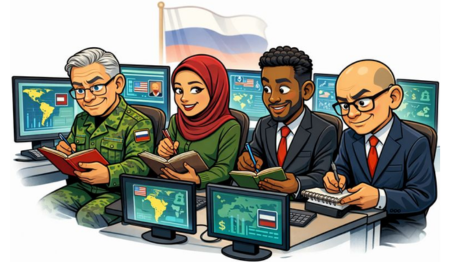
Russia, Taking Notes
Behind the calm, the Kremlin’s analysts were busy scribbling in invisible notebooks. Every move, every tweet, every vanishing president — data for later.
No dramatic gestures, no grandstanding. Just a quiet calculation: let the U.S. sweat over its new “liberation,” let Latin America gasp, let markets twitch. Russia didn’t need to intervene. The lesson was already visible: chaos somewhere else can be a convenience at home.
In KDF terms: the show goes on, the actors change, but Moscow keeps the popcorn close.
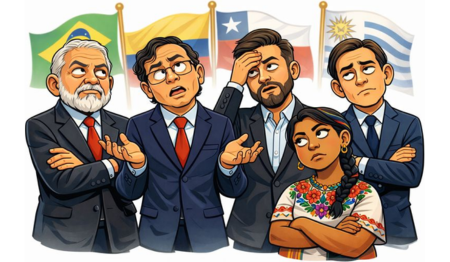
Latin America, Rolling Its Eyes
And not clapping for the Empire
While Washington smiled, much of Latin America gave the look you give someone who just called your abuela “vital terrain.” Leaders from Brazil, Chile, Colombia, Mexico, and Uruguay didn’t whisper it — they openly condemned the U.S. action, calling it a dangerous violation of sovereignty and international norms.
Gustavo Petro in Colombia took center stage, demanding immediate international talks and denouncing the aggression against “Venezuela and Latin America.” He could be next according to Trump’s statements.
Lula da Silva in Brazil called it an “unacceptable line crossed,” warning the hemisphere about precedent.
Gabriel Boric in Chile spoke for peaceful solutions and respect for sovereignty.
Mexico and Uruguay echoed the alarm: this isn’t help, it’s showtime intervention.
It wasn’t a rally. It was a regional eye-roll with official signatures.
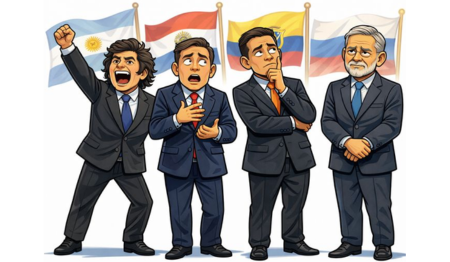
Some Cheer, Some Watch Quietly
Not everyone recoiled. Some leaders watched like gamblers at a weird card trick.
Argentina’s Javier Milei cheered the operation, shouting about “liberty advancing,” leaving diplomats clutching their chests.
Others — Paraguay, Ecuador — stayed muted, non-committal, quietly measuring domestic politics before reacting.
A mix of applause, silence, and internal calculations — the region is far from monolithic.
Regional Implications — Anxiety and Unease
The message? Latin America isn’t united behind Washington. Governments may voice caution while the public’s opinions vary, but leaders clearly don’t want foreign boots, foreign laws, or foreign narratives dictating the neighborhood.
For the region, this means something bigger than Venezuela:
- A sovereignty crisis — countries resisting U.S. dictation.
- A growing ideological split — right-leaning cheer; left-center warn.
- A collective anxiety — if the Empire decides how democracy should run here, what stops it elsewhere?
Latin America is yelling, “Not another rerun!” — because history shows the Empire’s reruns rarely come with happy endings.
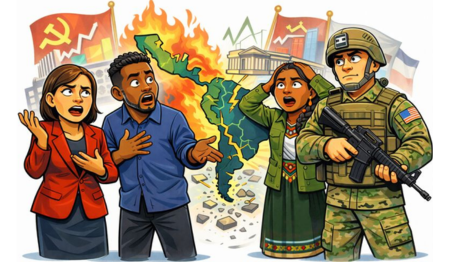
The Rerun Nobody Asked For
Latin America knows reruns. And not the kind you cozy up to on a Sunday — the kind that hit like déjà vu with a side of chaos.
For most of the 20th century, “U.S. intervention” wasn’t a footnote in textbooks. It was front-page, prime-time, and usually messy. From Guatemala ’54 to Chile ’73, from Dominican Republic ’65 to Panama ’89, the Empire didn’t need to invade with tanks alone — it used economics, diplomacy, and carefully staged “concern” to run the show.
Each rerun had the same plot:
- Local leaders resist or wobble.
- Washington steps in with helpful suggestions.
- Regimes collapse, elections are “supervised,” resources shift, and the lesson is quietly delivered: sovereignty is negotiable if you forget your place.
For today’s Latin American leaders, the Venezuela episode isn’t just current affairs — it’s a reminder of decades of reruns. You can smell the déjà vu in the press conferences, see it in the careful words, feel it in the markets.

What It Means Now
This time, the rerun carries a warning, but the audience is bigger, louder, and more skeptical. Social media and instant global news mean every “temporary” intervention is broadcast in real-time — no script editors, no friendly narrators.
For the region, the lessons are clear:
- Don’t underestimate U.S. decisiveness.
- Don’t overestimate loyalty in hemispheric politics.
- And never, ever assume that “just until” comes with a calendar date.
In KDF style: the rerun is here, the Empire is starring again, and Latin America? It’s squinting at the screen, muttering: “we’ve seen this episode before — and we’re not applauding this time.”
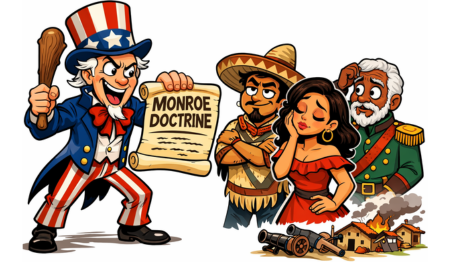
The Monroe Doctrine
Ah, the Monroe Doctrine. Classic 19th-century headline: “Europe, hands off the Americas!” Signed, sealed, mostly ignored, occasionally waved like a club when convenient. For over a century, it was the hemisphere’s invisible leash, a way to say, “We see you, we decide, don’t get cute.”
Latin America learned early: every big power announcement came with a wink and a warning. Some listened. Some rolled their eyes. Most just sighed and got back to surviving the telenovela of politics, coups, and foreign promises that never quite stuck.
Monroe Redux
Fast forward to 2026, enter… the Don-roe.
Yes, Trump’s marketing genius strikes again: the Monroe Doctrine, but with a Trumpian twist. Bigger font.
More tweets.
A name that sounds like a superhero and a tax form at the same time. Suddenly, history isn’t dusty law textbooks — it’s the plot of a very live, very American reality show.
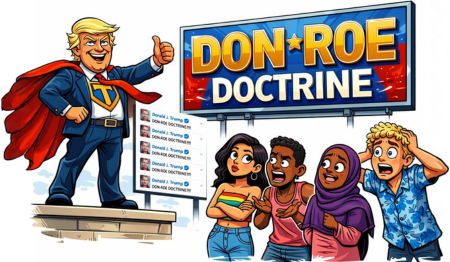
Don-roe in Action
The idea? Same hemisphere, same “we watch, we decide” energy — but now it’s personalized. Trump steps in, calls it the Don-roe, and suddenly past and present collide. Latin America doesn’t just get the rerun, it gets the commentary, the spin, the hashtags.
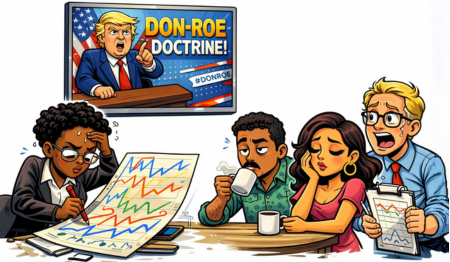
What does it mean for the region? Oh, the usual:
- Governments brace for optics, not policy.
- Analysts scribble frantic charts no one really believes.
- Citizens shrug, sip coffee, and mutter “otra vez la misma historia…”
The Don-roe isn’t just policy. It’s theater. It’s nostalgia with a Trump twist. And for the hemisphere? Well, it’s like watching a telenovela you know by heart — but somehow, the main character still surprises you every single episode.
This Is Our Hemisphere
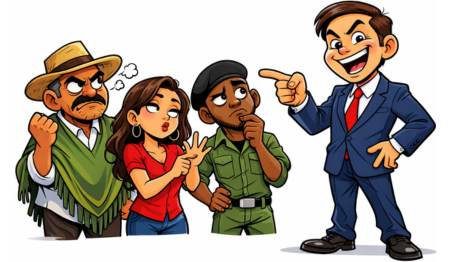
“This is our hemisphere,” Rubio said.
And just like that, centuries of history, treaties, revolutions, and whispered warnings condensed into one bold, territorial flex. No nuance. No diplomacy. Just a reminder that someone still thinks the Western Hemisphere comes with a name tag: Property of the U.S.
Latin America, naturally, didn’t clap. Some groaned. Some shrugged. Some started counting how many times “sovereignty” had been politely ignored in the last hundred years.
The Don-roe’s Final Throw
By now, the rerun is playing out in real time — the Empire in its starring role, Latin America squinting at the screen, China calculating, Russia grinning in the back row.
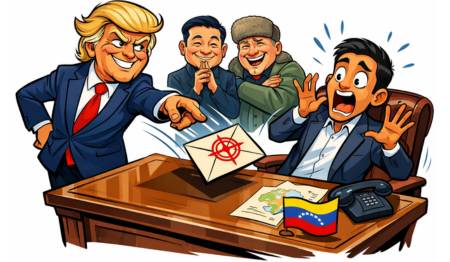
And somewhere in Mar-a-Lago, the Don-roe wasn’t done sending messages. Not subtle ones. Not coded in diplomatic language. One that landed square on the desk — and nerve endings — of Venezuela’s interim leader.
Delcy Will Pay a Very Big Price
“If she doesn’t do what’s right, she is going to pay a very big price, probably bigger than Maduro,” Trump said, invoking a threat that sounds more like a mob line than a diplomatic doctrine.
The point was clear: the Empire doesn’t just watch. It points, it decides, it warns — and it expects obedience, not sovereignty.
And with that, the curtain falls — for now. The rerun will continue. The Empire will strike again in phrases, in pressures, and in very public threats. And in the hemisphere, everyone knows the line between spectacle and policy is thinner than ever.
So… What Does This Have to Do With Spanish?
Everything.
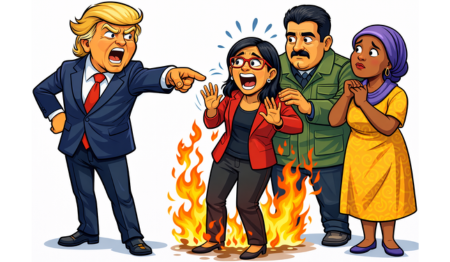
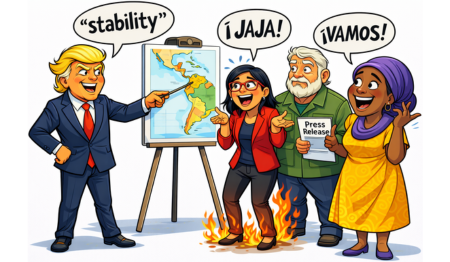
Because if you don’t speak Spanish, you’re forced to consume Latin America through press releases, subtitles, and people who say “stability” while pointing at a map they can’t pronounce. Spanish is how you hear what’s actually being said when empires rebrand invasions as concern and countries as “temporary projects.”
Understanding Spanish means catching the sarcasm, the frustration, the jokes, and the history that never make it into official statements. It’s the difference between reading the narrative and hearing the response.
One Last Thing Before We Close This Tab
Before you scroll away, there’s one more layer worth looking at — not missiles, not sanctions, not press conferences, but language.
Because none of what you just read happens without words doing most of the work first.
Policies move faster when they sound harmless. Interventions last longer when they’re wrapped in vocabulary that feels familiar, reasonable, almost boring.
Below is a short English–Spanish vocabulary list. It’s useful if you’re learning Spanish. It’s also useful if you’re trying to understand how power explains itself — especially in Latin America.
Same words. Two languages. One story.
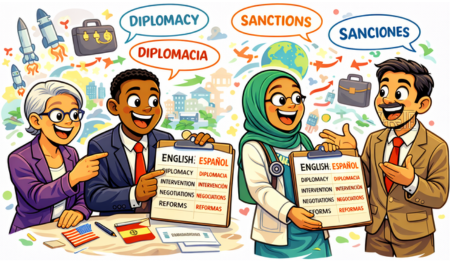
Key Vocabulary: U.S. Intervention & Foreign Policy (English–Spanish)
| English Term | Spanish Equivalent |
|---|---|
| Invasion | Invasión |
| Military intervention | Intervención militar |
| Regime change | Cambio de régimen |
| Sanctions | Sanciones |
| Economic pressure | Presión económica |
| Humanitarian aid | Ayuda humanitaria |
| National security | Seguridad nacional |
| Strategic interests | Intereses estratégicos |
| Oil reserves | Reservas de petróleo |
| Democratic transition | Transición democrática |
| Political stability | Estabilidad política |
| Opposition leader | Líder de la oposición |
| International community | Comunidad internacional |
| Temporary administration | Administración temporal |
| Foreign influence | Influencia extranjera |
| Sovereignty | Soberanía |
| Geopolitical interests | Intereses geopolíticos |
| Power vacuum | Vacío de poder |
| Civil unrest | Disturbios civiles |
| Proxy conflict | Conflicto indirecto |
Learn the Language. Then Go See It.
At KiDeeF Spanish and Kasa de Franko, we don’t teach Spanish so you can order a drink on vacation. We teach it so you can understand headlines like this one without someone translating the empire for you.
And if reading about Latin America from a screen feels insufficient, you can always do the dangerous thing: travel. Explore Peru and the region with Koslachek, talk to real people, hear real accents, and realize very quickly why phrases like “temporary management” sound very different once you understand the language.
Empires explain themselves in English.
Latin America answers in Spanish.
Choose wisely.