
Look Again & Try to Understand
Look at the sky tonight—but don’t rush to explain what you’re seeing.
Stay with the image for a moment before turning it into information. Because that move—the instant need to label, to name, to “understand”—usually happens faster than the act of actually seeing.
So pause there.
Are you really seeing the Moon?
Or are you looking at something your brain is actively constructing out of light, contrast, memory, and expectation?
Before getting into the thousand and one faces of the Moon, sit with this first.

The One Million Question
And here it is: the most uncomfortable question for a kid (and maybe for all human beings).
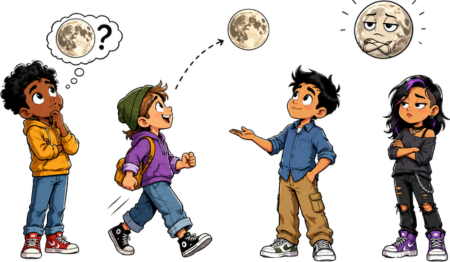
Is the Moon moving and following you…
or are you the one moving, while the Moon simply remains there—unavoidable, constant, present no matter where you go?
It feels personal.
That doesn’t mean it is.
What is it then? The Moon is clearly not that interested in you.
It just happens to be there.
How I Saw the Moon as a Kid
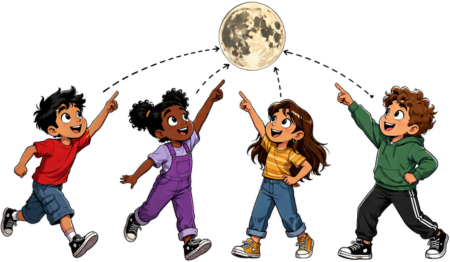
When I was a kid, I used to play outside at night with my cousins and friends, looking up at the sky and noticing how the Moon seemed to move every time I moved.
And of course, we all said the same thing.
“Look, the Moon is following me.”
“No, it’s following me.”
“That’s not true — it’s following me.”
We could have gone on like that all night and never agreed. Not because we were joking, but because each of us was completely sure.
That’s the part that’s easy to miss.
We weren’t just playing—we were convinced.
Was the Moon Choosing Me?
The Moon wasn’t actually choosing anyone. But each of us experienced it as something personal, almost as if it were responding to us individually.
And that’s where it gets interesting.
Because that moment—simple, almost ridiculous—already contains the core idea of everything that follows:
What we see is never just what is out there.
It is always shaped by where we stand, how we move, and what we assume is happening.
We didn’t misunderstand the Moon.
We misunderstood what it means to see.
The Object is The Same
The experience is not.
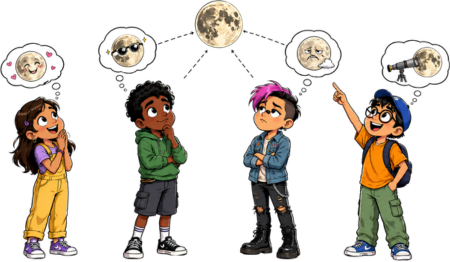
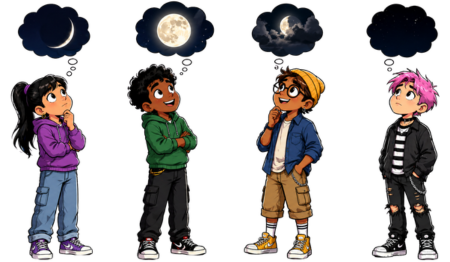
Here’s what almost no one stops to think about: the Moon itself changes very little, yet our experience of it changes constantly. On some nights it appears as a thin, fragile curve that feels like it could disappear at any moment. On others, it dominates the sky as a full, almost excessive presence. And sometimes it seems to vanish altogether, leaving behind the impression that something is missing.
So instead of asking what the Moon is doing, it becomes more interesting to ask what is happening on our side of the observation.
Now, before this starts sounding like speculation, let’s ground it for a second.
Eva Villaver’s “Las mil caras de la Luna”
The scientific lens behind what you’re about to read is grounded in the work of astrophysicist Eva Villaver. In Las mil caras de la Luna—literally, The Thousand Faces of the Moon—she explores how one single object can generate radically different experiences depending on how, where, and from where it is observed.
Not in a heavy, academic way, but through a clear idea: the physics is not the mystery.
The Moon rotates.
It orbits.
It reflects sunlight in predictable ways.
There is no confusion there.
And yet—
what we see does not always align with what is happening.
The Moon looks larger near the horizon.
It seems to follow us as we move.
It appears to change shape, speed, even presence.
None of that is physically real.
All of it is perceptually real.
That is the space this text lives in.Not between science and imagination—
but between what is stable and what is experienced as changing.
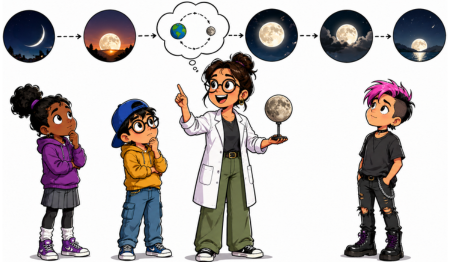
The Illusion of Phases
From an early age, we’re taught that the Moon has phases, and the language itself already suggests transformation. It sounds as if the Moon is growing, shrinking, appearing, disappearing—changing its form in some meaningful way.
But that’s not actually what’s happening.
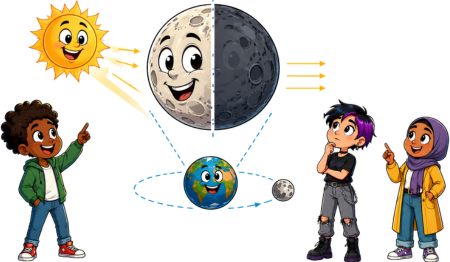
What we call “phases” are nothing more than sunlight hitting the Moon from different angles as it orbits the Earth. The sequence we learn—new Moon, crescent, quarter, gibbous, full—is not a story of change in the Moon itself, but simply the result of how the Sun, the Moon, and the observer line up.
The Moon is always half illuminated by the Sun. What changes is how much of that illuminated half we can see from Earth.
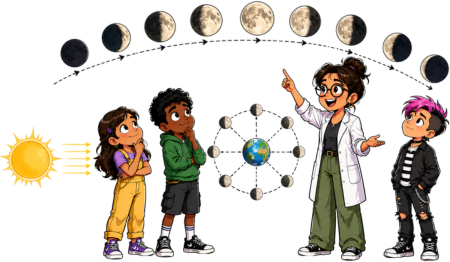
Nothing Is Changing
In other words, nothing is happening to the Moon itself. What changes is the portion of it that becomes visible to us under specific lighting conditions.
And this is where things start to break.
Because the moment you see this, the Moon stops being something that changes—and starts revealing how much of what you see depends on where you are and how you’re looking.
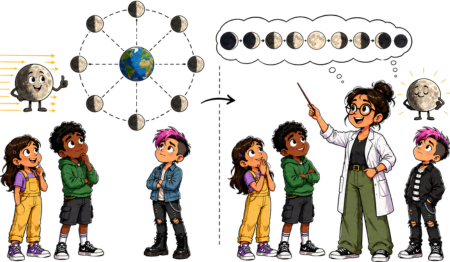
One Face, Always
There is another idea that people often “know” but rarely stop to fully process: we only ever see one side of the Moon.
This is due to what is known as tidal locking. The Moon rotates on its axis in exactly the same time that it takes to orbit the Earth, which means the same hemisphere is always facing us.
From our point of view, the Moon does not turn.
At least, not in the way we expect.
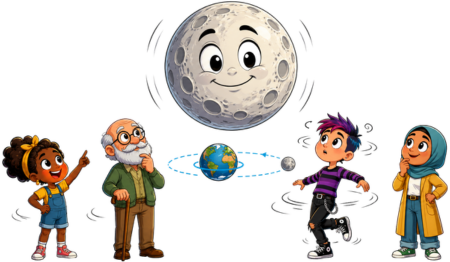
The Dark Side of the Moon
This has led to the popular expression “the dark side of the Moon,” which tends to be interpreted as something hidden or permanently in shadow. But that interpretation is misleading. The far side of the Moon receives sunlight just like the side we see; it is not dark, only inaccessible from our perspective.
Once again, the limitation is not in the object itself but in the position of the observer. What we call “hidden” is often simply “out of view.”
The Brain Is Not a Passive Observer
At this point, it becomes necessary to question the role of the observer more directly. We tend to assume that seeing is a neutral act, as if the eyes simply capture what is there and present it to us without distortion.
That is not how perception works.
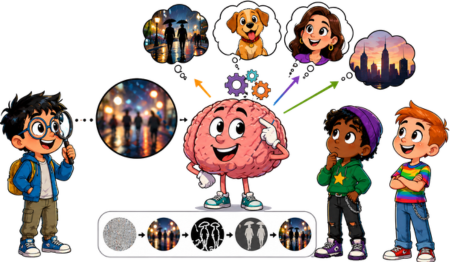
The brain is constantly interpreting, simplifying, and completing incomplete information. It enhances contrasts, defines edges, and organizes visual input into recognizable patterns. It prefers familiarity, so it often transforms ambiguity into something known.
Perception as Construction
This idea aligns closely with principles from Gestalt psychology, which propose that perception is not built from isolated pieces, but from structured wholes.
We do not see fragments and assemble them—
we perceive organized forms almost instantly.
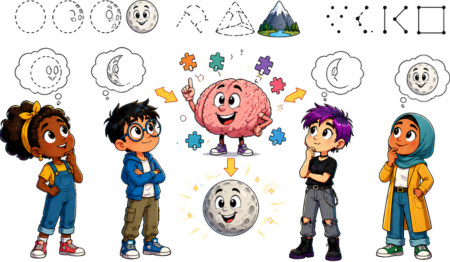
We see shapes that are not fully there.
We complete lines that were never drawn.
We recognize patterns before verifying them.
In other words, perception is not a recording process.
It is a construction.
And once this is understood, the Moon becomes something different.
Not just an object moving through space,
but an object continuously reconstructed by the observer.
Why People See Shapes on the Moon
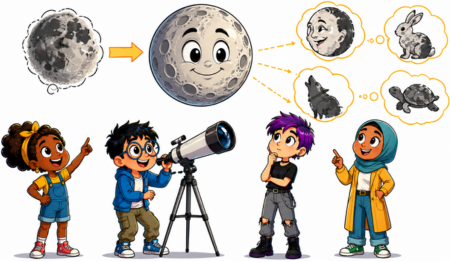
This is why many people see shapes on the Moon’s surface: a face, a figure, an animal. These are not features that the Moon is actively presenting, but patterns the brain imposes on irregular distributions of light and shadow.
What feels like direct observation is, in reality, a negotiation between external stimuli and internal interpretation.
The Moon does not contain those shapes.
But perception completes them anyway.
Size, Distance, & the Horizon Effect
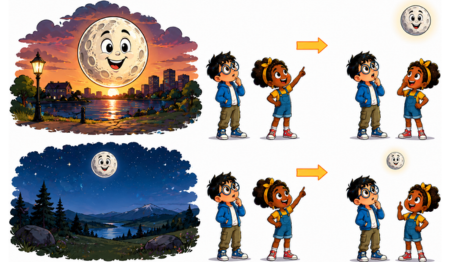
One of the most striking examples of this interpretive process is the so-called “Moon illusion.” When the Moon is close to the horizon, it appears significantly larger than when it is high in the sky.
Physically, however, its size in the sky remains almost constant.
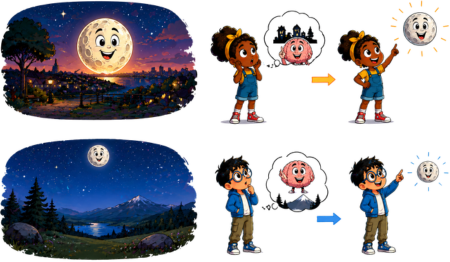
The difference comes from context. Near the horizon, the Moon is seen alongside buildings, trees, and other familiar objects that provide a sense of scale.
Remove those references, and the Moon changes again.
Not in reality—
but in perception.
How Our Brain Tricks Us
The brain uses these references to interpret size, and the result is an exaggerated perception of the Moon’s dimensions.
When the Moon rises higher, those reference points disappear. Without them, the brain recalibrates, and the Moon appears smaller, even though nothing about it has changed.
This effect reveals something important: perception is not only about what is seen, but also about what surrounds what is seen.
Color, Atmosphere, and Emotion
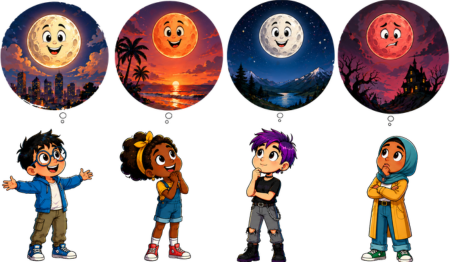
The Moon does not have a fixed color in our experience. It can appear yellow, orange, white, or even slightly red, depending on atmospheric conditions such as the scattering of light through the Earth’s atmosphere.
But beyond these physical explanations, there is another layer—one that is harder to measure.
The Moon can feel warm or distant, comforting or unsettling.
These qualities are not properties of the Moon itself, but responses generated within the observer.
Where the Moon Ends and You Begin
Memory, mood, and context all play a role in shaping how the Moon is experienced.
We are not only perceiving the Moon; we are projecting onto it.
And maybe that’s what those thousand faces really are.
Not changes in the Moon—but reflections of the one looking at it. This isn’t a glitch. This is how the system works.

The Moon as a Cultural Construction
And if we extend this same pattern outward, something else becomes visible.
What we noticed in individual perception does not stop at the brain.
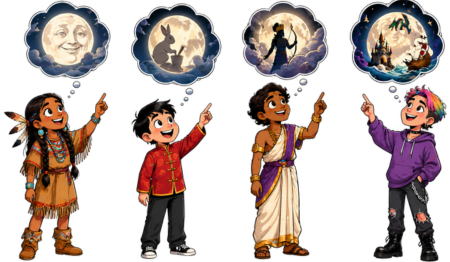
Different cultures, looking at the same Moon, have ended up seeing completely different things: a face, a rabbit, a god, a story.
The surface is the same, but what appears on it changes depending on the memory of the people looking.
These Are Not Random Interpretations
They come from stories already inside the culture—shared symbols, inherited meanings, ways of making sense of the sky long before science explained it.
The Moon, in this sense, continues the same pattern we saw before: it becomes a surface where human imagination keeps projecting itself.
And that makes the idea of a single “true” Moon more complicated.
Because what we call seeing is never just seeing. It is always filtered through what we already carry inside.

Time, Cycles, and Human Organization
And if we follow this logic one step further, even something as “fixed” as time starts to show the same pattern.
For most of human history, the Moon has been used as a reference for time. Its cycles helped structure months, seasons, rituals, and daily life. It gave rhythm to things that otherwise felt scattered.

The Moon Just Repeats a Pattern
But the Moon itself is not “creating” time. It is repeating a pattern. What we do is take that repetition and turn it into structure.
Calendars, in that sense, are not discovered inside the sky. They are built from how we interpret what the sky is doing.
The Moon offers rhythm. We turn that rhythm into order.
And just like before, what we are really looking at is not only the Moon—but how we organize reality around what we think we are seeing.
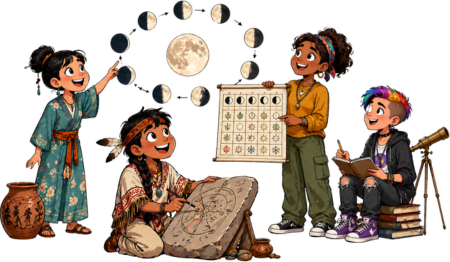
Motion Everywhere
There is another thing that usually disappears from everyday awareness: how much motion is actually involved in something that feels completely still.
The Earth is rotating on its axis. At the same time, it is orbiting the Sun. And meanwhile, the Moon is orbiting the Earth and also rotating on its own axis in a way that keeps the same face toward us. All of this is happening at once.
And yet, none of it feels like motion—maybe not the same way your head starts moving after too much cerveza amigouu.
From where we stand, the ground feels stable, the sky feels fixed, and the Moon appears calm and almost motionless.
What disappears is not the movement itself, but our awareness of it.

Too Much Motion to Hold at Once
But we do not experience it that way.
And yet, the brain gives us a stable image. It presents the Moon as something fixed in the sky, something we can point at, name, and treat as if it were not moving at all.
That stability is not a property of the world itself—it is something the mind builds so we can function inside it.
Because without that stability, perception would stop feeling like perception at all. It would become too much motion to hold at once.
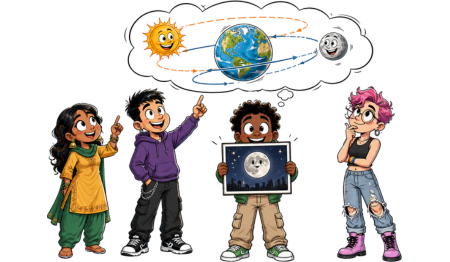
The Limits of What We Call “Seeing”
At this point, the idea that the Moon has many faces starts to shift in meaning.
It is not that the idea is wrong, but that it tends to place the variation in the Moon itself, when most of it actually comes from somewhere else.
The Moon does not change in the ways we often imagine. What changes is everything around it: light, position, context, and even the internal state of the person looking.
And that is where things become less obvious.
Because seeing is not simply receiving something from the outside. It is something that happens between what is there and the system trying to make sense of it.
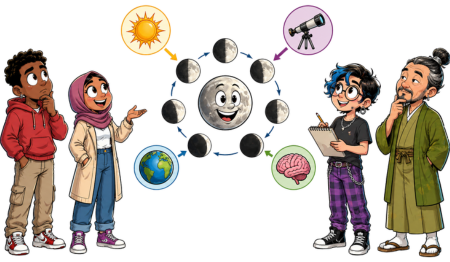
What Seeing Actually Is
Seeing is not a passive act.
It is an active process—one that combines external reality with internal structure at the same time.
What reaches us is never raw information. It is always filtered, adjusted, and completed.
And the Moon, in that sense, is not really a changing object with “many faces,”
but a stable presence that reveals how unstable perception actually is.
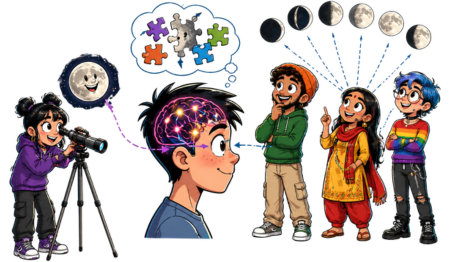
It Was Never About the Moon
It was always about us.
If anything can be taken from this, it is not that the Moon is an illusion, but that our experience of it is mediated at every level.
The Moon may be one of the most stable objects in our sky, yet it reveals how unstable perception can be. It shows how easily we attribute change, meaning, and even emotion to something that remains fundamentally consistent.
So when we say the Moon has a thousand faces, what we are really pointing to is not the Moon itself, but the range of ways we are capable of seeing, interpreting, and projecting.
And in that sense, the multiplicity was never in the Moon.
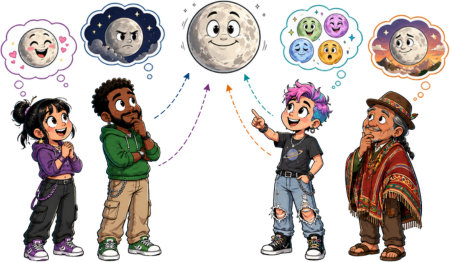
From Perception to Language
The Moon shows how perception is constructed.
Language does the same thing.
And Spanish learning becomes something different when seen this way—not the memorization of words, but the gradual reorganization of how reality is interpreted through another system of meaning.

And This Is Exactly Why Language Matters
The Moon was only the example.
The same process that shapes how we see it also shapes how we use language. We are not simply naming reality—we are interpreting it, and in many ways, constructing it through a system that defines what we are able to notice in the first place.
This idea is not new. Thinkers like Jacques Derrida have long argued that meaning is never fixed, and that language does not passively reflect reality—it actively shapes it.
This is where the perspective shifts.
Spanish is no longer just vocabulary to memorize or grammar to follow. It becomes a different way of organizing meaning.
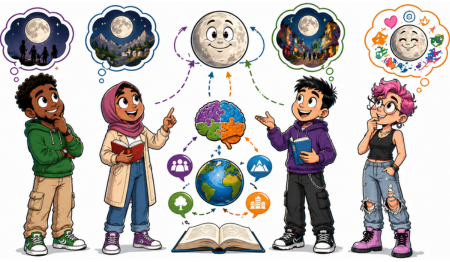
From Seeing the Moon to Learning a Language
The Moon reveals something deeper: perception is constructed.
What is easier to overlook is that language operates through the same mechanism.
When you learn Spanish, you are not simply attaching new words to a world you already understand. You are engaging with a different system of segmentation—another way of dividing reality into meaning.
In English, experience is organized one way. In Spanish, the same moment can be structured differently: time, emotion, intention, even the distance between people can be framed through distinct linguistic patterns.
And just like with the Moon, what changes is not reality itself, but the system through which it is interpreted.
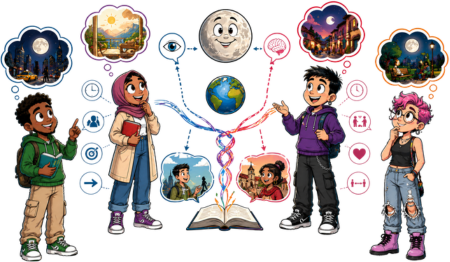
Learning to See Differently
Learning Spanish is not only about speaking.
It is about reorganizing what you notice—and understanding that meaning is not fixed, but structured through language.
It is not just a new vocabulary, but a shift in how reality is accessed, interpreted, and expressed.

Spaces Where Language Becomes Experience
If language works like perception—shaping what we notice, how we interpret, and even how we structure reality—then it is unlikely to change through explanation alone.
It develops through contact, through repetition, and through being inside situations where meaning is not described, but lived.
This is why the environment in which language is encountered matters more than it initially appears—not because it simplifies learning, but because it changes the conditions under which understanding becomes possible.

Language in Context
At KiDeeF and Kasa de Franko, Spanish is approached from this perspective: not as a set of rules to memorize, but as a space of interaction where meaning emerges through conversation, cultural reference, and real use.
In that sense, the focus shifts away from treating language as an object to be explained, and toward creating conditions in which it can be experienced—indirectly, through context, repetition, and use, much like perception itself.

From Language to Cultural Perception
If language shapes how we see, then culture extends that process on a larger scale.
The Moon is never just the Moon—it becomes myth, calendar, symbol, and story depending on who is observing it. The same sky gives rise to different realities, shaped by the systems of meaning surrounding it.
And this is not limited to language alone. It appears in the way entire civilizations have organized knowledge around the sky, time, and nature.
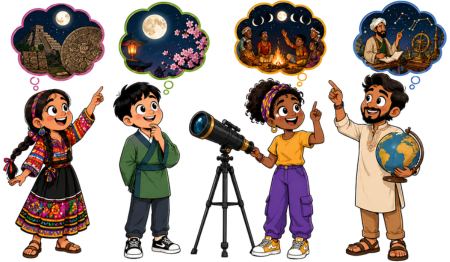
Where Astronomy Was Also a Way of Seeing
In ancient Peru, the relationship between perception and meaning was not theoretical—it was embedded in culture. Sites like Huaca de la Luna reflect a world where astronomy, ritual, and symbolic systems were not separated, but deeply intertwined.
Even the visual language of the Moche culture, expressed through ceramics often referred to as huacos, reveals a complex relationship between observation, symbolism, and human behavior—where the body, nature, and cosmos formed part of a single interpretive system.
To encounter these places today is not simply to observe historical artifacts, but to come into contact with a different way of seeing—one in which meaning was not added to the world, but emerged through it.

Koslachek Tours and the Experience of Perspective
This is part of what Koslachek Tours explores in Peru: not only the locations themselves, but the cultural and cognitive frameworks that shaped them—where meaning, astronomy, and symbolism were experienced as a single, interconnected system.
In that sense, these journeys are less about distance and more about perspective. They offer a way of observing how different cultures constructed meaning from the same world we continue to look at today.

Language for the Perception of the Moon
What follows is where the idea becomes practical.
If perception is constructed, then language is one of the tools that shapes that construction.
These are not just words—they are ways of organizing how the Moon is observed and understood.
| Spanish | English | Meaning in Context (Moon & perception lens) |
|---|---|---|
| la luna | the Moon | The central object of perception in the text |
| fase lunar | lunar phase | The changing appearance of the Moon due to sunlight angle |
| luna nueva | new moon | Phase where the illuminated side is not visible from Earth |
| cuarto creciente | first quarter | Phase where half of the Moon appears illuminated |
| luna llena | full moon | Phase where the visible side is fully illuminated |
| órbita | orbit | The curved path the Moon follows around the Earth |
| rotación | rotation | The Moon spinning on its axis |
| eje | axis | The invisible line around which the Moon rotates |
| sincronización | synchronization | The matching of lunar rotation and orbit (tidal locking) |
| bloqueo de marea | tidal locking | Phenomenon where the same face of the Moon always points to Earth |
| gravedad | gravity | Force that keeps the Moon in orbit around Earth |
| luz solar | sunlight | Source of illumination that creates lunar phases |
| sombra | shadow | The unlit portion of the Moon visible from Earth |
| hemisferio | hemisphere | One half of the Moon (visible and hidden sides) |
| cara oculta | far side | The side of the Moon never visible from Earth |
| observación | observation | The act of viewing the Moon from Earth’s surface |
| perspectiva | perspective | The Earth-based position that shapes what is seen |
| distancia | distance | Space between Earth and Moon affecting perception |
| atmósfera | atmosphere | Layer that alters how the Moon appears from Earth |
| refracción | refraction | Bending of light that can influence appearance |
| ilusión lunar | Moon illusion | Perception that the Moon appears larger near the horizon |
| movimiento aparente | apparent motion | The illusion that the Moon is “following” the observer |
| eje de observación | observational axis | The mental frame from which perception is structured |