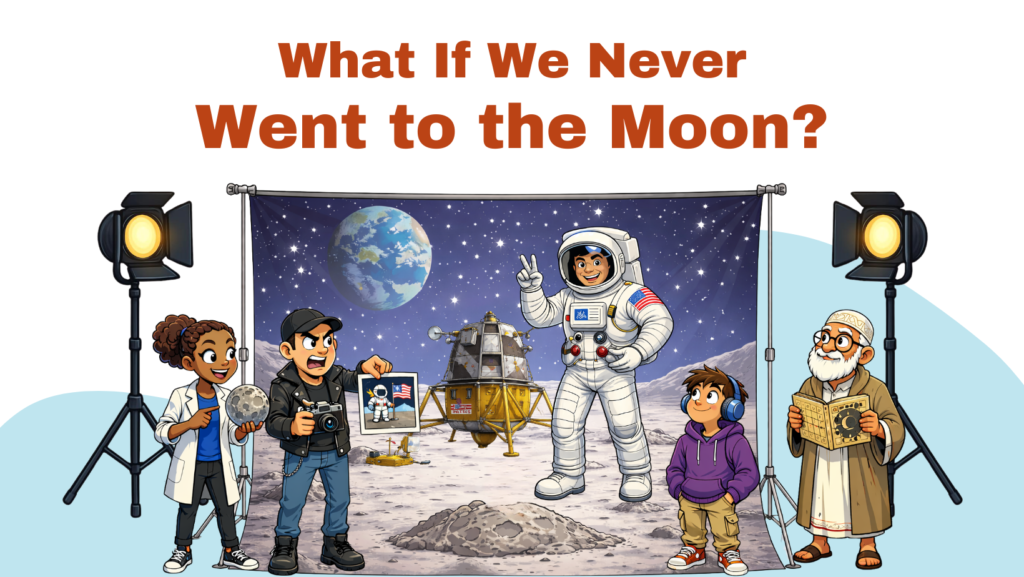
This Isn’t About the Moon
What if we never went to the Moon? It’s a question that keeps coming back in different forms—did we really go, or is it just another version of the Moon landing conspiracy theories people still debate decades later? And that’s really where the question shifts into something deeper: why do people believe in Moon landing conspiracy theories in the first place?
The Moon landing isn’t the conspiracy—the conspiracy is how fast we call “fake” when something is just well done… but sure, WiFi is probably magic anyway. Then…

Why We Believe in Conspiracy Theories
Let’s look at the Moon without cheap romanticism. Not as the backdrop of a sad song or a poetic excuse, but as what it actually is: a massive, silent, indifferent rock that has been there while humanity invented gods, empires, wars… and now, conspiracy theories.
It doesn’t care what we believe about it. But we care a lot about what we believe through it. And that’s where it stops being about the Moon… and starts being about us.
What the Moon Meant to Us
Before it was a destination, the Moon was a tool. It helped organize crops, mark time, and explain what people didn’t yet understand. But more than that, it gave people something they’ve always needed: a sense of control over things they couldn’t explain.
For thousands of years, the Moon wasn’t a place we could go to—it was a way to make sense of the world.
A reference point in the middle of chaos, something stable in a reality that often wasn’t. And that matters more than we usually admit.

Not Knowing Leads to Belief
We hate not knowing! Because let’s be honest—humans are not great at uncertainty. We don’t like randomness, and we definitely don’t like silence. So when something big, distant, and predictable shows up in the sky every night, we don’t just observe it… we assign meaning to it.
The Moon becomes a calendar, a warning sign, a symbol, sometimes even a personality. Not because it is—but because we need it to be.
At the end, what’s the difference between a myth and a conspiracy theory?
From Moon Myths to Conspiracy
And once something becomes part of how you understand reality, you don’t just let it go. You build stories around it, pass them on, protect them. And if someone comes along and changes what that thing is… you don’t just question the new version.
You question everything. And that’s where things start to get interesting.
And if the Moon was never just a rock to begin with, then going there was never going to be just a scientific achievement.
So why do people believe in Moon landing conspiracy theories?

Crossing the Line Between Myth & Reality
Because when we finally decided to go there, we weren’t just launching rockets. We were crossing a boundary between imagination and reality. We were testing whether something that had lived only in stories could become something physical.
That shift is not just scientific. It’s cultural. It’s philosophical. Because it forces a new question: what happens when something we once mythologized becomes something we can actually touch?

The Question That Won’t Leave
Did we go to the Moon or not?
It sounds like a technical question, but it isn’t. It’s psychological.
Accepting the Moon landing means accepting something uncomfortable: that humans—despite being inconsistent, political, and often irrational—were capable of coordinating one of the most complex engineering achievements in history and getting it right.
For some people, that’s harder to believe than the idea of a perfectly executed global deception.
Because believing in failure feels more familiar than accepting success at that scale.
And when a question becomes uncomfortable enough, people don’t always look for better answers. They look for answers that feel easier to hold onto—even if that means simplifying reality to the point of distortion.
And sometimes, they lead to theories like this.

What If the Moon Were Made of Cheese?
The idea is obviously absurd. That’s exactly why it works.
Absurd ideas don’t survive because they’re convincing. They survive because they’re simple.
They take a complicated, technical reality and replace it with something easier to process. Something that doesn’t require understanding physics, engineering, or history—just imagination.
Conspiracies don’t compete with facts. They compete with comfort. And comfort usually wins.
The Moon Is Also Inside Us
Language reveals how deeply the Moon is embedded in human thinking.
In English, some historical terms for unusual or erratic behavior come from the Latin luna (meaning Moon), reflecting an old belief that the Moon could influence human behavior. Across cultures, similar expressions link the Moon to distraction, instability, or altered states of mind.
Scientifically, those beliefs don’t hold up. But psychologically, they tell us something important: the Moon has always been less about what it is and more about what we project onto it.
Different languages. Different cultures. The same instinct.
We don’t just observe the world—we interpret it, reshape it, and sometimes distort it to make it easier to live with.

When the Moon Becomes Language
Spanish does the same thing—but in a way that feels more visual, more immediate.
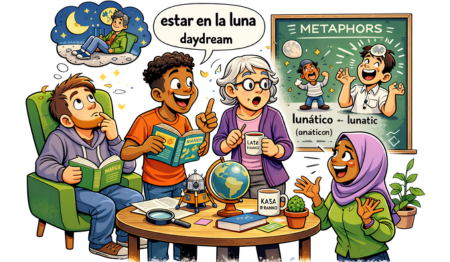
You might hear someone say “estar en la luna”—literally, to be on the Moon. It doesn’t mean they’re an astronaut. It means they’re distracted, not paying attention, mentally somewhere else.
Then there’s “lunático”, which carries that same old belief: that the Moon can influence how people think or behave.
And sometimes, people say “estar con la luna”, suggesting someone is acting strange, unpredictable, or just… not quite themselves.
Scientifically, these ideas don’t hold up. But psychologically, they reveal something deeper: the Moon has always been less about what it is and more about what we project onto it.
These expressions aren’t scientific—but they’re revealing. They show how language preserves old ways of thinking, even after we’ve stopped believing in them.

When the Moon Stopped Being Perfect
For most of human history, the Moon was seen as perfect. Smooth. Untouched. Almost divine.
That changed when early telescopes revealed its surface in detail: craters, shadows, irregular terrain. It wasn’t perfect anymore—it was geological.
And that shift mattered.
When something stops being perfect, it stops being sacred. And when it stops being sacred, it becomes something we can approach, study, and eventually try to reach.
The Moon didn’t change. Our perception did.
And that’s where the real journey began—not in 1969, but in the moment we stopped seeing it as untouchable.
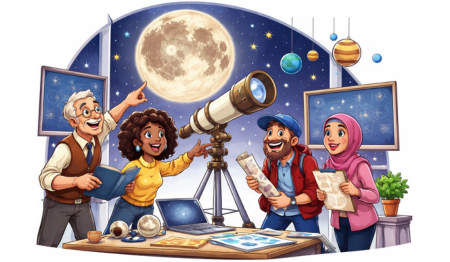
The Moon as a Political Tool
By the mid-20th century, the Moon had taken on a new role. It wasn’t just an object of curiosity—it became a geopolitical objective.
During the Cold War, space exploration turned into a competition for global influence. Each milestone was both a scientific achievement and a symbolic statement.
- 1957: Sputnik proves that reaching space is possible
- 1961: Yuri Gagarin becomes the first human in orbit
- 1969: Apollo 11 lands on the Moon
These weren’t isolated events. They were moves in a global performance—each one designed to prove not just technological superiority, but ideological dominance.
The Moon, in this context, was not just a destination. It was a message. And in 1969, that message reached its peak.

1969 — The Moment
On July 20, 1969, Apollo 11 successfully landed on the Moon. Neil Armstrong and Buzz Aldrin walked on its surface while Michael Collins remained in orbit.
But this wasn’t just an engineering success. It was a global broadcast. Hundreds of millions of people watched it in real time, making it one of the first truly shared technological experiences in human history.
And that visibility created a paradox.
The clearer and more compelling the images were, the more some people felt something was off. Too clean. Too well presented. Almost too perfect.
But that reaction confuses production with fabrication. A well-documented event can look staged—not because it is fake, but because it was carefully prepared.

Beyond 1969 — What Gets Ignored
The Moon landing wasn’t a one-time event. It was repeated.
Between 1969 and 1972, six Apollo missions successfully landed on the Moon:
- Apollo 11
- Apollo 12
- Apollo 14
- Apollo 15
- Apollo 16
- Apollo 17
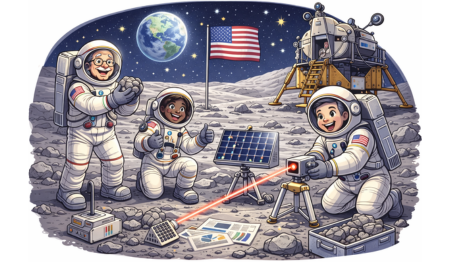
Twelve astronauts walked on the lunar surface. They collected over 380 kilograms of rock samples, deployed scientific instruments, and generated data that has been studied for decades.
Some of those instruments, like retroreflectors, are still used today to measure the distance between Earth and the Moon with lasers.
Rejecting all of this requires a much more complex explanation than accepting it. And complexity is exactly what most conspiracy theories try to avoid.
At this point, we’re no longer just talking about the Moon. We’re really asking why people believe in Moon landing conspiracy theories even when evidence is available.
The Detail That Breaks the Conspiracy
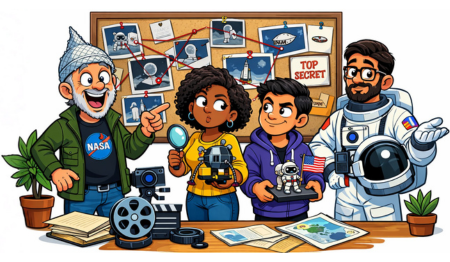
To claim the Moon landing was faked, you need to assume a coordinated system of deception involving thousands of individuals across multiple institutions and countries.
You would need to explain how such a system remained consistent over time, produced physical evidence, and avoided credible leaks.
In theory, large-scale deception is possible.
In practice, maintaining that level of coordination without failure is extraordinarily unlikely.
At some point, the explanation becomes more complicated than the event it is trying to replace. And when that happens, it stops being a simplification—and starts becoming something else entirely.
The Science Behind the Doubts
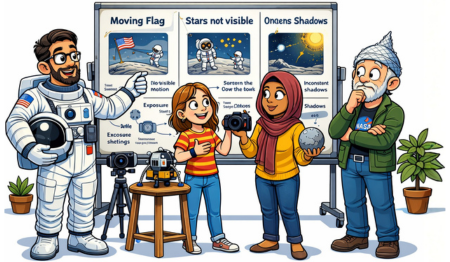
Many of the arguments that fuel why people believe in Moon landing conspiracy theories come from misunderstandings of physics and photography rather than actual inconsistencies.
- The flag appears to move → There is no atmosphere on the Moon, so no wind. However, when astronauts planted the flag, they transferred motion to it. Without air resistance, that motion lasts longer, creating the illusion of waving.
- No stars appear in photos → The cameras were adjusted for a brightly lit surface. The stars, being much dimmer, were not captured under those exposure settings—just as they are not visible in daylight photos on Earth.
- Shadows look inconsistent → Uneven terrain and reflected light can distort shadow angles. A single light source, like the Sun, can produce non-parallel shadows on irregular surfaces.
- The images look staged → This is a cognitive bias. When something appears too precise or too well composed, we associate it with artificial production, even when it is the result of careful engineering.
- It could have been filmed in a studio → This argument ignores scale. Replicating not just visuals, but also physical samples, telemetry, and decades of independent verification would be more complex than conducting the mission itself.
These explanations are not speculative. They are consistent, testable, and repeatable.
The issue is not a lack of answers.
It’s that the answers are less exciting than the alternative.
And that’s usually where belief starts to bend.
But understanding something is not the same as accepting it. And even when science explains something clearly, people don’t always stop needing a different version of the story
Why Doubt Persists
Conspiracy theories are not primarily driven by a lack of information. They are driven by psychological needs.
They provide a sense of control, a feeling of insight, and a simplified version of reality that is easier to navigate.
Believing that something is hidden can feel more satisfying than accepting that the explanation is already available.
So the persistence of doubt is not surprising.
It is human.
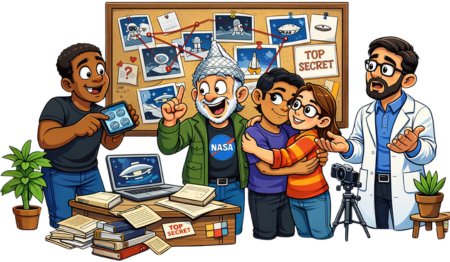
Why We Stopped Going
After Apollo 17 in 1972, crewed missions to the Moon stopped.
Not because they became impossible, but because they stopped being politically necessary.
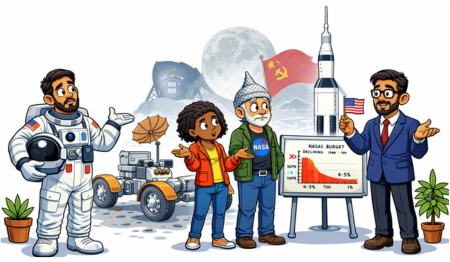
At its peak in the 1960s, NASA’s budget reached about 4–5% of the U.S. federal budget, driven by Cold War competition. Once the United States achieved the symbolic objective of landing on the Moon before the Soviet Union, that urgency declined.
By the 1970s, funding dropped below 1%.
Without political pressure, large-scale missions lost priority.
Space exploration did not end—but its motivation changed.
Going Back, With Different Goals
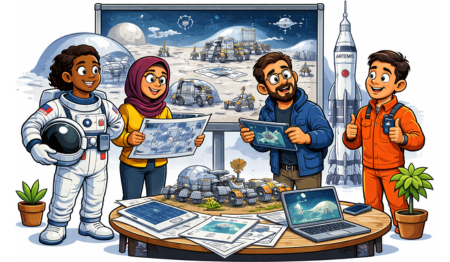
Today, interest in the Moon is returning, but under a different logic.
The goal is no longer symbolic victory. It is long-term presence, resource exploration, and strategic positioning.
Programs like Artemis aim to establish sustainable operations on and around the Moon.
The Moon is no longer just a destination.
It is becoming infrastructure.
The Real Question
The Moon remains unchanged. It does not respond to belief or doubt. In the end, why people believe in Moon landing conspiracy theories says more about us than it does about the Moon.
But our interpretation of it reveals something important. It shows how we process complexity, how we assign trust, and how we deal with uncertainty.
Maybe the question was never whether we went to the Moon. Maybe the real question is why it is so difficult to accept that we did.
Which is exactly what we explore at Kasa de Franko: how language doesn’t just describe reality—it quietly shapes it.

🗣️ Why This Matters for Spanish (and Everything Else)
Learning Spanish isn’t just about vocabulary. It’s about seeing how another language organizes reality differently—but also strangely familiar.
Because once you notice how languages carry old ideas like luna, you start noticing something else:
we all build meaning the same way… just with different words.
And that’s exactly where Kasa de Franko comes in—learning Spanish not as translation, but as a way to rethink how you see the world 🌙

🌕 The Moon We Speak (and Learn From)
We’ve already seen how deeply the Moon lives in our language. Expressions like estar en la luna or lunático aren’t just poetic leftovers—they’re small fossils of how humans once tried to explain the mind through the sky.
And even if we’ve mentioned them before, it’s worth noticing something deeper: we still think through these metaphors without realizing it.
🌙 The Moon in Spanish
Earlier we saw how the Moon isn’t just something in the sky—it also lives inside the way we think and speak. Even when we stop treating it as mystical, it stays quietly embedded in language.
Spanish is a perfect example of this. The Moon didn’t just inspire stories—it shaped everyday words, expressions, and even how people describe behavior, time, and identity.
Once you notice it, you start seeing it everywhere.

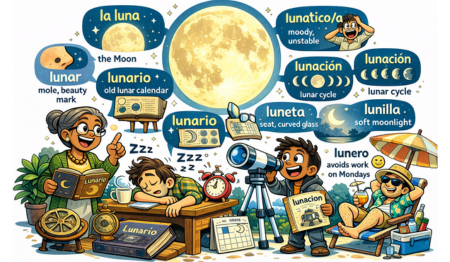
🌕 Moon-Inspired Spanish Vocabulary
| Word | Meaning | How it’s used |
|---|---|---|
| la luna | the Moon | the literal celestial body |
| lunático / lunática | moody or “unstable” person (old belief origin) | Está un poco lunático hoy |
| lunación | lunar cycle | used in astronomy / calendars |
| lunario | old lunar calendar / almanac | historical / traditional reference |
| lunar | mole / beauty mark | Tiene un lunar en la mejilla |
| luneta | small seats / viewing area / curved glass | theater seats or optics |
| alunizar | to land on the Moon | technical / space context |
| lunero | someone who avoids work on Mondays or holidays 😏 | informal / regional slang |
| lunilla | soft moonlight | poetic / literary usage |
| lunisolar | relating to Moon + Sun calendars | calendars and time systems |
🧠 Quick note on “lunero”: in informal Spanish, it describes someone who stretches the weekend or avoids working Mondays and holidays—basically someone living on a very flexible lunar schedule.
We Won’t Take You to the Moon
We might not take you to the Moon—but we can definitely change the way you see it.
Because in the end, this was never just about whether we went there. It’s about how we think, how we question, and how we understand the world around us.
And in a world where the new space race is global, understanding more than one language isn’t optional—it’s an advantage.

But We’ll Take You Further in Spanish
That’s exactly what we do at Kasa de Franko and Kolacheck.
Through Spanish, you don’t just learn vocabulary—you explore ideas, culture, and perspectives that make the language stick. From expressions like estar en la luna to the many ways prehispanic Peruvian cultures understood the Moon, language becomes a way of seeing, not just speaking.
So maybe we won’t help you on your journey to the Moon—but we will help you move forward on your Spanish journey, with meaning, context, and real connection.