Intro — Rome is on Fire!
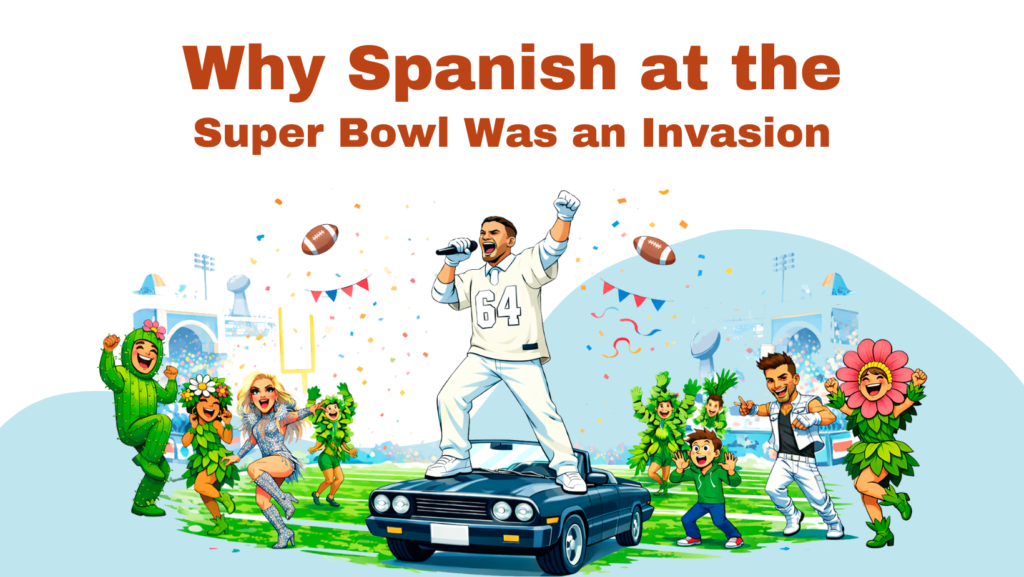
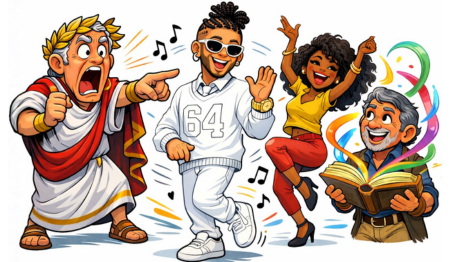
The “Invasion”: Bad Bunny hits the Super Bowl halftime stage — in Spanish — and suddenly, Rome is burning. Or at least that’s how some people react.
Not because of the choreography. Not because of the production. Not even because of the lyrics. Because of the language.
The halftime show reached over 120 million viewers — one of the largest television audiences in U.S. history — which makes the panic feel even more theatrical. And that visibility changed the temperature of the room.
Act I — The Barbarians Are Back!
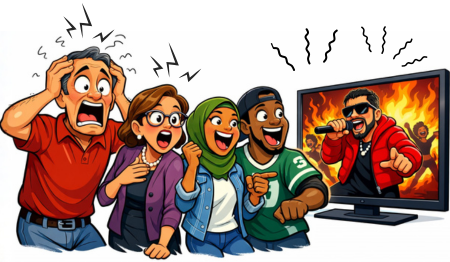
Thirteen minutes of Spanish on the biggest American broadcast of the year — and suddenly words like “division,” “agenda,” and “decline” start floating through the air.
Amazing how a vowel shift — a change in sound, nothing more — can spark a civilizational emergency: the 15th-century Great Vowel Shift, rebooted and bilingual.
Apparently the empire can handle fireworks, billion-dollar ads, and fighter jets over the stadium — but not rolled r’s on primetime.
Act II — The Empire Responds
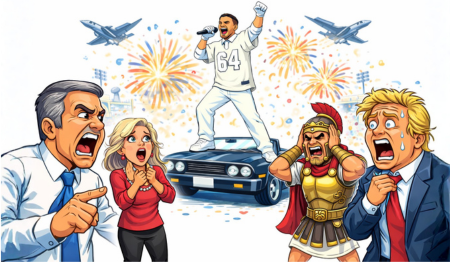
Once upon a time, Rome blamed the barbarians for everything. They spoke differently. They didn’t center Rome. They existed too loudly on the edges. Sound familiar?
Empires love diversity — as long as it performs quietly and knows its place. The moment another language stops being background flavor and becomes the headline, it’s suddenly an invasion.
Here’s the inconvenient irony: Latin didn’t disappear. It multiplied. It evolved. It became Spanish, French, Italian, Portuguese. If Spanish is barbaric, Rome technically exported the problem.
But we’re supposed to believe a halftime show is the fall of Western civilization?
Relax. It’s reggaetón, not a siege engine.
Act III — What Actually Scares People
Let’s be honest. It’s not about football. It’s not about patriotism. It’s not about “keeping politics out of entertainment.” It’s about visibility.
When Spanish isn’t an accent in the background but the main event on the most American stage imaginable, some people feel something shift.
Not attacked. Not replaced. Just no longer centered.
Empires don’t fall because someone sings in another language. They fall when they confuse dominance with permanence. The stadium is still standing. The anthem still played. The country did not implode.
What changed was simple: The microphone didn’t translate. And the reaction revealed more than the performance ever could.

Act IV — The Culture War ‘Merica Didn’t Want
Most scrolled past. MAGA freaked out.
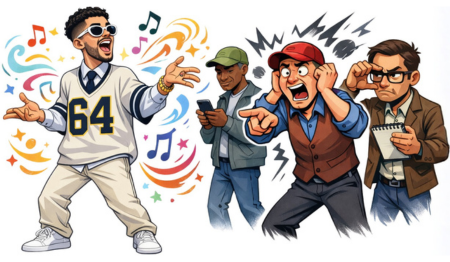
Thirteen minutes of symbolism, posture, and visual statements — without naming a single politician. No direct attacks. No campaign slogans. No explicit references to the current administration.
And yet it was treated like a provocation.
He didn’t mention Trump. Trump has mentioned him. That asymmetry matters.
One side performs culture. The other reacts to it. One side sings in its own language. The other frames it as cultural decline.
Act V — Who’s Actually Fighting a Culture War?
If this was a “political performance,” it was political in the way visibility is political — by existing at scale.
That’s what unsettles people. Not criticism. Not opposition. Presence. Because power is comfortable debating its critics. It is less comfortable competing with cultural gravity.
You can argue with a speech. You can’t easily argue with relevance. So who is actually fighting a culture war? The artist who performed without naming a rival?
Or the politician who keeps naming the artist?
Outrage becomes more revealing when the logic behind it is contradicted by the facts. But…

Act VI — Who Is Actually Winning?
The official reaction didn’t take long.
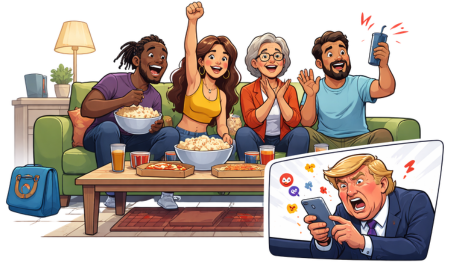
In the early hours of the morning, indignation appeared online. He had claimed he wasn’t planning to watch — but he watched enough to publicly slam the performance as “absolutely terrible” and “a slap in the face to our country.”
Images of him watching the halftime show at Mar-a-Lago soon began circulating online — hypocrisy on full display. The message spread quickly among those already inclined to agree.
Decline.
Disrespect.
Disorder.
Inside that ecosystem, the reaction felt enormous. Urgent. Existential. But outside that loop, nothing shifted.
For thirteen minutes, Spanish stood at the center of the most watched broadcast in the United States of America — a country that took over the name of an entire continent, América.
Not translated. Not softened. Not explained. And millions didn’t need it to be. So when someone says, “Nobody understands…” (Trump on Truth Social)
It’s worth asking:
Nobody?
Act VII — The Math No One Can Argue With
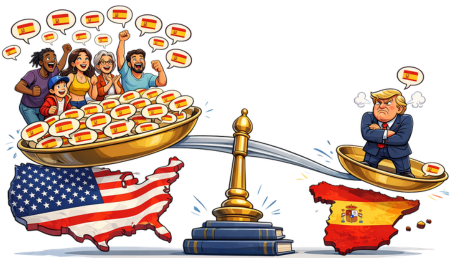
The United States now has roughly 65 million Spanish speakers — about 45 million native and another 20 million non-native. Spain has about 49 million. Pause there.
The United States contains more Spanish speakers than Spain.
So when something is dismissed as incomprehensible, the issue isn’t comprehension.
It’s audience. Why?
Because they are the ones who don’t want — quoting Trump — to “understand.”
Act VIII — Spanish Is Not a Visiting Language
It is not an imported accessory. It is not a translation setting. It is domestic.
Spanish was spoken in what is now the United States long before English arrived — San Agustín, Florida, for starters. Spanish is not new here; it’s foundational.
Globally, more than five hundred million people speak Spanish as a native language — over six hundred million when you include those who learned it as a second language.
That is not a niche audience. That is a civilizational one.
And when an audience is that big, it doesn’t just exist quietly in the background. It shapes attention, markets, and culture — which brings us to the stage that counts: the NFL.
The lingering question then: Does the National Football League Understand Markets?
It does.
Act IX —The NFL’s International Play
An NFL game in Mexico City was not random. Madrid is not symbolic.
A regular-season game in Spain marks a deliberate expansion into a Spanish-speaking market. Through its Global Markets Program, teams now hold commercial rights in countries like Colombia and Argentina. Spanish-language broadcasts continue expanding, reaching more than 11 million fans in Spain alone, with growing reach across Latin America.
Campaigns like Por La Cultura aren’t cosmetic. They reflect what the numbers already show: Latino audiences are among the fastest-growing segments of the league’s fan base.
This isn’t a cultural accident.
It’s strategy. It’s market math.
Act X — The Stage Already Adapted
So the question is no longer whether Spanish belongs on that stage. That debate is already over. Spanish was center stage, visible, and unapologetic.
The real question is whether the stage is ready for the scale, the presence, the gravity of this audience.
Because for thirteen minutes on the biggest broadcast of the year, it already was. Millions didn’t need translation. Millions didn’t need explanation. Millions were already there.
Not a curiosity. Not a side note. Not background flavor. Visibility at scale shifts culture — quietly, powerfully, and permanently. The stage didn’t wait for anyone’s permission.
It adapted first, and the rest of the empire will have to catch up.
Act XI — The Stage Didn’t Stop Being American
If anything, it became more so — displaying the continental breadth that the word “America” has always carried, even when the United States chose to claim it as shorthand for itself.
América is not a synonym. It is a geography. A hemisphere. A linguistic ecosystem stretching from Patagonia to Montreal. The United States occupies part of it. It does not exhaust it.
For thirteen minutes, that broader meaning surfaced on the most-watched broadcast in the country. Not as protest. Not as translation. Simply as presence.
That presence unsettled some viewers because scale changes perception. Spanish, when heard in fragments — in restaurants, in neighborhoods, in background conversation — is familiar enough. But Spanish at center stage, amplified and unapologetic, alters the symbolic frame.
Act XII — What Had Been Ambient Became Dominant
And when visibility reaches a certain density, culture begins to sound territorial. The language of aesthetics shifts toward the language of boundaries. Questions that once concerned rhythm and choreography begin to concern ownership and representation.
Who is this for?
Who does this stage belong to?
Those questions are rarely about music. They are about scale. And scale, unlike sentiment, is measurable.
Markets do not respond to metaphors. They respond to numbers.
And when arithmetic becomes visible, it begins to feel political. Backlash is often the sound a culture makes while adjusting.

Act XIII — Panic at the Halftime Show
Apparently, thirteen minutes in Spanish constituted a national emergency.
Megyn Kelly did not critique the choreography. She did not debate the mixing. She did not analyze the staging. She questioned the premise, same as Trump and the conservative ecosystem.
Why should the number of Spanish speakers matter? Why should that influence the most-watched broadcast in the United States?
It was framed as a defense of tradition. Of Americanness. Of the familiar. Curious defense, considering that roughly 65 million Spanish speakers already live inside the country being defended.
The language was treated as foreign. The math was domestic.
And once the premise was reframed as threat, the reaction did not remain isolated.
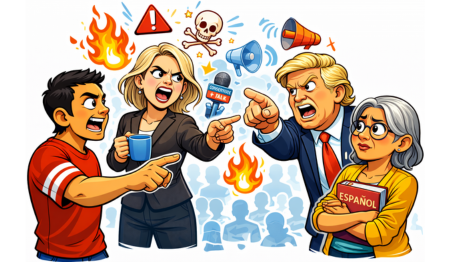
Act XIV — The Possession Reflex
Other conservative pundits followed the same script. The halftime show was called divisive. Alienating. A signal of decline. What is fascinating is how quickly the grammar shifted.
It wasn’t “I didn’t like it.”
It was “This isn’t for us.”
And eventually, “This shouldn’t happen.”
A performance became trespassing. A microphone became a border crossing. Some corners of the internet escalated further — half-joking about enforcement, half-serious about correction — as though a song required supervision.
Satire? Yes.
But satire only works when it mirrors a real anxiety.
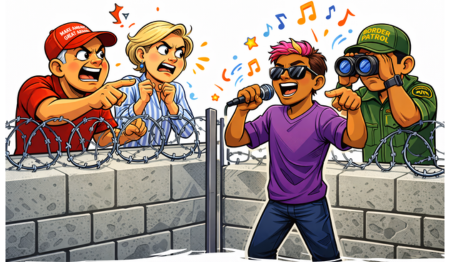
Act XV — The Absurdity of Control
Here’s the irony.
The same commentators who champion free markets were outraged when the market reflected the audience. The same voices that defend capitalism bristled when capitalism followed demographics.
The league didn’t wake up one morning and decide to experiment with bilingual rebellion. It followed growth. It followed audience. It followed revenue.
And revenue, inconveniently, speaks Spanish too. The outrage was loud, theatrical, and predictably viral.
The broadcast continued. Which suggests the panic was never about comprehension. It was about hierarchy.
When a language long treated as background noise steps into the center of the frame, it doesn’t ask permission. It doesn’t apologize. It doesn’t translate itself for comfort.
It simply exists — at scale. And that is far more destabilizing than any lyric.

Act XVI — This Didn’t Start in 2026
The anxiety feels contemporary. It isn’t.
Spanish did not appear on that stage out of nowhere. It did not cross a border last week. It was the other way around: the border crossed it. It did not slip into the broadcast through a production glitch.
It was here long before the league. Long before the anthem. Long before the United States hardened into a name.
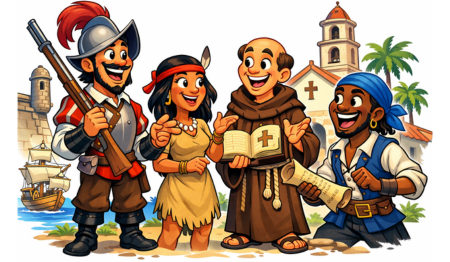
San Agustín, Florida — 1565.
Forty-two years before Jamestown.
The oldest continuously inhabited European-established city in what is now the United States did not begin in English. That detail rarely makes the halftime recap.
For centuries, Spanish functioned as a language of administration, religion, and trade across vast regions of the continent.
And when the colonies sought independence from Britain, Spain did not stand at a distance. It supplied arms, funding, naval support, and military campaigns along the Gulf Coast — contributions that materially weakened British control. The Revolution, too, unfolded in more than one language.
The idea that Spanish is newly arriving depends on selective memory. It requires forgetting that English was not the first European language spoken on this soil.
And forgetting is easier than revising the myth.
Act XVII — The Border Moved
When the United States expanded west and south in the nineteenth century, it did not enter silence.
It absorbed territories where Spanish was already domestic — spoken in homes, recorded in deeds, argued in courts.
The Southwest did not suddenly become bilingual in the twenty-first century. It changed sovereignty. The language predated the transfer of power.
The border moved. The language didn’t. That distinction matters.
Because “invasion” implies arrival. Continuity implies something else entirely.
So when Spanish surfaces at the symbolic center of American spectacle, it is not demographic improvisation. It is historical persistence. What feels like expansion is often resurfacing.
What sounds new is sometimes simply audible. And when volume increases, memory is mistaken for intrusion.
Act XVIII — When Spanish Was Law
History is not only written in maps. It is written in statutes.
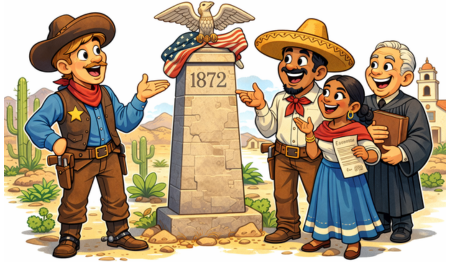
In 1848, the Treaty of Guadalupe Hidalgo ended the war between Mexico and the United States. The United States did not merely gain land. It gained people — citizens who were already there, already speaking Spanish, already operating within legal systems that recognized that language.
The treaty guaranteed civil and property rights to those inhabitants. It did not describe them as foreigners. It did not describe their language as temporary. It incorporated them.
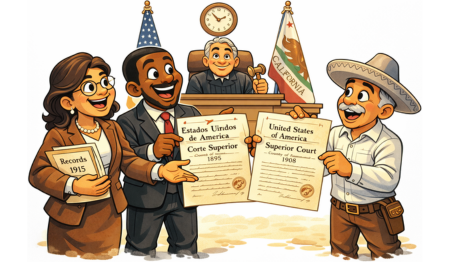
When California drafted its first constitution in 1849, it required that laws be published in both English and Spanish. Not as a multicultural gesture.
As governance.

Act XIX — Bilingualism Wasn’t an Act of Inclusion
It was administrative reality.
Court proceedings, public documents, political life — Spanish was not a background murmur. It was text. Ink. Record.
Decades later, that requirement was removed. English consolidated its institutional dominance. In 1986, California formally declared English its official language.
But declarations do not erase precedent. The historical record remains stubborn. Spanish was not tolerated.
It was recognized. And recognition is harder to dismiss than presence. When a language once held legal standing, its continued audibility is not novelty.
It is echo.
Act XX — Arithmetic
History explains presence. Law explains recognition. Numbers explain inevitability.
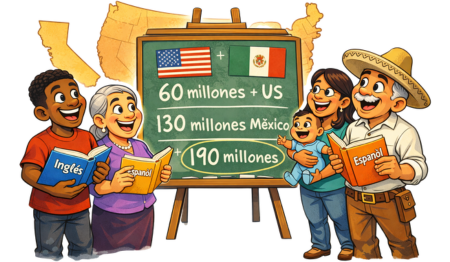
The United States is home to more than 40 million native Spanish speakers. Include second-language speakers and those with varying degrees of fluency, and the number surpasses 60 million.
Only Mexico has more Spanish speakers. This is not a fringe demographic. It is not a cultural accessory. It is not a seasonal marketing segment.
It is structural.
In states like California, Texas, Arizona, and New Mexico, Spanish is not expanding into silence. It exists alongside English at scale — in homes, churches, courts, classrooms, and markets.
A nation of that size does not host a Spanish-language moment at its most symbolic event by accident.
It reflects itself. The question is no longer, “Why is Spanish appearing at the Super Bowl?”
The question is:
How could it not? When tens of millions share a language, that language does not remain peripheral forever. It becomes audible.
And audibility is often mistaken for invasion. But arithmetic is not ideology. It is simply reality at volume.
Act XXI — As American As Apple Pie
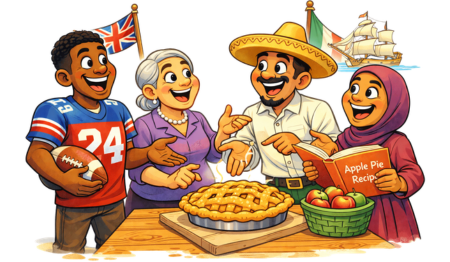
During the backlash, a familiar phrase resurfaced. On air with Piers Morgan, Megyn Kelly argued that the Super Bowl should reflect something closer to “good old-fashioned American apple pie.”
The phrase is meant to settle the matter. Apple pie signals purity. Tradition. Home. The unquestioned center.
But apple pie did not originate in the United States. Apples came from elsewhere. The earliest recipes trace back to Europe. The dish crossed oceans, evolved, and was absorbed into a new national mythology.
Which makes it, in a way, perfectly American. Layered. Imported. Adapted. Claimed. That is how American culture works.
English itself arrived from abroad. Football evolved from British rugby. The country’s name was borrowed from a continent it does not fully contain.
Purity, in the American context, is rarely origin. It is adoption. So when Spanish is treated as an intrusion into something supposedly native, the metaphor quietly unravels.
If apple pie qualifies as American after crossing borders and centuries, why wouldn’t a language that predates Jamestown?
The halftime show did not undermine Americanness. It illustrated it. Not a single culture preserved in glass. But a culture assembled in motion.
The empire is not on fire. It is what it has always been. Absorptive. Expansive. Multilingual.
And perhaps the discomfort is not that Spanish was heard. It is that the myth of singular origin is harder to maintain when the microphone is loud.
Act XXII — América Was Never a Country
There is another word that slipped quietly through the backlash. América. Not the United States of America.
America. The term predates the nation. It named a continent before it named a state. A hemisphere before a government. A geography before a flag.
From Patagonia to Montreal, América has always been plural.
When the United States adopted the name, it narrowed it. Claimed it. Turned a continental identity into a national shorthand.
Efficient. Powerful. But incomplete.
At the end of the performance, when “God Bless America” was invoked alongside the names of countries across the hemisphere, it wasn’t a rejection of the United States.
It was a reminder. That America was never singular. That the word itself contains multitudes — languages, histories, sovereignties.
And that Spanish is not echoing from outside the frame. It is speaking from within the hemisphere the name originally described.
The discomfort, then, is not linguistic. It is semantic.
If “America” is continental, not exclusive, then the cultural center cannot be monolingual.
And when that realization surfaces on the largest broadcast in the country, it doesn’t diminish the nation.
It reframes it.

Act XXIII — Fluency Is Not Surrender
Empires once demanded others learn their language. Sustainable nations learn the languages within their borders. Spanish in the United States is not a foreign code. It is a domestic one.
It is spoken by neighbors.
By voters.
By consumers.
By soldiers.
By artists topping charts.
Learning Spanish in 2026 is not ideological. It is practical. Not assimilation. Literacy. Not concession. Competence.
If the Super Bowl reflects the country, and the country is bilingual in practice if not in statute, then fluency is not activism. It is preparation.
Act XXIV — Bad Bunny for Dummies
A Survival Guide for Stadium-Level Spanish
Disclaimer:
Spanish speakers don’t fully understand Bad Bunny either.
Puerto Rican slang is fast. Trap swallows syllables. Metaphors appear, disappear, and reappear wearing sunglasses.
We understand the vibe. We understand most of the words. Sometimes we also Google the rest.
This is not a grammar lesson. It’s cultural orientation.
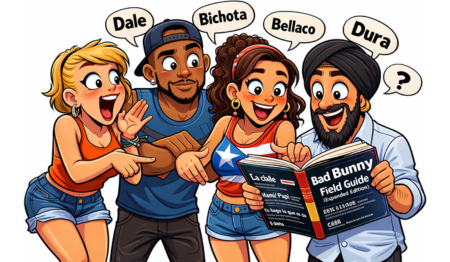
🧠 Bad Bunny Field Guide (Expanded Edition)
| Word / Phrase | Literal Meaning | What It Actually Means |
|---|---|---|
| Perreo | “Dog-like” | Reggaetón dance style. Low stance. High confidence. |
| Boricua | Puerto Rican | Cultural identity. Pride. History. Not generic “Latino.” |
| Bellaco / Bellaca | Lustful | Flirtatious, suggestive energy. |
| Duro / Dura | Hard | Impressive. Attractive. Elite. |
| Nena / Baby | Baby | Term of endearment. Not a toddler. |
| La calle | The street | The culture that shaped you. Authenticity. |
| Corazón | Heart | Emotional core. Passion. Sometimes regret. |
| Mami / Papi | Mom / Dad | Flirty nickname. Calm down. |
| Yo hago lo que me da la gana | I do what I want | Personal manifesto. |
| Flow | Flow | Style. Presence. Aura. |
| Bichota | Female boss | Powerful, self-made woman. |
| Titi | Auntie | Family figure. Cultural archetype. |
| Wepa | — | Celebration shout. Joy burst. |
| Wapa / Guapo | Pretty / Handsome | Attractive. Also confident. |
| Rumba | Party | Celebration mode activated. |
| Janguear | To hang (Spanglish verb) | To hang out. |
| Cabrón / Cabróna | Literally “goat” (insult) | Depends on tone: jerk… or legend. Context matters. |
| Fuego / Brutal / | Strong / Brutal | Amazing. Intense. Top tier. |
| La vuelta | The turn | The situation. The move. The hustle. |
| Pariseo | Partying | Nightlife lifestyle. |
| Mala mía | My bad | Casual apology. |
| Dale | Give it | Let’s go. Okay. Say no more. |
| Bregar | To deal with | To handle something. |
| La movie | The movie | The lifestyle. The vibe. The fantasy. |
| Tiraera | Throwing | Diss track energy. Public lyrical attack. |
| Real hasta la muerte | Real until death | Loyalty above all. |
| Coro | Choir | Your friend group. Your crew. |
| Frontiar | To front | To show off. |
| Sandunguera | — | Woman with rhythm and swagger. |
| Qué vuelta? | What turn? | What’s going on? |
You don’t need to master verb tenses. You just need to recognize something: The vocabulary is not foreign to millions of Americans.
It’s domestic. It lives in neighborhoods, playlists, classrooms, stadiums. When 70,000 people shout “Dale” in unison, the country doesn’t fracture.
It adapts. And fluency doesn’t start with perfection. It starts with curiosity.
Act XXV —🎧 10 Essential Bad Bunny References
(For Cultural Orientation Purposes Only)
You don’t need to memorize lyrics.
But recognizing these titles helps decode the conversation.
| Song | Why It Matters |
|---|---|
| “Tití Me Preguntó” | A chaotic ode to modern dating. Also explains why “Titi” (aunt) is culturally iconic. |
| “Yo Perreo Sola” | Reclaims reggaetón space. Feminist anthem disguised as club track. |
| “Safaera” | Controlled musical chaos. Reggaetón history compressed into one track. |
| “Estamos Bien” | Released after Hurricane María. Resilience disguised as minimalism. |
| “El Apagón” | Direct political commentary on Puerto Rico’s power grid and gentrification. |
| “Un Verano Sin Ti” | Album that globalized Caribbean melancholy. |
| “Me Porto Bonito” | Irony and seduction. Title literally means “I behave nicely.” He rarely does. |
| “Dákiti” | Atmospheric, global crossover moment. |
| “La Canción” | Regret anthem. Unexpected vulnerability. |
| “Amorfoda” | Anti-love ballad. The title itself bends Spanish grammar for emphasis. |
Notice something:
This isn’t fringe culture.
This is stadium culture. Billboard culture. Streaming-dominating culture.
If you know these songs, you already understand part of the shift.
If you don’t — the shift is happening anyway.

Act XXVI — In 2026, Fluency Is the Advantage
Yes, 26 is your lucky number and lucky year.
this year represents anything, it is not controversy but clarity. The United States is not becoming bilingual; it already operates that way in practice. In neighborhoods, in markets, in politics, in music, in media — Spanish is not emerging. It is functioning.
Learning Spanish in this context is not ideological, and it is certainly not cultural surrender. It is strategic literacy in a hemisphere that was called América long before it became shorthand for a single nation. Economic power, demographic momentum, and cultural influence increasingly move in two languages. Fluency is not activism. It is participation.
At KDF, we approach Spanish from that premise. Not as a trend. Not as a political statement. But as access — to conversation, to opportunity, to nuance. That’s why we offer free Spanish lessons, and why our blog explores the intersections of politics, linguistics, cultural shifts, language blunders, and yes, even the vocabulary behind the songs that now fill American stadiums.
Because language is not just grammar. It is leverage. It is memory. It is reach.
Empires once asked the world to learn their words. The future may belong to those willing to learn their neighbors’.
Fluency begins with curiosity. And Don’t Stop to….