

- This event has passed.
How We Learned to Measure Time
Online Spanish Socials$35.00
Conversational Spanish
Tuesday, 09-15-2026 (PT)
07:00 pm to 08:30 pm (PT)
Level: Int. – Adv.
How We Learned to Measure Time
How Did Humans Learn To Measure Something We Can’t See?
We all measure time—but have you ever wondered how we learned to measure time?
Before clocks, watches, phones, and smartwatches, humans had to find ways to recognize and measure the passage of time using the world around them.
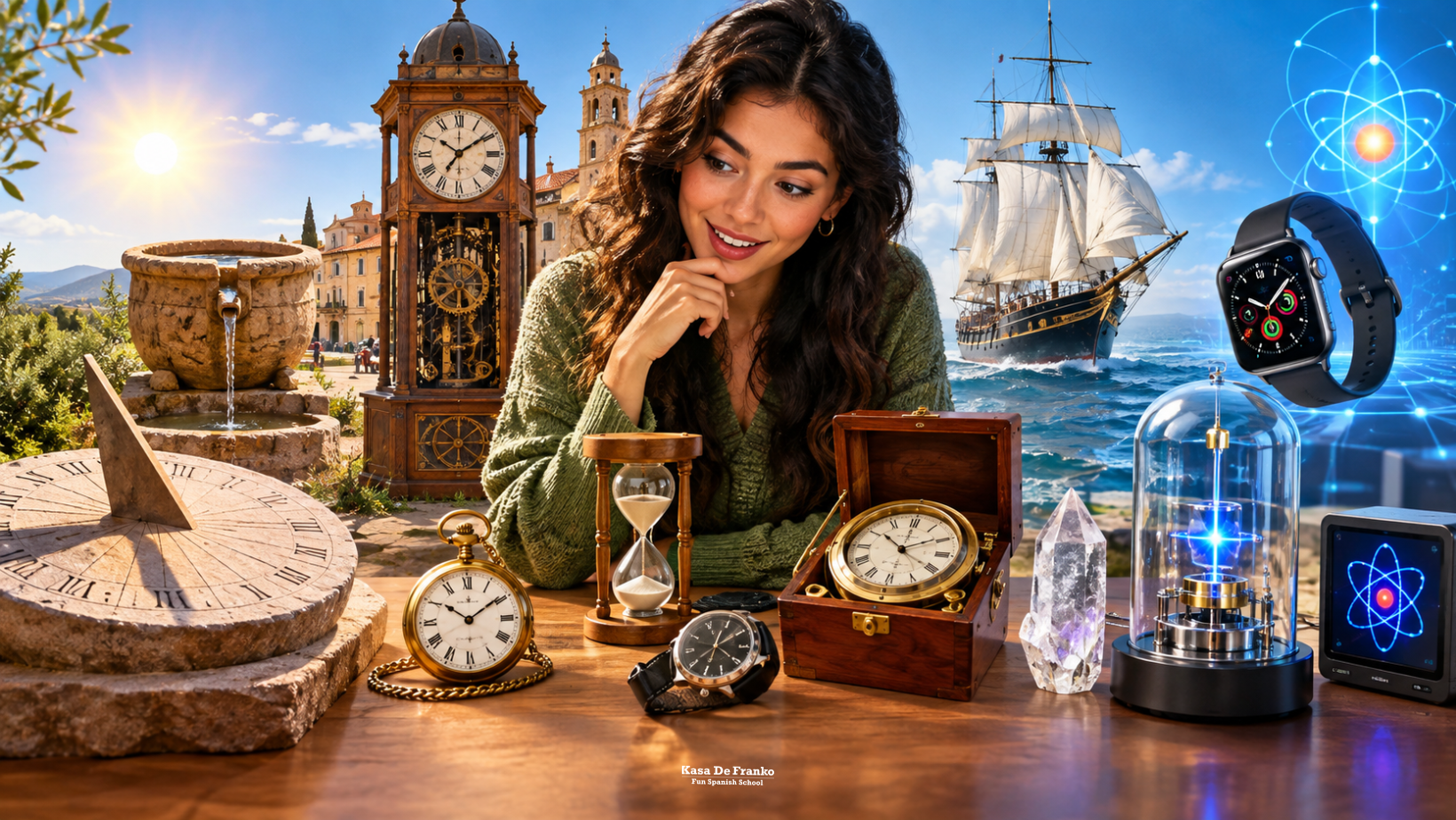
The story takes us from shadows and sunlight to gears, pendulums, quartz crystals, and eventually atoms.
☀️ From Shadows to Clocks
The earliest timekeeping devices worked with things people could observe directly.
A sundial used the movement of the Sun and the changing position of a shadow. Water clocks offered another way to measure passing time, even when the Sun wasn’t visible.
But these methods had limitations.
What happened when you needed something more reliable? Something that could keep working without depending on sunlight, weather, or a steady supply of water?
That’s where mechanical clocks changed the game.
⚙️ When Time Became Mechanical
Medieval mechanical clocks introduced a new idea: instead of simply observing nature, humans could build a machine that produced a regular rhythm.
Gears and mechanical movements made it possible to create increasingly reliable clocks. Public clocks then gave entire communities a shared way to organize their day.
And as clocks became more accurate, the stakes became higher.
Navigation, astronomy, science, and transportation all needed better ways to measure time.
🚢 The Race for Accuracy
Imagine crossing the ocean with no GPS, no smartphone, and no digital clock.
For sailors, accurate time could help determine longitude—but only if the clock remained accurate during a long voyage.
The development of the marine chronometer helped solve this problem and made precise timekeeping an essential tool for navigation.
Later came quartz clocks, which were even more precise.
And then scientists took timekeeping to an entirely different level.
Atomic clocks use the behavior of atoms as their reference.
From watching shadows to measuring atoms, humans had come a very long way.
🤔 What Is a Clock Actually Measuring?
Here’s the interesting question:
Are clocks really measuring time?
A clock doesn’t capture time itself.
Instead, it measures something that changes in a regular, predictable way—a moving shadow, flowing water, a swinging pendulum, a vibrating quartz crystal, or the behavior of atoms.
So perhaps the history of timekeeping isn’t simply the history of clocks.
It’s the history of finding better ways to measure change.
🗣️ Practice Spanish & Discover Something New
You will practice Spanish while discussing:
✅ Ancient and modern timekeeping devices
✅ Clocks, watches, and measurement
✅ Science and technology
✅ Navigation and the marine chronometer
✅ How humans learned to measure time
📢 Join Us
Come practice Spanish, explore the fascinating history of timekeeping, and discover how humans went from watching shadows to measuring atoms.
👥 Group Size Policy
🕗 1 attendee: 07:00 p.m. – 07:45 p.m.
🕗 2 attendees: 07:00 p.m. – 08:00 p.m.
🕗 3+ attendees: 07:00 p.m. – 08:30 p.m.