

- This event has passed.
Why Does the Day Have 24 Hours?
Online Spanish Socials$35.00
Conversational Spanish
Tuesday, 08-25-2026 (PT)
07:00 pm to 08:30 pm (PT)
Level: Int. – Adv.
Why Does the Day Have 24 Hours?
A Number We Never Question
Every day, we look at the clock without thinking about it.
We wake up at 7:00, have lunch at noon, finish work at 5:00, and go to bed at night. But why is a day divided into 24 hours?
Why 24? Why not 10, 20, or 100?
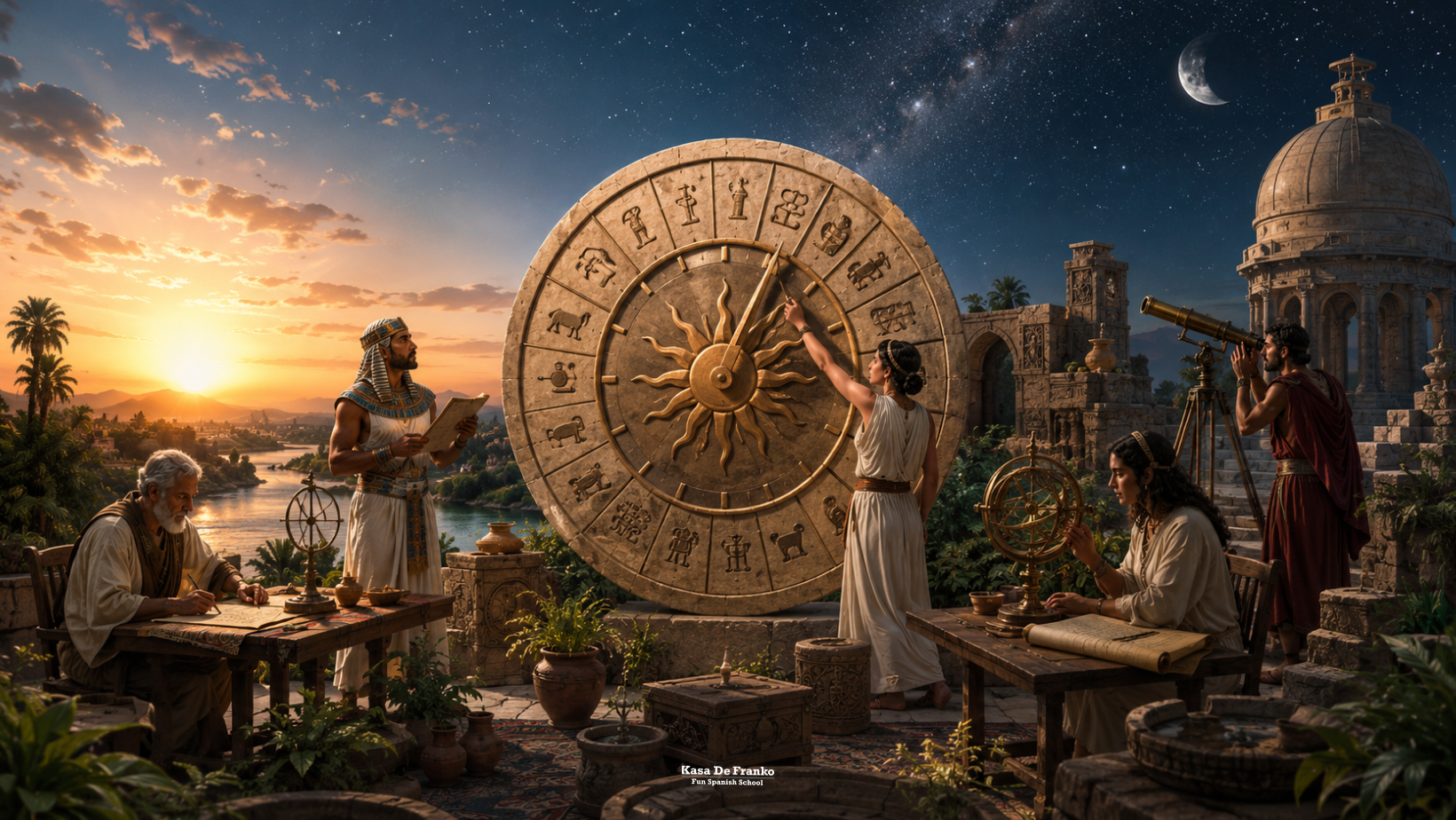
In this fascinating cultural and language session, we’ll travel back thousands of years to discover how ancient civilizations observed the sky and developed the systems we still use to measure time today.
⏰ What Will We Discover?
✅ How ancient civilizations measured the passage of time.
✅ Why the number 24 became important.
✅ How the ancient Egyptians divided the day and night.
✅ The role of the Sun in measuring time.
✅ Why an hour has 60 minutes.
✅ Why a minute has 60 seconds.
✅ How ancient mathematics influenced modern clocks.
✅ Spanish vocabulary related to time and daily routines.
🌞 From Sunrise to Sunset
Before clocks existed, people had to observe the world around them to understand the passage of time.
The Sun provided one of the most obvious ways to measure a day. But dividing that day into smaller, consistent periods required observation, mathematics, and ingenuity.
Ancient civilizations developed different ways of organizing daylight and darkness—and some of their ideas eventually became part of the system we use today.
🏺 A Journey Through Ancient Time
Our modern clock may seem completely disconnected from the ancient world.
But many of its basic ideas have surprisingly old origins.
We’ll explore how ancient Egyptians, Babylonians, and other civilizations thought about time and how their mathematical systems influenced the way we divide hours, minutes, and seconds.
💭 What Would Time Look Like Without 24 Hours?
Imagine if a day had only 10 hours.
Or if an hour had 100 minutes.
How would you organize your schedule?
Would our concepts of morning, afternoon, and evening be different?
During the meetup, we’ll use these questions to discuss how much of our understanding of time comes from nature—and how much comes from human decisions.
🗣️ Learn, Discuss & Question
This is more than a history lesson.
You will:
🗣️ Practice speaking Spanish.
❓ Discuss interesting questions about time.
☀️ Explore how humans observed the Sun and sky.
🧠 Learn vocabulary related to clocks, schedules, and daily routines.
💡 Share your thoughts about how we organize our lives around time.
⌚ Look at Your Clock Differently
Every hour, minute, and second seems ordinary.
But behind those numbers is a story that began thousands of years ago.
Discover why 24 became the number that structures our days and how ancient ideas continue to shape something as familiar as the clock on your wall.
📢 Come Explore the Story of Time
Come practice Spanish, exchange ideas, and discover the fascinating history behind the 24 hours we use every day.
👥 Group Size Policy
🕗 1 attendee: 07:00 p.m. – 07:45 p.m.
🕗 2 attendees: 07:00 p.m. – 08:00 p.m.
🕗 3+ attendees: 07:00 p.m. – 08:30 p.m.