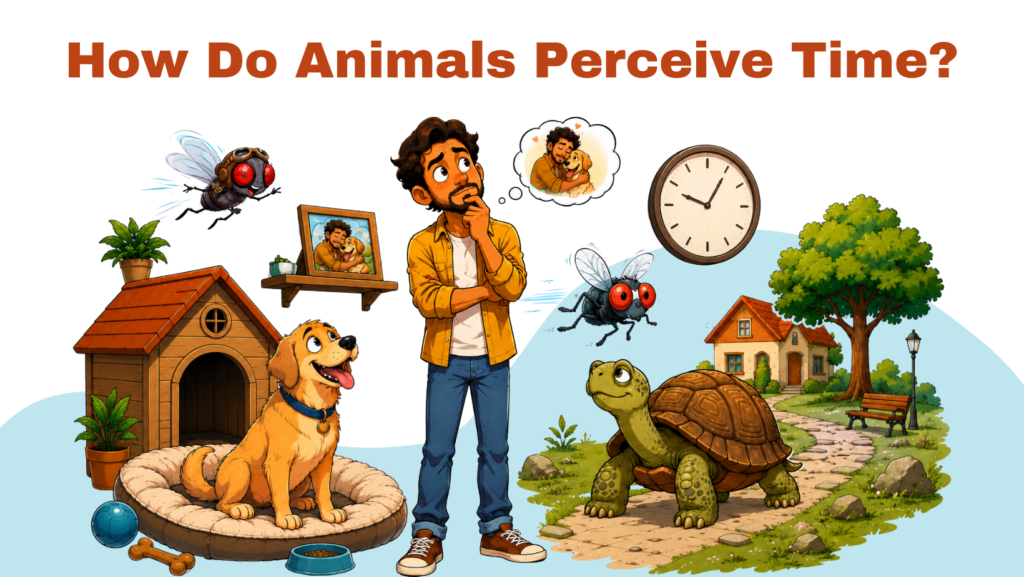
The Assumption We Rarely Question
We tend to talk about time as if it were universal—like that was never really in question.
As if every living being is quietly running on the same internal system. Same experience. Same flow. Same “now.”
Almost like time is just there in the background—stable, obvious, unquestioned. Something that doesn’t need explaining because everyone supposedly gets the same version of it.
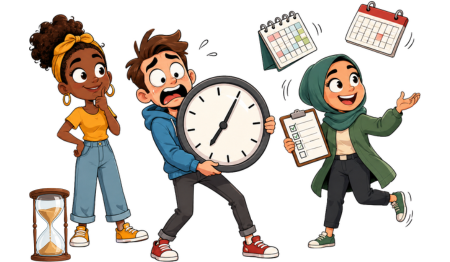
We organize our lives in hours, days, calendars.
We measure, plan, optimize.
And without noticing, we start treating time like something fragile—something that would fall apart if we stopped managing it properly.
As if it needs us to keep it in order—just in case time forgets how time works
Where Does This Actually Come From?
And yet, there’s a question hiding underneath all of this that we rarely touch:
Where is this experience actually coming from?
Because “what is time?” sounds simple enough.
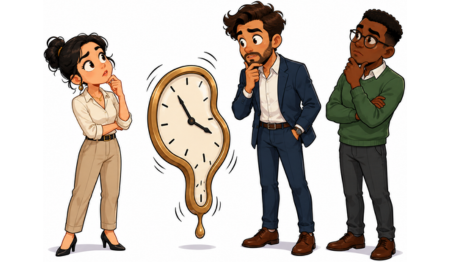
Until you try to step outside your own way of experiencing it.
Then it stops behaving like a stable question.
It starts to wobble.
When “Now” Stops Being Universal
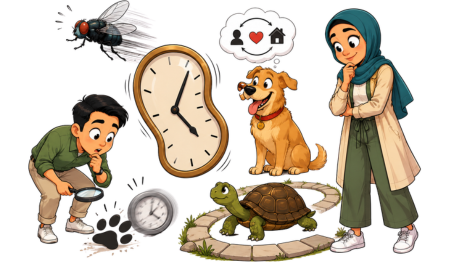
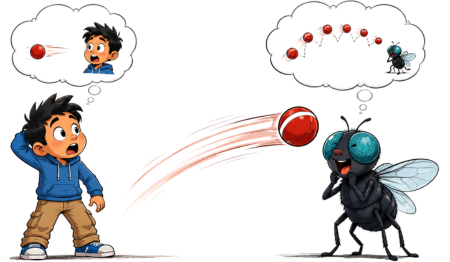
A fly reacts so quickly that our movements look slow.
A dog doesn’t measure hours—it tracks presence, absence, repetition.
A turtle moves through life at a pace that makes human urgency feel less like a necessity and more like a habit we confused with reality.
And something subtle breaks here.
Not because animals are “experiencing time differently” in a poetic sense.
But because we quietly assumed there was only one version of it in the first place.
Sharing an Uneven Timeline?
One shared timeline. One universal “now.” One continuous flow that everyone is supposedly living inside in the same way.
Which starts to sound less like a fact… and more like an assumption we never checked.
And then the question shifts.
Not:
“What time is it?”
But something harder to ignore:
👉 Who is actually living this moment… and what does it feel like from the inside?

We Don’t Perceive Time — We Organize Change
A large part of human life is built around time. But cognitively, something else is happening.
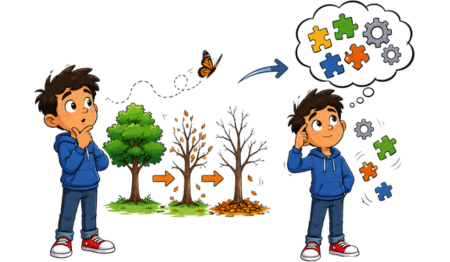
We don’t perceive time directly.
What we perceive are changes: movement, transitions, differences between states. The brain takes those changes and organizes them into sequences.
From that organization, the feeling we call time begins to take shape… almost as if it were assembled rather than found.
This Distinction Matters
Because if different organisms process change differently, then what they experience as “time” will also differ.
Time, in that sense, is not simply something that passes.
It starts to look less like something that simply passes… and more like something constructed from how change is processed.
Different Nervous Systems, Different Temporal Worlds
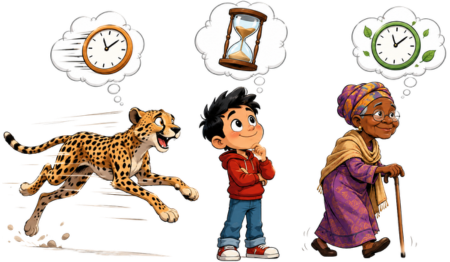
Not all organisms process information at the same rate.
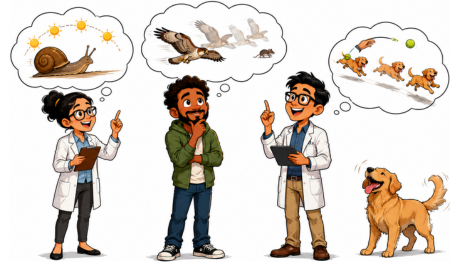
Insects, for example, can detect visual changes at a much higher frequency than humans. What looks like a quick movement to us may appear slow and extended to them. Their perceptual system samples reality at a finer temporal resolution.
Some researchers describe this as experiencing more “events” within the same physical interval.
The World Is Not Faster for Them
It is denser. At the other end of the spectrum, animals with slower metabolisms and different neural processing rates interact with their environment in a more gradual way. Their responses are not delayed — they are calibrated differently.
What begins to appear instead is that time may not be a uniform flow experienced equally by all organisms.
It seems to be filtered through the structure of each nervous system—shaped as much by the observer as by anything being observed.
Measurement Is Not Experience
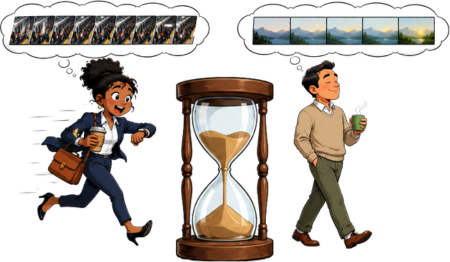
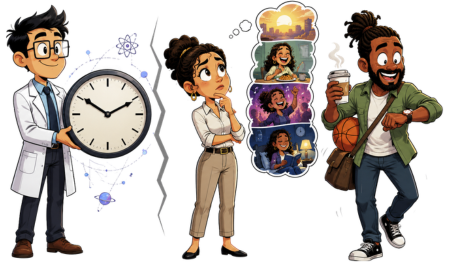
Humans have developed precise systems to measure time: clocks, calendars, atomic standards.
These tools allow coordination, prediction, and large-scale organization.
They make complex societies possible—while quietly shaping how we believe time itself behaves.
But they also introduce a subtle confusion. Measuring time is not the same as experiencing it.

A Clock Divides Intervals
It does not feel duration.
Humans do not perceive seconds or minutes as objective units. We perceive sequences of change, and only afterward interpret them through learned frameworks.
This creates a gap between physical time — as described by physics — and lived time — as structured by perception.
And somewhere along the way, we started treating them as if they were the same—without noticing where one ends and the other begins
The Brain as a Temporal System
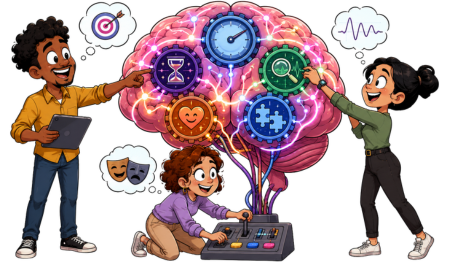
The brain does not contain a single, centralized clock.
Instead, it relies on multiple interacting systems that estimate duration, detect rhythms, anticipate events, and coordinate behavior.
These systems shift depending on attention, memory, emotional state, and cognitive load—never entirely fixed, even within the same mind.
What If Attention Gets Fragmented
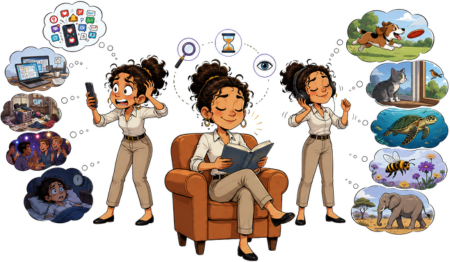
When attention fragments, time begins to feel unstable. When attention narrows, it can seem to compress—or in some cases, disappear altogether
Emotional states also distort temporal perception. Anxiety can stretch moments; absorption can collapse them.
These variations already occur within a single individual.
Across species—with entirely different neural architectures—the differences stop looking situational… and start to feel structural, as if each organism is not just experiencing time differently, but quietly constructing its own version of it.
Animals and Temporal Awareness
Animals do not use hours or minutes, but that does not place them outside of time.
They anticipate. They adjust. They move within patterns that return—feeding, migration, cycles that repeat without needing to be named.
Something is being tracked.
But it never becomes an idea.
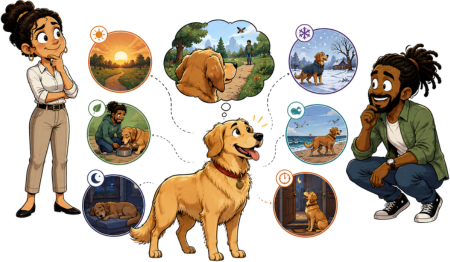
A dog does not think in durations or schedules. There is no internal timeline sitting behind its behavior. No abstract structure organizing experience into units.
What exists instead is a direct sensitivity to pattern—what returns, what changes, what disappears.
And none of it needs to become “time.”
Beyond Measurement
This is where the difference sharpens.
The relationship is not symbolic. It does not measure, label, or step outside the moment to organize it. The structure we rely on simply isn’t there.
And what looks, at first, like a simpler experience may not be simpler at all.
It may be less mediated—closer to change before it is divided, named, and stabilized into something we recognize.
Which raises a more difficult possibility:
What we experience as time may not be a more advanced form of perception.
It may be a layer added on top of it—convincing enough that we forget anything came before.
Time as a Function of Change
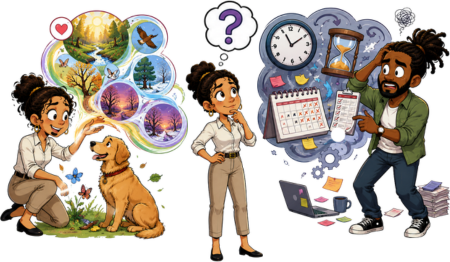
Remove change, and the question starts to collapse.
No movement. No variation. No transition.
Nothing to measure. Nothing to order. Nothing to separate into “before” and “after.”
From a perceptual standpoint, time disappears with it.
Which suggests something simple, but easy to overlook:
Time may not exist independently of change.
It may be what happens when change is organized.
Where the Differences Come From
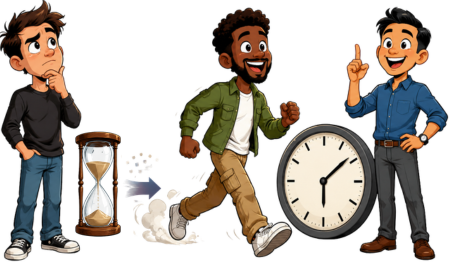
The differences across species don’t come from time itself.
They come from how change is processed.
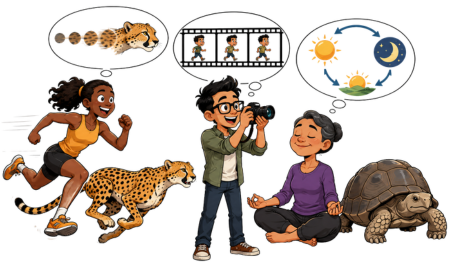
Processing speed shapes how much can be detected within a given interval. Faster systems register more detail. Slower ones move through broader transitions.
Biological rhythms extend this across longer scales—cycles of activity and rest, patterns that repeat without being measured.
Memory holds sequences together, giving continuity where there would otherwise be fragments.
Attention determines how much is taken in at once, shaping how dense or sparse experience feels.
Not Different Time — Different Structure
These differences do not create separate “versions” of time.
They shape the structure of experience itself.
And from that structure, something we call time begins to appear.
Not as a fixed flow.
But as something that emerges—quietly—from how change is processed.
The Confusion Between Physics and Perception
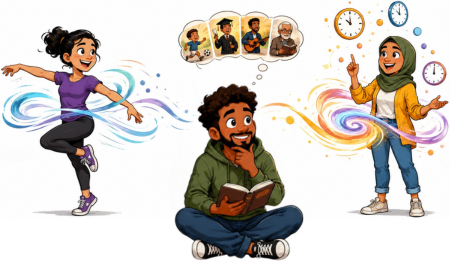
Physics treats time as part of the structure of the universe—a dimension that can be measured, modeled, and predicted.
But that description operates at a different level than lived experience.
The issue is not that one is correct and the other is not. It’s that we tend to collapse them into a single idea.
We assume the time we measure is the same as the time we experience.
But they do not belong to the same system. One exists within models of the universe.
The other emerges from how organisms process change. And somewhere along the way, the distinction blurred—quietly enough that we stopped noticing it was ever there.
The Human Bias
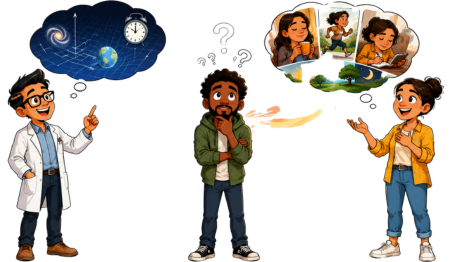
Humans tend to assume that their perception reflects reality accurately.
Or at least, that it comes closest.
But comparison with other species suggests something else.
Our perception of time is not universal.
It is adapted.
It works well enough for coordination, planning, and communication.
But it is not a neutral window into reality.
It is one version among many.
The Layer We Inherited: Social Time
Beyond biology, there is another layer shaping our experience: social time.
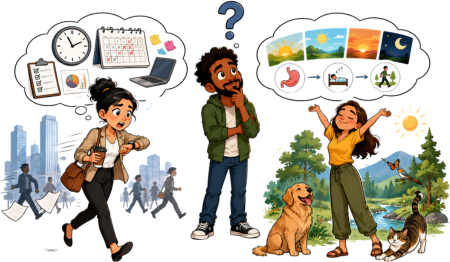
Human societies impose synchronized structures: work hours, deadlines, schedules, calendars.
Over time, these external rhythms can begin to override internal signals. We eat without hunger, rest without fatigue, act without readiness.
Many animal behaviors, by contrast, remain more tightly coupled to internal rhythms and environmental conditions, without this level of abstract synchronization.
This introduces another layer into the model:
👉 how much of what you experience as time is biological coordination… and how much is social construction?
Memory, Anticipation, and the Expansion of Time
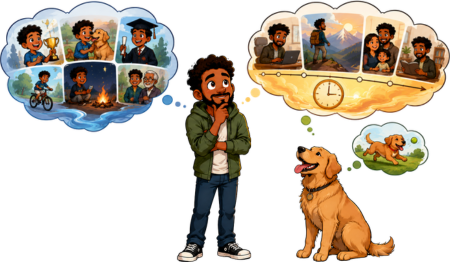
Humans extend beyond the present through memory and projection.
We revisit past events, reinterpret them, and construct narratives. We simulate future scenarios, anticipate outcomes, and prepare for possibilities.
This ability allows planning, but it also fragments experience.
We are often not where we are.
Part of us is in the past.
Part of us is in the future.
Many animals, by contrast, appear more anchored to immediate contexts. They remember and learn, but they do not seem to construct extended temporal narratives in the same way.
Human cognition does not simply experience time. It expands, compresses, and reorders change into a layered structure that we later mistake for time itself.
Language as a Temporal Tool
Humans do not only perceive time. They encode it in language.
We divide it into past, present, and future. We assign value to it. We treat it as something that can be used, saved, wasted, or lost.
These linguistic structures influence how we experience time.
They introduce evaluation, pressure, and abstraction.
Animals do not appear to operate within these symbolic frameworks.
They do not optimize time. They do not judge it.
They engage with it.
Language does not merely describe time.
It reshapes it.
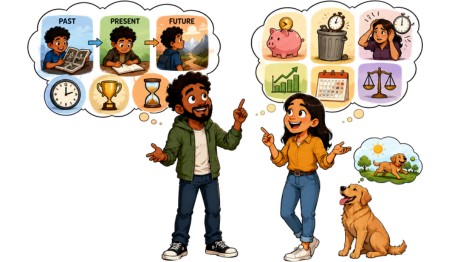
A Biological Anchor: Internal Timing Mechanisms
From a scientific perspective, temporal perception is grounded in biology.
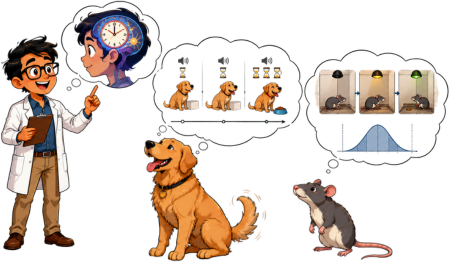
Research on interval timing suggests that both humans and non-human animals possess internal mechanisms capable of estimating duration.
These systems are not precise clocks, but probabilistic processes that allow organisms to anticipate intervals and coordinate behavior.
Experiments show that animals can learn consistent durations through reinforcement.
They do not understand time conceptually.
But they are sensitive to its structure.
Different Worlds, Different Times
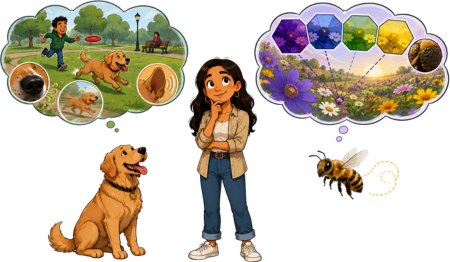
The biologist Jakob von Uexküll proposed that each organism inhabits its own perceptual world — its Umwelt.
Even when organisms share the same physical space, they do not inhabit the same experiential reality.
Each system selects, filters, and organizes information differently.
If perception differs, then the structure of experience differs.
And if the structure of experience differs, then time — as part of that structure — differs as well.
There is no single lived time.
There are multiple temporal frameworks, each tied to a specific way of perceiving.
The Shift in the Question
At this point, the original question begins to change.
It is no longer just about how animals perceive time.
It becomes a question about our own assumptions.
Not whether time exists.
But how it appears, and to whom.
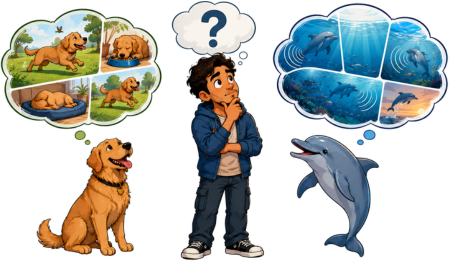
The Uncomfortable Angle
So maybe the real question isn’t:
“What is time?”
But something closer:
👉 what kind of time are you living?
And more importantly:
👉 how much of it is actually yours… and how much was given to you?