
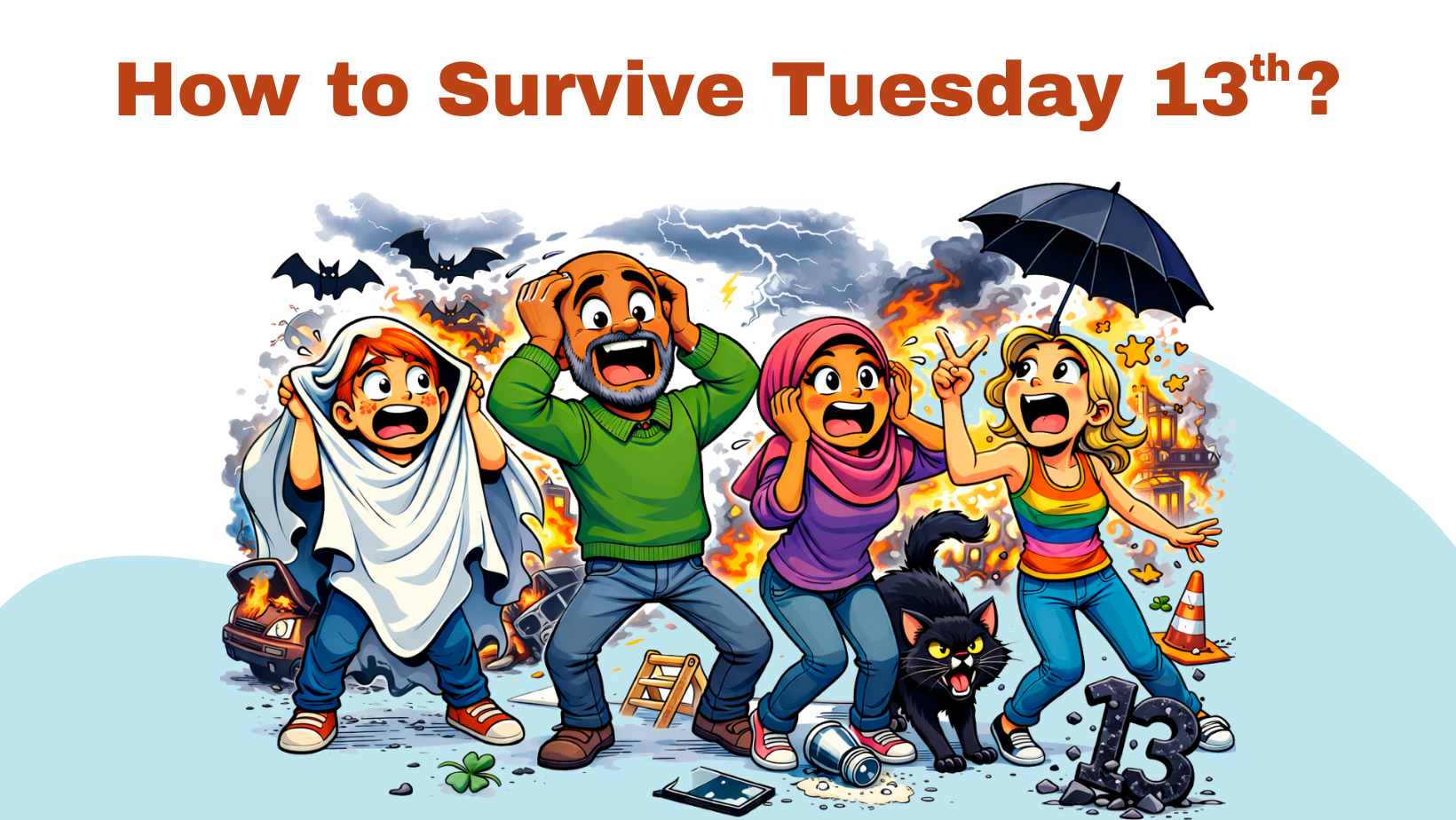
Fear Tuesday the 13th? Learn Spanish Instead!
It’s Tuesday the 13th. Your mirror’s cracked, a black cat just stared you down, and your Spanish is still rusty? Yeah — we’ve got a problem. But don’t panic. And definitely don’t fear what’s free. At Kasa de Franko, you can learn Spanish with Tuesday the 13th traditions and superstitions, turning bad luck into a fun excuse to practice.
In Spanish-speaking cultures, it’s Tuesday the 13th that gets all the side-eye — not Friday. So why not flip superstition on its head, explore cultural quirks, and turn myths into real conversation?
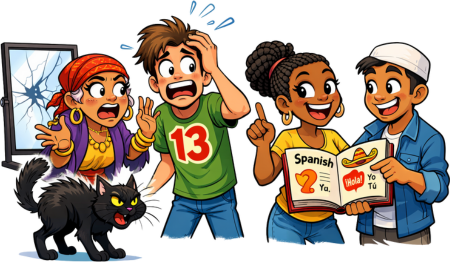
Don’t Hide Under the Covers!
Instead of hiding under the covers, why not face your fears head-on — in Spanish?
Ever wondered why Friday the 13th gets such a bad rap? That fear didn’t come out of nowhere. But here’s the twist: in Spanish-speaking cultures, the real drama doesn’t happen on Friday.
It happens on Tuesday the 13th.
Yes, you read that right. Same number. Different day. Different cultural logic.
🎁 Get a free Spanish class this Tuesday the 13th and turn superstition into conversation. Come learn with us… if you really dare 👻
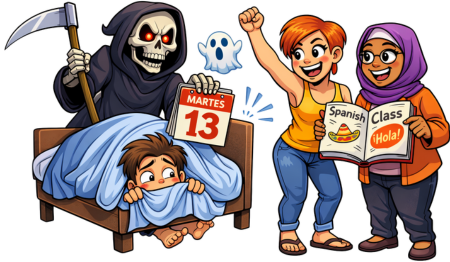
The 13th Is Perfect for Learning Spanish
Maybe a black cat crossed your path.
Maybe you forgot to knock on wood.
Or maybe… it’s centuries of myths, historical betrayals, and human imagination gone wild.
In the English-speaking world, all that fear tends to land on Friday the 13th. But in Spanish-speaking cultures, superstition points the finger elsewhere — at Tuesday the 13th.
So instead of fearing it, why not flip the script? Make it your lucky day and start learning Spanish.
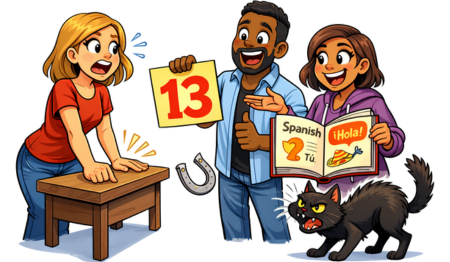
Learn Spanish Traditions & Superstitions!
Flip your luck by diving into Spanish traditions and superstitions.
In Spanish-speaking cultures, superstition doesn’t peak on Friday the 13th — it shows up on Tuesday the 13th. At Kasa De Franko, we use that cultural twist as a good excuse to learn something new.
Explore myths, traditions, and everyday beliefs while leveling up your Spanish. And yes, sounding bilingual and culturally sharp never hurts — especially when employers are paying attention.
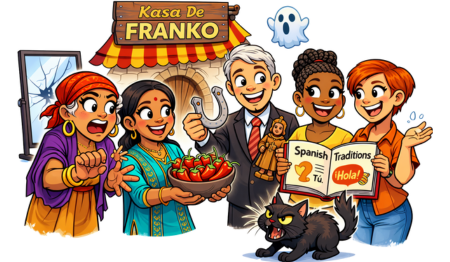
Why are Spanish-speakers so Weird?
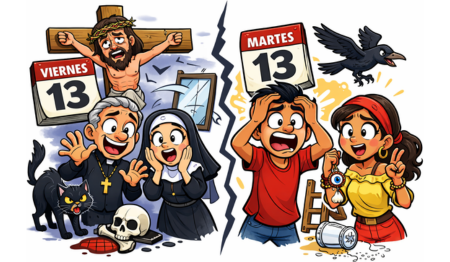
Here’s the twist: in the Spanish-speaking world, superstition doesn’t land on Friday — it lands on Tuesday the 13th. Martes 13 is the day that raises eyebrows in Spain and Latin America.
Different culture, different fears, different logic.
So let’s unpack where that comes from, look at a few quirky traditions, and turn superstition into a reason to smile — and learn. Bonus: you’ll pick up some Spanish along the way without even trying.

The World’s Most Unwanted Guest: 13!
Why is 13 considered unlucky? It’s like the party crasher of numbers, ruining perfectly good vibes. Many cultures view 12 as a symbol of completeness: 12 months, 12 zodiac signs, 12 apostles, etc. Then comes 13, breaking the harmony like a misplaced mariachi at a rock concert.
Ancient Babylon skipped the 13th law on its tablets (we’ll assume it wasn’t just a typo). Even today, buildings and hotels worldwide conveniently “skip” the 13th floor. Let’s be real, though—nobody’s fooled by the magic of labeling the 13th floor as “14.”

Triskaidekaphobia: WTF?
WTF, indeed. But in this case, it stands for Watch The Fear—because we’re talking about a real, name-brand phobia with enough syllables to scare anyone.
Triskaidekaphobia (say that five times fast) is the official term for the fear of the number 13. Sounds fancy, right?
But at its core, it’s basically the numerical equivalent of dreading your ex’s name lighting up your phone at 3 a.m.—you don’t know what’s coming, but you know it’s going to ruin your day.
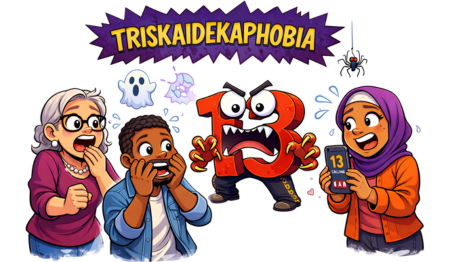
13 Across the World
From skipped hotel floors to “No seat 13” on some airlines, this superstition runs deep—especially in Western cultures.
And yet, in many Spanish-speaking countries, the number 13 is just a number… unless, of course, it falls on a Tuesday.
But don’t worry—we’ll get to that cursed little twist soon.

How Friday Got This Bad Rap!
Friday wasn’t exactly a fan favorite in Christian traditions. It’s the day of Jesus’ Crucifixion, so historically it carried a more somber vibe than celebration.
Pair that with the number 13, and English-speaking cultures had the ultimate combo for bad luck.
But in Spanish-speaking countries, the number 13 isn’t the villain… unless it lands on a Tuesday. That’s when superstition really steps in.
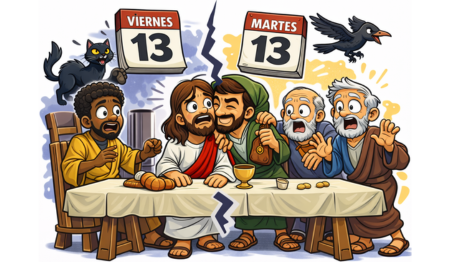
13: The Number of Betrayal
Why 13? It’s all about betrayal, thanks to Judas. That extra seat at the Last Supper? Yep—13. And that’s where Judas made his infamous move. Talk about a recipe for superstition.
In English-speaking cultures, that story fuels Friday the 13th fears. But in Spanish-speaking countries, 13 is just a number… until it lands on a Tuesday.
Friday + 13 = The Perfect Storm!
Let’s do the math! Friday has a history of bad vibes, and throw in the number 13, and English-speaking cultures treat it like a day cursed by fate.
But in Spanish-speaking countries, the real “perfect storm” hits on Tuesday the 13th—the day superstition really flexes its muscles.
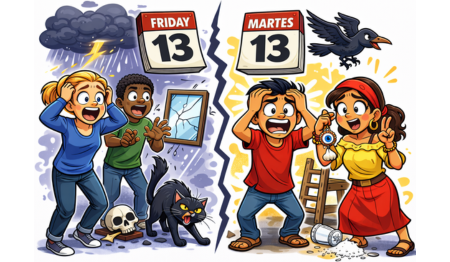
The Medieval Origins of the Curse!
The superstition around 13 has deep roots. One often-cited origin: October 13, 1307. On this fateful Friday, King Philip IV of France ordered the mass arrest of the Knights Templar, accusing them of heresy. Many were tortured, executed, or burned at the stake.
English-speaking cultures remember that as the day Friday the 13th got its creepy reputation. But in Spanish-speaking countries, the number 13 only really becomes ominous when it lands on a Tuesday—and that’s when superstition truly flexes its muscles.
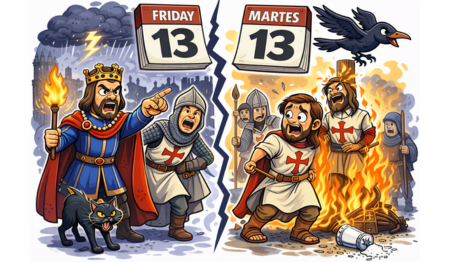
Medieval Telenovela: ¨Bills You Don’t Wanna Pay”
King Philip and Pope Clement V owed serious cash to the Templars. Killing them off? The medieval version of just “forgetting” to pay your credit card—except instead of fees, it was torture and execution. Makes a late fee seem kinda manageable, right?
And while history remembers this on a Friday, in Spanish-speaking cultures, superstition really flexes when that unlucky 13 lands on a Tuesday—so keep an eye on your calendar.
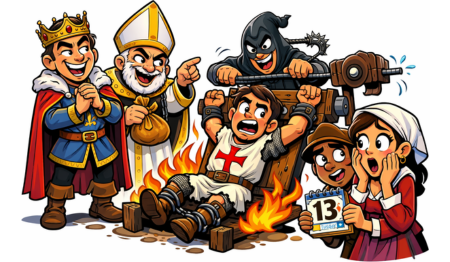
Bad Luck Forever
Legends say this betrayal—the mass arrest of the Knights Templar on Friday, October 13, 1307—cursed the date forever, branding it with a dark, unlucky energy that still lingers today. It was the medieval equivalent of:
“Never trust that shady friend who owes you money… and also wants your land, titles, and probably your horse.”

From Betrayal to Superstition Supernova
From that point on, Friday the 13th became more than just a date—it turned into a superstition supernova. One act of royal backstabbing sparked centuries of paranoia, fear, and bad omens, echoing through folklore like a ghost with unfinished business.
And so, here we are: still side-eyeing our calendars, centuries later, all because of some royal betrayal, a few power-hungry men, and a whole lot of unresolved medieval drama.

A Question of History
Now, was this whole Friday-the-13th-is-cursed-because-of-the-Templars thing actually true? Or just a spooky story that snowballed over centuries?
Historians still argue. Some say the connection between the Templars and Friday the 13th is mostly a modern invention—dreamed up by writers and pop culture to give us chills.
Others think there’s enough smoke to suggest fire… or at least a lot of roasted knights.

Cursed or Just Dramatic Storytelling?
Either way, one thing’s for sure: King Philip IV wasn’t winning “Most Popular Royal” that year. And Pope Clement V? Let’s just say he probably wouldn’t have made the guest list for any royal afterparties—or Templar reunions, for that matter.
So whether it’s historical fact or just really dramatic storytelling, the legend stuck. And the number 13’s bad rep was officially cemented… or cursed.

Karma Strikes Back!
Legend has it King Philip IV of France and Pope Clement V were cursed by Jacques de Molay.
He burned at the stake. Flames licked his robes. Smoke swirled around him.
While he roasted like pollo a la brasa (Peruvian style, of course), de Molay called upon divine justice.
He demanded it hit before the year was out.
And hit it did.
Both men met their spectacular ends within months.
Crowns tumbled. Papal robes faded. History watched in awe.
The curse? Legendary.
Bad karma served with a side of medieval drama.
And, of course, a telenovela-level plot twist.

Tuesday 13th: Latin America’s Villain
While the English-speaking world shudders at Friday the 13th, Latin America and Spain reserve their fear for martes 13 (Tuesday the 13th). Why Tuesday? Blame Mars, the Roman god of war, chaos, and destruction. That’s right — every martes 13 comes with a little extra cosmic attitude.
Across Spanish-speaking countries, people avoid traveling, signing contracts, or making big life decisions on this day. Some won’t even cut their hair or leave the house after dark.
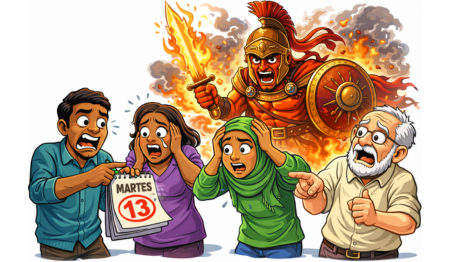
What About a Black Cat on Tuesday the 13th
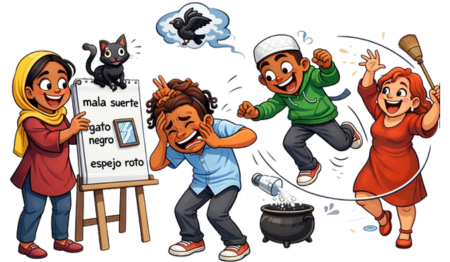
And if a black cat crosses your path on Tuesday the 13th? Forget it — you might as well stay under the covers and binge your favorite telenovela.
So next time someone says “Friday the 13th is unlucky,” you can smirk and reply, “Hold my mate… we do Tuesdays a little differently.”
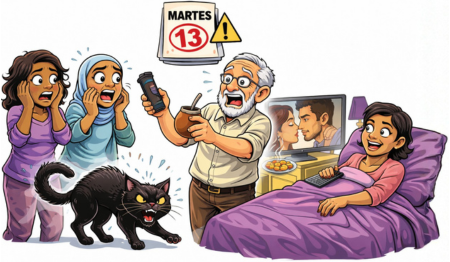
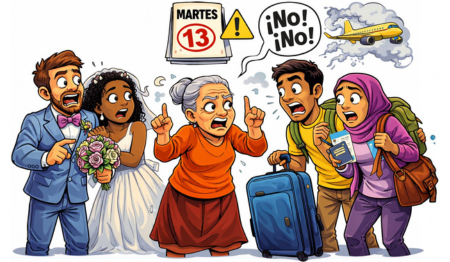
“En martes, ni te cases ni te embarques”
In many Spanish-speaking countries, Tuesday is considered a day of conflict, so adding the number 13 makes it a double whammy of bad vibes. As the saying goes:
“En martes, ni te cases ni te embarques”
(On Tuesday, don’t get married or embark on a journey).
Basically, it’s the universe saying, “Stay home, mind your own business, and maybe binge a telenovela instead.”
Superstitions in the Spanish-Speaking World
If you think Friday or Tuesday the 13th is strange, wait until you hear about some of the superstitions in Spanish-speaking countries. These traditions range from practical to outright absurd:
| Superstition | What to Do | KDF Note |
|---|---|---|
| Spilling salt | Toss a pinch over your left shoulder | Evil spirits hate flavor 😏 |
| Sweeping at night | Avoid sweeping after sunset | Leave chores for mañana 🧹 |
| Tocar madera | Knock on wood | “Espero que no llueva mañana… toco madera” |
| Amulets | Carry ojo de venado or ojo turco | Charm your way out of trouble 🐾 |
| Major decisions | No weddings, contracts, or big purchases | Mars is watching 🔴 |
| Other quirks | Don’t put purse on floor, avoid cutting nails at night | Because… reasons 🤷♂️ |
Laugh at Fear, Learn Spanish
While viernes 13 is gaining some Hollywood-fueled fame, many Latinos use it as a day to laugh at superstitions instead of fearing them. It’s a perfect day to reírse del miedo (laugh at fear) y aprender español, pendexos.
The Global Fear: It’s Not Just 13!
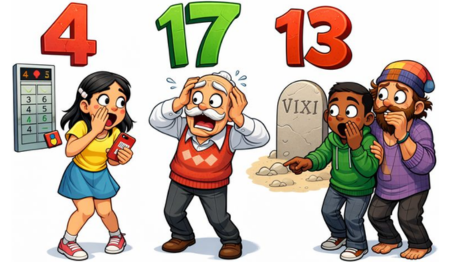
Turns out, 13 isn’t the only number causing drama. Around the world, different digits inspire dread:
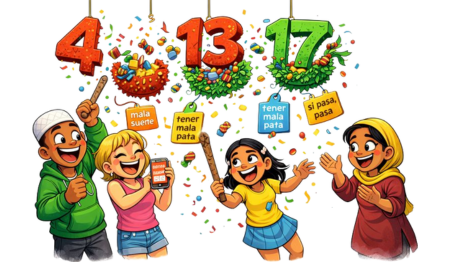
- China: The number 4 is considered unlucky because it sounds like the word for death. Buildings skip the 4th floor, elevators skip the 4th button, and some phone numbers cost extra if they don’t contain a “4.”
- Italy: It’s 17 that raises eyebrows. When written in Roman numerals (XVII), it can be rearranged to spell “VIXI,” which means “I lived” — a poetic way of saying, “I’m dead now.”
Compared to these, 13 doesn’t seem so bad, right?
Spanish Language Meets Luck
Learn Spanish with Tuesday the 13th Traditions and Superstitions: Now that we’ve sufficiently scared you with numbers, how about flipping the script? Use it as a chance to learn Spanish. Here’s how:
- Expand Your Vocabulary: Words like “mala suerte” (bad luck), “gato negro” (black cat), and “espejo roto” (broken mirror) will come in handy for spooky storytelling.
- Practice Idioms: Master Spanish expressions like “tener mala pata” (to have bad luck)
- Cultural Immersion: Understanding local superstitions gives you a sneak peek into Spanish-speaking cultures and their quirks.
- “Pájaro de mal agüero” (bad omen), “salto de la cuerda” (jump the rope – linked to childhood superstitions), “encantado” (bewitched), “agüero” (omen), “alivio” (relief, often used in superstitions), and “despedir la mala suerte” (to get rid of bad luck).
Friday or Tuesday for the Spanish-Speaking World!
In Latin America and Spain, the reactions to martes 13 and viernes 13 vary widely:
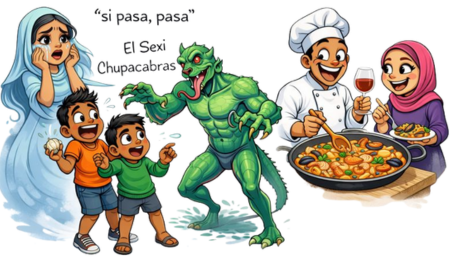
- In Mexico, you might hear about La Llorona, (The Weeping Woman), adding an extra layer of terror to an unlucky day.
- In Peru, families might casually drop sayings like “Si pasa, pasa” (If it happens, it happens) as a way to shrug off bad luck—even if El Sexi Chupacabras wants to suck your blood.
- In Spain, some people avoid making big decisions on martes 13, but others treat it as just another day. Because who has time for superstition when there’s paella to eat?
Final Thoughts: Turning Bad Luck into Good Fun
Friday, Tuesday, or even Wednesday the 13th—every culture has its quirks. The important thing is to laugh at the absurdity, learn from the traditions, and maybe even pick up some Spanish along the way.
So why not flip superstition on its head? Instead of hiding under the covers, dive into the quirks of Spanish-speaking cultures. Laugh at the absurdity, marvel at the traditions, and walk away with a few new Spanish phrases in your pocket.
Because hey—if you’re going to tempt fate, you might as well do it bilingually.
Turn Friday 13th Into Your Lucky Day!
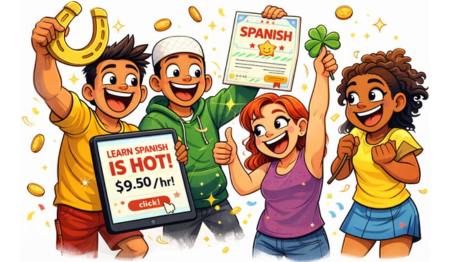
Why let Tuesday the 13th bring you down when you can turn it into a fun and productive day? Kasa de Franko’s offering Spanish lessons for just $9.50/hr.
It’s the perfect chance to start learning something new and exciting. Whether you’re looking to change your luck or just want to pick up a new skill, now’s the time to start!
For more info, check out our Learning Spanish is Hot: $9.5/hr. article and discover some fun and sexy phrases along the way in our blog section Things Spanish People Say in Bed!
Learn Spanish from Anywhere!
From the San Francisco Bay Area to anywhere in the U.S., our online classes bring expert instruction to you. Check out our locations and get started today with Spanish lessons for less than ten bucks an hour!

Stay Connected & Keep Learning!
Get the latest updates, fun facts, and exclusive offers by following Kasa de Franko on Facebook, Instagram, Twitter, TikTok, Pinterest, and YouTube. It’s never been easier to immerse yourself in Spanish—let’s keep learning!

Join the Kasa de Franko Fiesta!
At Kasa de Franko, we offer engaging, affordable, and flexible Spanish lessons for all levels—whether online or in-person. Join us today for free classes and let’s Learn Spanish with Tuesday the 13th Traditions and Superstitions!

The Funniest Part of All
Let’s face it, the fear of Tuesday the 13th is basically just a cultural hangover—or even worse, un pajazo mental (a pipe dream). People get scared for no reason, and, in reality, the universe couldn’t care less if it’s Friday or Tuesday.
But hey, since you made it this far — and just in case you got curious — here’s a spooky little list of Spanish vocab that might come in handy.
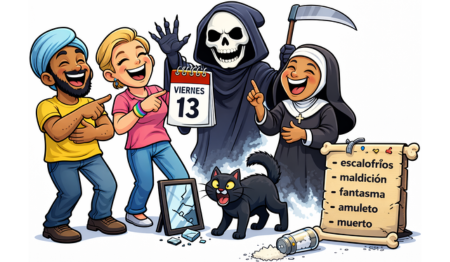
💬 Spook Up Your Spanish with This Tuesday Words
Wanna sound spooky and smart in Spanish? Whether you’re dodging black cats or whispering curses under your breath, here’s a list of Tuesday the 13th–inspired words that’ll charm any language lover. From potions to bad omens, add some dark magic to your vocab list — sin miedo.
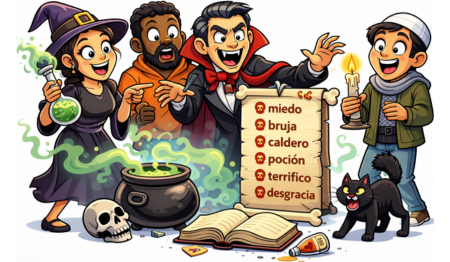
🕷️ Tuesday the 13th Spanish Vocab (Bonus Chart)
| 🧛 Spanish Term | 💀 English Meaning | 🎭 Context Example |
|---|---|---|
| presagio | omen | Un mal presagio cayó sobre la casa. |
| agüero | superstition/omen | Dicen que es un mal agüero ver un búho. |
| fatalidad | doom/fatal event | El número 13 siempre trae fatalidad. |
| conjuro | spell/incantation | Lanzaron un conjuro para alejar el miedo. |
| brujería | witchcraft | Creían en la brujería en la Edad Media. |
| encantamiento | enchantment | El bosque tenía un extraño encantamiento. |
| hechicero(a) | sorcerer/sorceress | El hechicero vivía solo en la montaña. |
| maldición | curse | Romper la maldición requería un sacrificio. |
| pócima | potion | La pócima daba valor… o alucinaciones. |
Why a Friday-13th -Free-Spanish Lesson?
Maybe that’s why we need a Tuesday the 13th Free Spanish Lesson, to help shake off the bad vibes and learn something new.
Learning a new language isn’t just productive—it’s also one of the best ways to turn your brain away from fear and toward fun. Instead of obsessing over broken mirrors and black cats, you’ll be learning how to say “superstition” in Spanish (it’s superstición, by the way) and discovering why martes 13 is the real villain in Latin America.
So if the universe is feeling a little off today, maybe it’s trying to tell you something:
Take the risk. Learn something new. In Spanish. For free.

Join us on Tuesday, the13th?
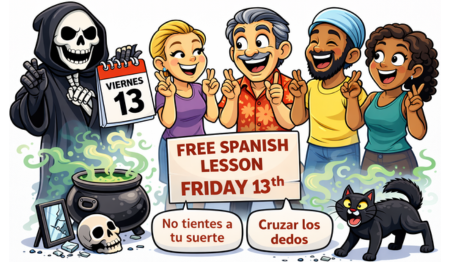
So why not join us for our FREE Spanish Lesson on Tuesday the 13th, and let’s laugh together at how ridiculous and delightful the world of superstitions can be?
We’ll explore the dark magic of learning Spanish phrases tied to bad luck, like “no tientes a tu suerte” (don’t push you luck) and “cruzar los dedos” (crossing fingers), which we can all agree is practically a universal superstition.
Ready to get started?
Are you read to Learn Spanish with Tuesday the 13th Traditions and Superstitions? Click below, and let’s turn your Spanish journey into an unforgettable adventure! And always remember…..
