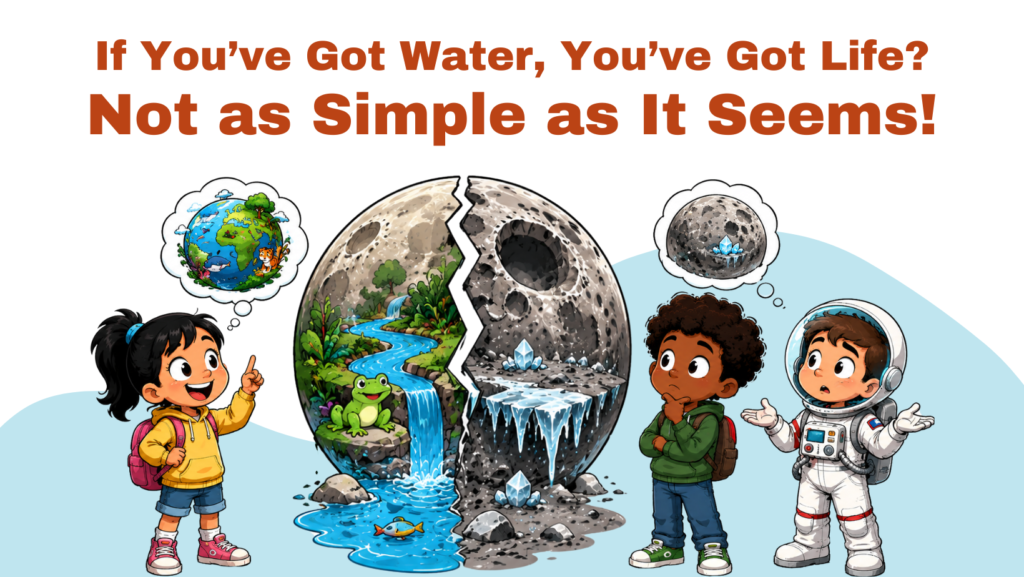
So If the Moon Got Water… Where’s the Life?
There’s water on the Moon. Not a metaphor. Not a poetic exaggeration. Actual water. So the obvious question shows up almost immediately: If there is water… where is the life?
Or more directly: does water on the Moon actually mean life?
Because that’s what we’ve been trained to expect. On Earth, water and life are practically inseparable. At some point, we’ll have to define what we even mean by agua (water) and vida (life) before we can even say for sure:
If we’ve got water, we’ve got life! Or at least—that’s the assumption.
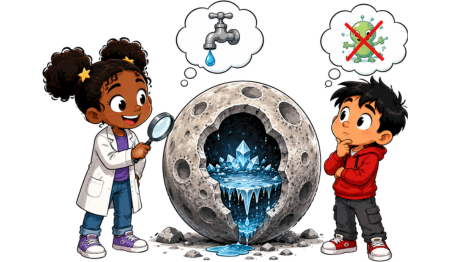
So…Does Water on the Moon Actually Mean Life?
Yeah… on Earth, it kind of does. At least from what we’ve seen. Water is deeply connected to life here. It’s one of the reasons life exists in the first place.
Maybe it’s even where life started. Or at least—that’s what we keep telling ourselves.
Wherever we find one, we usually find the other—oceans, rivers, underground reservoirs, even microscopic films of moisture clinging to rocks. Water starts to feel like a signature. Like a promise. Almost like a guarantee.
But does it mean the same somewhere else? Does water on the Moon actually mean life anywhere?
Because the Moon doesn’t care about our expectations.
And that’s where this starts to get interesting.
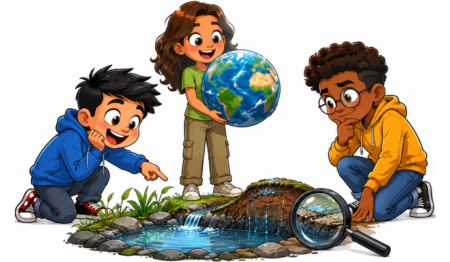
The Assumption We Carry Without Noticing
Most people don’t consciously think, “water equals life.”
But they act like it’s true.
You see it in how we talk about space. When scientists announce the discovery of water somewhere—Mars, Europa, Enceladus—the headlines practically write themselves. Could there be life? The question is immediate, automatic, almost reflexive.
And to be fair, there’s a reason for that.
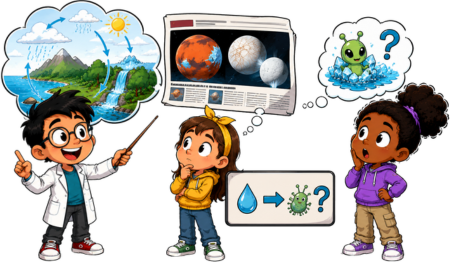
Why Do We Think That?
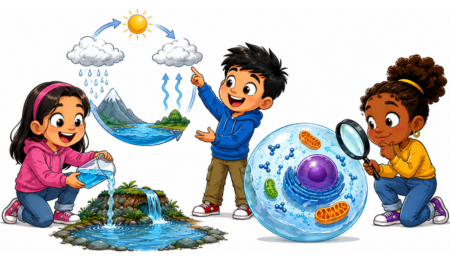
On Earth, water isn’t just present—it’s active. It moves, cycles, dissolves, carries things around. It mixes chemicals that would otherwise never meet. It creates environments where reactions can actually happen instead of just sitting there doing nothing.
Life, as far as we know, depends on that kind of activity. Even at the smallest scale, inside cells, water is doing most of the work—moving molecules, enabling reactions, keeping everything from freezing into place.
So over time, we start noticing a pattern. Wherever there’s water, something tends to happen. Not always immediately, not always visibly—but enough that the connection starts to feel reliable.
And then the brain does what it always does: it simplifies.
Water → life.
Clean. Intuitive. Easy to remember.
And just convincing enough to be dangerous.
Not All Water Is Created Equal
Before we even talk about life, we need to slow down and ask something more basic:
What do we mean by “water on the Moon”?
Because it’s very easy to imagine the wrong thing.
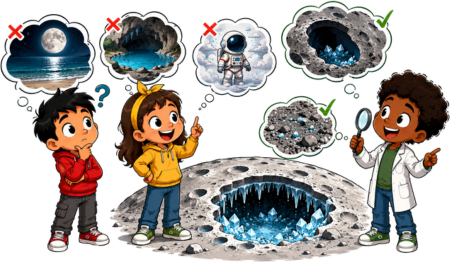
No—there are no lunar oceans quietly reflecting starlight. No hidden lakes beneath the surface. No mist, no clouds, no gentle rain tapping against a spacesuit.
So What’s Actually There?
So—does water on the Moon actually mean life? Not in the way we imagine.
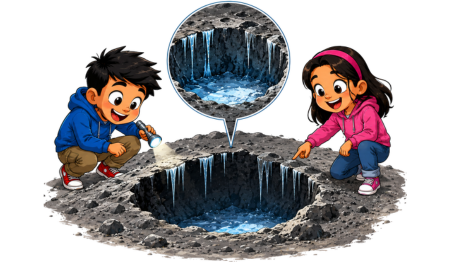
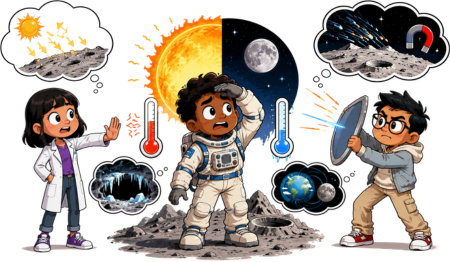
Most of the Moon’s water exists as ice, locked away in craters near the poles. These craters never see sunlight. Ever. They sit in permanent shadow, acting like natural freezers that have been running for billions of years.
Other traces of water are even less dramatic. Tiny amounts bound to minerals in the lunar soil, scattered and sparse, more like a chemical hint than a usable resource.
So yes, there is water. But it is frozen, isolated, and largely inaccessible.
Why That Changes Everything
Already, that should make us pause.
Because the kind of water that supports life on Earth isn’t just present—it’s liquid, dynamic, and part of a larger system.
On the Moon, water is mostly just… there.
And that difference matters more than it seems.
So… Is There Life on the Moon?
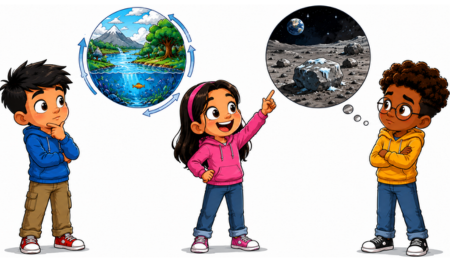
This is the part where people want a clean answer. But before that, we should ask something more precise: Does water on the Moon actually mean life?
Yes or no. Life or no life. Lie or no lie!
But the honest answer is less satisfying and more precise at the same time: We don’t know.
And before that sounds like a cop-out, let’s slow down for a second.
We have found water on the Moon.
We have not found life on the Moon.
But those two statements are not symmetrical. Because the second one hides an important detail.
What we actually mean is this: We have found no evidence of life. That’s a very different claim.
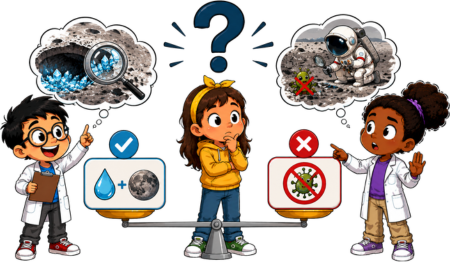
No Evidence ≠ No Life
Not finding something doesn’t automatically mean it isn’t there.
It means we haven’t seen it. That’s it.
This might sound trivial, but it’s one of the most important distinctions in science. Absence of evidence is not evidence of absence. It’s a statement about our knowledge, not necessarily about reality.
Think about it this way: if you search a room and don’t find your keys, it doesn’t prove the keys don’t exist. It just means they’re not where you looked—or you didn’t look carefully enough.
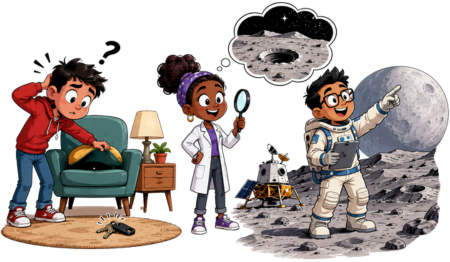
The Problem of Scale
Now scale that idea up to an entire celestial body.
The Moon is not a small, controlled environment. It’s vast, complex, and only partially explored. We’ve sampled certain regions, analyzed certain materials, sent instruments and missions—but we haven’t examined every crater, every shadowed pocket, every possible niche.
So strictly speaking, we cannot claim with absolute certainty that life is not there.
And science, when it’s being careful, avoids absolute certainty.
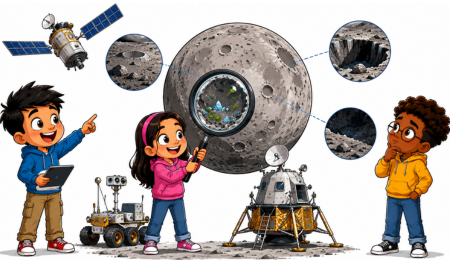
Where People Get It Wrong
But this is where people often take a wrong turn.
They hear “we don’t know,” and interpret it as “anything is equally possible.”
And that’s not how it works.
Uncertainty doesn’t mean every idea gets the same weight. It just means we don’t have a complete answer yet. Some explanations are still far more consistent with what we know than others.

Not All Possibilities Are Equal
Going back to the keys example—if you can’t find them in your room, it’s reasonable to think they’re somewhere nearby. Maybe under the bed, maybe in a pocket you forgot to check.
What’s not reasonable is to assume they might be on Mars.
Same logic applies here. The fact that we haven’t found life on the Moon doesn’t make it impossible—but it also doesn’t put it on equal footing with what we already understand about the Moon’s environment.
Some possibilities are just… more grounded than others.

Possibility Is Not Probability
Yes, it is possible that life exists on the Moon in some hidden form.
But possibility alone doesn’t tell us much.
Because almost anything is possible if you stretch the idea far enough.
What matters is probability.
Given what we know about the Moon—its environment, its chemistry, its history—how likely is it that life could exist there?
And this is where things stop being philosophical… and start being real.

A World That Doesn’t Want Life
The Moon is not just unknown. It is actively hostile.
There is no atmosphere to protect the surface. That means radiation from the Sun and from space reaches it directly, constantly breaking down complex molecules that would be essential for life.
There’s no real shielding, no buffer—just exposure.
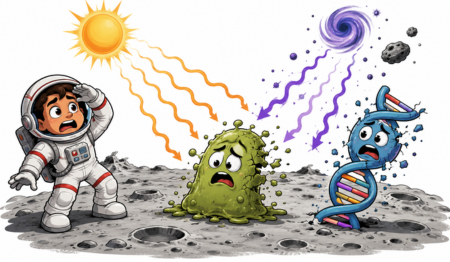
No Stability, No System
Temperatures don’t gently fluctuate—they swing violently. In sunlight, the surface can become extremely hot. In darkness, it plunges to extreme cold. There is no stable, comfortable middle ground where delicate biological processes can persist.
There is also no magnetic field to deflect solar wind. No thick atmosphere to maintain pressure. No global system to regulate conditions over time.
In other words, the Moon is missing almost everything that makes Earth a living planet.
Water Isn’t Enough
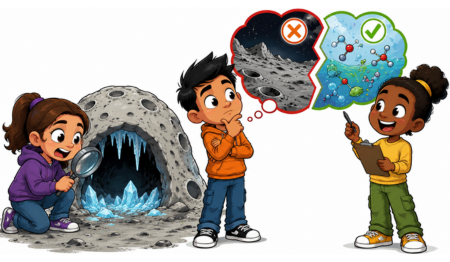
Water, as we’ve seen, is mostly locked away as ice in permanently shadowed regions. It doesn’t flow. It doesn’t circulate. It doesn’t create the kind of chemical playground that life depends on.
So while we cannot completely rule out the possibility of life, we can evaluate the conditions.
And those conditions are not just unfavorable—
they are overwhelmingly against it.
But Before That—What Is Life?
Up to this point, we’ve been using the word life as if it were obvious.
But it isn’t.
If we’re going to ask whether life exists on the Moon, we need to stop and define what we’re actually looking for.
So—what is life?
At first, the answer seems simple. Something alive grows, moves, reproduces.
But the moment you try to turn that into a precise definition, it starts to fall apart.

When Definitions Start to Break
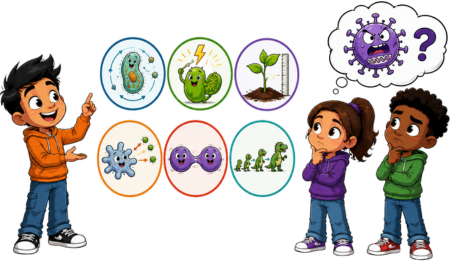
Biology doesn’t give a single clean answer. Instead, it gives a set of characteristics. Life is typically described as something that can:
- maintain itself (internal organization)
- use energy
- grow or develop
- respond to its environment
- reproduce
- evolve over time
That sounds solid—until you start finding exceptions.
Viruses, for example, can evolve and carry genetic material, but they cannot reproduce on their own. So are they alive?
There is no universal agreement.
And that’s the problem.
Life Doesn’t Fit in a Box
Life is not a perfectly defined category. It’s a concept we use to describe systems that behave in a certain way.
Different fields draw the line in slightly different places, depending on what they care about.
So instead of a strict definition, we end up with a cluster of traits—things that usually appear together, but don’t always have to.
A Different Way to Think About It
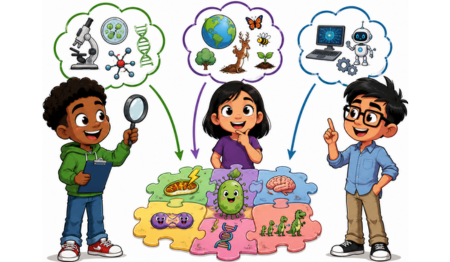
So a more useful way to think about life is this:
Life is not just a thing. It is a process.
A system of matter that is organized, uses energy, sustains itself, and can reproduce and evolve over time. And that changes how we look at the Moon.
Because now the question is no longer:
Is there water?
It becomes:
Is there any system on the Moon that behaves like this?
And that’s a much harder requirement.
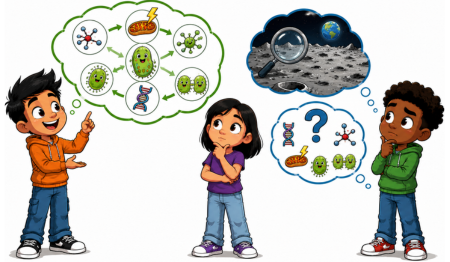
What Life Actually Needs
Before going further, it helps to be precise about what we’re actually talking about.
We’ve been using “water” and “life” in a very general way, but in science those words only matter if they sit inside a system.
Water on its own is not the point. It’s what water allows to happen that matters.
On Earth, life doesn’t depend on a single ingredient. It depends on a combination of conditions working together at the same time.
Liquid water is part of it, because it allows chemical reactions to take place.
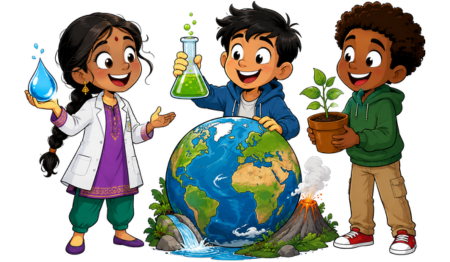
More Than Just Water
But it also needs a source of energy. Without energy, nothing changes. Nothing builds. Nothing evolves.
It needs a stable environment where molecules can persist long enough to become something more than random chemistry.
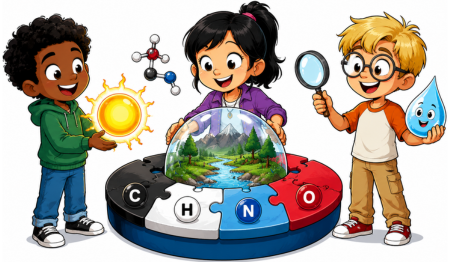
And it needs the right elements—carbon, hydrogen, nitrogen, oxygen—available in usable forms.
Put simply, life is not an ingredient list. It is a working setup.
If one part is missing, the system doesn’t partially work. It doesn’t “almost” start.
It just doesn’t begin.
We’ve talked about water as if it were obvious—but if you want a deeper breakdown of what water is, how it behaves, and why it matters for life, that’s covered in detail in separate articles.
When Ingredients Are Not Enough
So the important distinction is this: These conditions don’t just need to exist. They need to work together over time.
That interaction is what turns simple chemistry into something organized—something that can replicate, evolve, and eventually be recognized as life.
Without that interaction, nothing happens. The ingredients stay separate. The system never forms.
So what’s life about? Life is not about having the right ingredients in the same place. It is about what those ingredients do together over time. A system forming itself, not a checklist being completed.
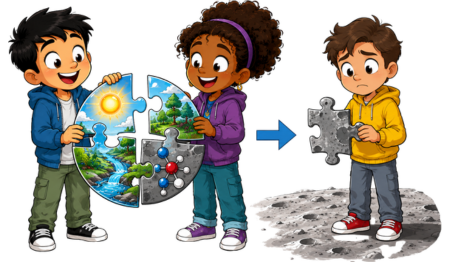
The Moon is exactly that kind of place. One ingredient exists, but the system never forms.
Back to the Moon
Now it’s where the Moon becomes relevant again. The Moon does have one of these ingredients: water.
But even that is frozen, isolated, and not part of any active system. The rest of the conditions simply don’t show up.
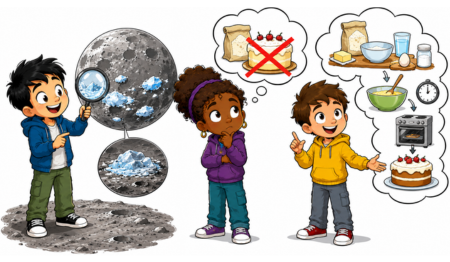
Seeing water and assuming life is like seeing flour and assuming there must be a cake.
Flour is necessary, but it does not create the system.
You need structure, time, energy, and a process that brings everything together
So What Are We Actually Looking For?
At this point, it helps to step back and ask a deeper question:
What does life actually require?
Not in a vague, poetic sense—but in a functional, biological one.
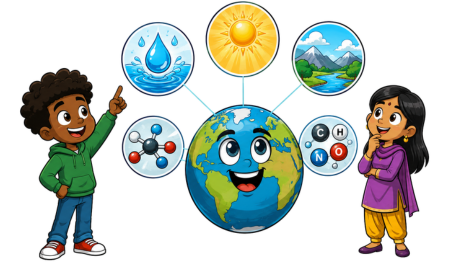
On Earth, life depends on a combination of factors working together:
- Liquid water that enables chemical reactions
- A source of energy, such as sunlight or chemical gradients
- A stable environment where complex molecules can form and persist
- The right elements—carbon, hydrogen, nitrogen, oxygen, and others
Why This Matters Beyond the Moon
It might seem like this is just a technical discussion about one celestial body. But the implications go much further. We use water as a starting point when searching for life beyond Earth, because it’s one of the few things we can detect from afar. It helps narrow the search—but it can also create a false sense of certainty.
The Moon is a reminder of that. What works as a clue is not automatically a conclusion.
When we detect water, it doesn’t tell us everything we need to know. It only tells us where to look closer.
And if we stop there, we risk turning a clue into an assumption.
What We Should Actually Be Asking
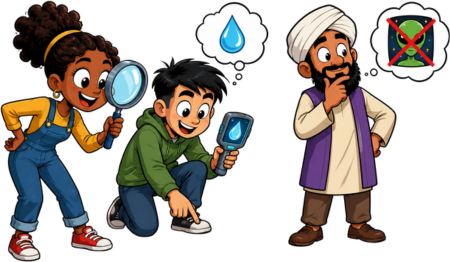
Is the water liquid?
Does it cycle?
Is there energy?
Are the conditions stable?
And more importantly—do these factors actually connect in a way that allows a system to sustain itself over time?
Because that is the real difference. Not the presence of an ingredient, but the presence of interaction.
So What the Moon Actually Tells Us
If water alone were enough to create or sustain life, the Moon would not be what it is. It would not be silent, barren, and still. It would be active, dynamic, alive.
But it isn’t. And that tells us something simple, but important. So… does water on the Moon always mean life? Not by itself.
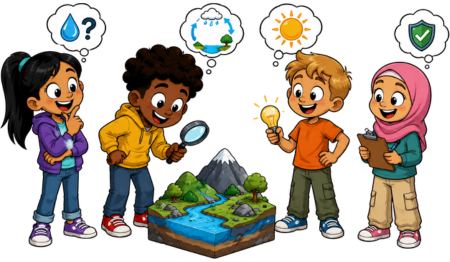
Life is not the result of a single ingredient. It is the result of a system forming when the right conditions connect and stay connected over time.
On the Moon, that system never came together.