What If Time… Isn’t What You Think It Is?
In previous articles we already did something important: we stopped treating time as something obvious.
And honestly, that already puts us ahead of most people.
Because normally, time is like WiFi: nobody really knows how it works, but everyone gets furious when it stops behaving.

Time Is Not Absolute
We saw that time is not absolute, that it depends on the observer, that it can dilate, slow down, and behave in ways that completely contradict everyday intuition.
In other words, we already broke the comfortable idea of time as a universal clock ticking the same for everyone.
And yes, that alone was already mildly unsettling.
But of course… once you start questioning something, it becomes very hard to stop at the exact point where you still feel comfortable.

Does Time Give Us Any Escape Route?
Not really? Only one? Then none. Because there are only two options:
Either you go back and pretend you didn’t see anything strange…
or you keep going until your intuition starts running out of arguments.
Today we choose the second one.

Does Time Really Exist?
Because if time is not what we thought, there is a question we can no longer dodge politely:
What if time, as we experience it… doesn’t really exist?
And it’s worth saying this clearly:
if this question doesn’t make you slightly uncomfortable, you’re probably not taking it seriously enough.
Or worse—you are quietly translating it into something safer without noticing.

This Is Not a New Idea
And here is where things get interesting. This discomfort is not new.
It didn’t start with modern physics. Not with Einstein.
More than 1,600 years ago, someone already got stuck in exactly this question.
Saint Augustine. And what he discovered is not exactly reassuring:
“What then is time?
If no one asks me, I know;
but if I wish to explain it to someone who asks, I do not know.
We can properly say that time exists only because it tends not to exist.”
And the most unsettling part is simple:
this question is still here. Waiting.

The Next Uncomfortable Step
If time doesn’t exist on its own—if it is not a thing “out there” but a way of organizing change—then something starts to feel strange.
Because in everything we’ve said so far, one element never disappears.
You.
There is always someone observing. Someone measuring. Someone saying “this happened before” and “this happened after.”
And if you remove that someone… things collapse quickly.

No Past Waiting, No Future Approaching
There is no past waiting somewhere. No future approaching you.
Not even a solid “now” you can hold onto like a metaphysical handrail.
The uncomfortable part is not the idea. It is what it implies:
Maybe time is not something out there.
Maybe it is something that happens… when you appear.

A Simple Experiment (But Not So Innocent)
No physics needed. No equations. No TED Talk confidence required.
Just try something basic.
For a few seconds, stop projecting forward. Don’t anticipate what comes next. Don’t retrieve what already passed. Stay with what is happening.
But really. Not as a nice mindfulness slogan.
As raw experience: sound, breath, pressure, temperature.
And observe.
The past does not appear… unless you bring it.
The future does not appear… unless you construct it.
Curious, isn’t it?
Time becomes noticeable exactly when thought appears.
Not before.

So What on Earth Is Going On?
This is not about saying “time doesn’t exist” as some cheap trick.
Clocks still work. Physics doesn’t break. Things change, processes unfold.
All of that remains intact.
But that is not the same as saying there is a hidden river of time flowing through everything while you drift inside it like an extra in a documentary.
It might be stranger than that.

What About If You’re the One Moving?
Maybe the universe does not “move forward” in time.
Maybe it simply… is.
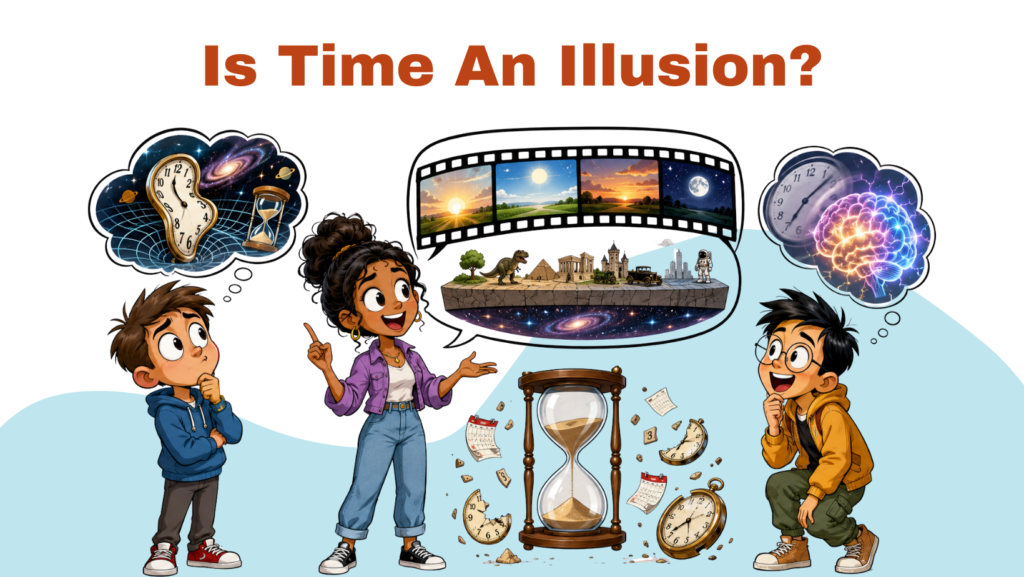
In different configurations. And what you call “the passage of time” is just the way you move through those configurations—like turning pages in a book.
And here comes the uncomfortable part:
Maybe the story is not moving.
Maybe you are the one moving… while reading.

And Now the Question Flips
We started by asking whether time is an illusion. A nice, harmless question.
But now it doesn’t sound the same.
Because if time depends on how you experience change…
then the question is no longer about time. It is about you.
What if the illusion is not time?
What if the illusion is the idea that you are inside it?

The Language Trap: “Time Passes”
Part of the problem is not physics, but language.
We say time passes, runs, flies, slips away. We treat it like a moving substance that somehow drags us along with it.
But that may be more metaphor than description—or a very ugly lie we’ve all politely agreed to believe.
Because if you look closely, you never experience “time passing” itself.
You only experience change.
A shadow moving.
A body aging.
An object falling.

We Never Experience Time Directly
Time itself never shows up as a direct object of experience.
And here it helps to pause—literally pause.
If you remove all change… absolutely all of it…no motion, no transformation, no process…
what exactly is left that you could call “time”?
This is not rhetorical. Try answering it.
Because if the answer is “nothing,” then time is not something that exists independently. It is a way of organizing what happens.
And that is no small shift. That is a change of category.

The Block Universe: An Idea Nobody Likes at First
Here is where intuition starts to resist. One of the most radical ideas in physics is the “block universe.” And yes, the name does not help.
The idea is simple to say but hard to accept:
The past, present, and future are not things that appear and disappear. They coexist.
Everything is already there.
Nothing “comes” from the future.
Nothing “goes” into the past.
There is only a complete structure.
Yes, it sounds extreme.
But so did the idea that time is not absolute—and we already saw how that went.

The Movie Analogy
A useful analogy—though imperfect—is a film reel.
All frames exist at once. There is no special frame called “the present.” Motion appears when the sequence is played.
Now here is the uncomfortable point.
If this is true, then time does not flow.
There is no “now” moving through reality.
There is a structure… and an experience moving through it.
And at this point, someone usually says:
“Okay, but it doesn’t feel like that.”
Exactly.
That is the problem.

The Present: the Main Suspect
If anything feels undeniable, it is the present.
If anything feels undeniable, it is the present.
We can doubt the past—memory is unreliable.
We can doubt the future—prediction is fragile.
But the “now” feels solid, immediate, unquestionable.
Or at least we think it does.
Because when you examine it closely, it starts to dissolve.
In relativity, there is no universal present. No shared “now.” What is present for one observer may be past or future for another depending on motion.
Not philosophy. Physics.

Kairos: What If the Instant Is All There Is?
So the question changes shape:
If there is no universal “now”… what exactly is the “now” you feel so confidently?
One possibility is that the present is not a property of the universe.
It is a construction. A kind of interface.
Not a description of reality as it is, but a simplified version that allows us to function without collapsing mentally.
The “now” is not fundamental.
It is useful.
And if that is true… you are living inside an edited version of reality. Which, ironically, is more common than we like to admit.

The Mind and the Construction of Time
At this point, the discussion is no longer only physics. It is psychology.
The brain does not record reality passively. It interprets, reconstructs, organizes it continuously. What we perceive is not the world as it is, but a processed version that makes sense to us.
Time may be part of that processing.
Our experience blends memory, perception, and anticipation into a continuous narrative. We feel like we come from somewhere and move toward something, even if that direction is not written into the structure of reality itself.

You Know It, but You Ignore It
And here is something you already know… but rarely take seriously.
Subjective time is unstable. One hour can vanish in a good conversation…
or feel endless in a meeting that should have been an email.
The clock does not change. Experience does.
So the question becomes unavoidable:
What exactly are you measuring when you say “time”?
If this is true, then time is not simply “out there.”
At least partly, it is in here. And no, that does not make it less real. But it does make it more suspicious.

The Arrow of Time: Direction Without Motion
Still, one thing seems hard to deny:
Time has direction.
We remember the past, not the future. We see processes that move one way: a cup breaks, but does not un-break.
This is called the “arrow of time.”

Entropy That Keeps Moving You on Time?
One explanation involves entropy, the degree of disorder. The universe tends toward more disordered states, creating a difference between past and future.
But here is the key point:
This does not necessarily imply that time flows.
It only implies that certain processes are more likely in one direction.
Direction is not necessarily movement.
And that small distinction changes everything.

So, Illusion or Reality?
At this point, saying “time is an illusion” doesn’t sound so absurd anymore.
But it also doesn’t mean what people usually think.
It does not mean nothing happens. It does not mean everything is fake. It means something more precise—and more uncomfortable:
Our concept of time may not match the structure of reality.
In that sense, “illusion” does not mean non-existence.
It means misinterpretation.

Does Color Exist?
A good analogy is color.
Color exists in experience, but not as an independent property of objects. It is how the brain translates wavelengths of light.
Time may be similar. Not a fundamental entity. A way of organizing what happens.
Not that it does not exist.
But that it probably does not exist the way you think.
And that difference… is not small.

It Is Less Comfortable than It Sounds
If we take this seriously, the implications are not just theoretical.
They reshape how we understand experience itself.
If past and future exist in some sense, then “moving forward” becomes strange. If the present is constructed, then the center of experience is less stable than we assume.
And if time does not flow, then the question changes completely.
It is no longer “where are we going?”
It becomes “which part are we experiencing?”
And phrased like that, it starts to sound like we are not moving at all.
Just… passing through something already there.
Yes, still uncomfortable.
And no, thinking harder does not fix it.

Living Inside a Very Convincing Story
Maybe time is not an independent entity.
Maybe it is a way of organizing experience. A narrative built by the mind so the world makes sense.
A coherent narrative. Useful. Hard to question.
And probably incomplete.
Because if that is true, then the final question is not about time.
It is about us.
If time is the story we use to understand change, then the uncomfortable question is not whether time exists.
It is this:

The Illusion of Reality
What remains of reality when we stop telling that story?
And even more importantly:
If you could step outside it for a moment… would you recognize what remains?
Or, more interestingly:
Would you even want to?
Well… you probably wouldn’t.
But worse still: even if you did, there’s no time left.