
So… How Much Is Your Aura Worth?
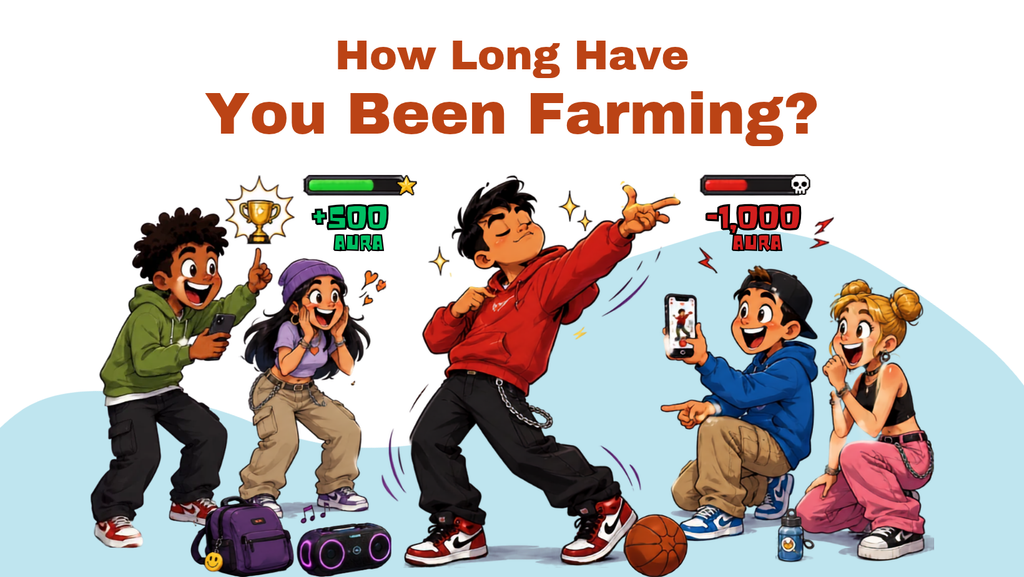
Imagine you’re walking through a plaza and you see a group of teenagers gathered around one of their friends.
One kid suddenly gets up, starts walking strangely, strikes a pose, or does something completely ridiculous with enough confidence to make you wonder whether you missed a meeting where everyone agreed this was normal.
His friends start yelling and laughing. Somebody pulls out a phone.
Then someone says:

“Your aura: +500!”
A few minutes later, another kid tries something and completely bombs it.
“−1,000 aura!”
Nobody won anything. Nobody lost anything. There’s no trophy, no referee, and no actual scoreboard.
And yet, everybody knows exactly what just happened.
So what on Earth are they doing?
They’re farming aura.

Okay… What the Hell Is Aura Farming?
At first glance, it looks like a bunch of kids making fools of themselves.
And, to be fair, sometimes that’s exactly what it is.
But there’s another layer to it. The idea is that certain things make you look cool, confident, funny, impressive, mysterious, or just somehow different from everybody else.
If people react the way you hoped they would, you’ve gained aura.
But wait…

How Do You Actually Gain Aura?
If you completely embarrass yourself, well…
There goes your aura.
It’s as if you’ve been walking around your entire life with an invisible meter above your head and nobody bothered to tell you about it until now.
Apparently, the internet finally gave that meter a name.
Aura.

What the Hell Is “Aura”?
We’re not talking about the mystical energy surrounding your body.
Well… not exactly.
On the internet, aura has become a way of describing someone’s presence or the impression they give off. Someone walks into a room and somehow gets everyone’s attention. Someone does something with so much confidence that everybody notices. Someone can even do almost nothing and still somehow look cool doing it.

What Would You Say About It?
You might say that person has aura.
It’s not exactly confidence, charisma, attractiveness, or being cool, although it can involve all of those things.
And that’s probably the point.
Aura is vague.

You Can’t Actually Measure It
There is no machine that goes:
AURA DETECTED.
There’s no government agency keeping track of your aura. No bank where you can deposit it. No app where you can check whether you’re up or down for the day.
At least, not yet.

But Somehow, We Keep Score
The internet took something vague and human and turned it into a game, complete with imaginary points.
And somehow, it works.
We’ve taken someone’s presence, their vibe, their ability to make an impression, and started talking about it as if we’d discovered a new natural resource. Apparently, we’re mining the invisible now.

So What Does “Farming” Mean?
If you’ve played video games, you probably already know the idea.
You don’t always get what you need simply by moving through the story. Sometimes you have to repeat the same activity because you want more experience, gold, weapons, materials, or whatever else your character needs.
You do the same thing again.
And again.
And again. You’re farming.

You’re Not Actually Growing Anything
The point isn’t that you’re growing something. You’re repeating an activity because you want to accumulate a particular reward.
You’re doing the same work over and over because you want more of something.
And eventually, that word escaped the games.

Then English Went to Spanish
People started talking about farming followers, farming views, farming likes, farming attention.
And then something particularly interesting happened in Spanish.
Spanish-speaking gamers didn’t simply translate the word.
They turned it into a Spanish verb:
farmear.
So you might hear:
“Estoy farmeando experiencia.”
I’m farming experience.

And Nobody Had to Explain It
And nobody has to stop the conversation to explain what farmear means.
The English gaming word crossed into Spanish and started behaving like a Spanish verb.
That’s not unusual.
That’s actually what languages do.

Nobody Asked Permission to Create “Farmear”
Nobody sits down and says, “Today we shall create a new word.”
People borrow something. They change it a little. They start using it with their friends.
If other people understand it, they use it too.
And if enough people keep using it, congratulations.
You have a word.

Then Farmear Escaped the Games
Then farmear started escaping the gaming world. You could farm followers, farm attention, farm reactions, farm views…
And now, apparently, you can farmear aura.
Which may be the strangest thing we’ve managed to farm so far.

So Why Can’t You Farm Aura?
Think about it.
If you’re farming gold in a video game, you end up with gold. If you’re farming experience, your character levels up. If you’re farming materials, you collect materials.
But if you’re farming aura, where does it go?
Do you put it in a jar?
Can you trade 500 aura for a sandwich?
Can you save it for later?
“Sorry, I can’t hang out tonight. I’m sitting on 8,000 aura and I’m not spending any of it.”

You’re Farming an Impression
That’s the joke.
Aura isn’t something you actually collect. It’s an impression. Yet we’re talking about it as if we’ve discovered a new natural resource.
And somehow, the metaphor works. Maybe because humans have always had a strange habit of turning invisible things into things we can talk about, compare, measure, and worry about.
Now apparently we’ve added social coolness to the list.

From the Meme to the Street
And this is where the whole thing gets more interesting.
What starts online doesn’t necessarily stay online, especially when you’re talking about young people who already live comfortably in the language and humor of internet culture. Someone strikes a ridiculous pose.
Someone walks into a situation with exaggerated confidence.

Suddenly, They’re Performing
Someone dances, performs, or does something completely unnecessary just to see what kind of reaction it gets.
Suddenly, they’re not just hanging out.
They’re performing.
They probably wouldn’t call it that.
But that’s what they’re doing.

When Hanging Out Becomes a Performance
They’re playing with what looks cool, what gets a reaction, and what makes everybody else say:
“Okay, that was actually pretty good.”
And now the people watching become part of the game.
Because you can think you’ve just delivered the coolest moment of your life, but unfortunately, nobody else may agree.
That’s when your imaginary aura account takes a hit.

The Audience Has a Vote
There isn’t an official scoring system.
That’s what makes it funny.
The people watching decide whether you pulled it off. If everyone laughs, screams, stares, or starts recording, you’ve probably gained some aura.

What If You Lose?
If everyone looks at you like you just made a terrible decision, you may want to accept the loss and move on.
The plaza has become a stage, and your friends have become the judges.
And unlike real judges, they’re probably going to laugh at you while they’re scoring you.

You Don’t Get to Give Yourself the Points
That’s another reason aura is such a strange idea.
You don’t get to decide your own score.
You can walk away thinking you absolutely nailed it while everybody else is still trying to figure out what the hell you were doing.
The same action can look confident to one person and ridiculous to another.
That’s because aura doesn’t really live inside you.
It lives somewhere between how you see yourself and how other people see you.

Then Someone Pulls Out a Phone
And now the audience can get much bigger.
Someone records ten seconds, posts it, and suddenly something that would have disappeared five minutes after it happened can be watched by hundreds or thousands of people.
Maybe more.
Now you’re not necessarily doing something only for the people standing around you.
You’re potentially doing it for everyone who might see the video later.
And that changes things.

The Camera Is No Longer Just a Camera
The phone doesn’t simply record the moment.
Sometimes it becomes part of the reason the moment happens in the first place.
Before smartphones, you could do something ridiculous in front of your friends and, assuming nobody remembered it too clearly, eventually the whole thing disappeared.
Now the possibility of being recorded can become part of the performance itself.
You know someone might be watching.
You know someone might be recording.
And maybe that’s exactly the point.
That’s a pretty big audience for one stupid pose.

When the Camera Changes What We Do
You might do something funny because you’re having fun.
Then somebody says:
“Wait, do it again. I’m recording.”
Same action. Different situation.
Now there’s an audience, even if nobody else is physically there. And sometimes that changes the way you do the thing.

Performing for People Who Aren’t Even There
Those people might be strangers.
They might live in another country.
They might not even have seen the video yet.
They don’t exist as an audience in the traditional sense.
And yet the possibility that they’ll see you can still affect what you do.
That’s kind of weird when you stop and think about it.
We’re not always performing for people who are there anymore.
Sometimes we’re performing for people who might be there later.

Why Do We Want People to Notice Us?
So why do we care?
Why do we want people to laugh at our jokes, notice what we’re wearing, admire something we’ve done, or think we’re interesting?
The answer is surprisingly simple.
Because we’re human.

This Part Isn’t New at All
Humans are social animals.
We live in groups, and other people’s opinions have always mattered to us. We want to belong. We want to be accepted and respected. And, generally speaking, we’d rather people like us than spend their time wondering what the hell is wrong with us.
None of that started with TikTok.
None of it started with Instagram either.
The internet simply gave us a new vocabulary for something we’ve been doing forever.
Instead of saying, “That person really made an impression,” we can now say:
“+1,000 aura.”
Much more scientific.
