
Why Does the Day Have 24 Hours?
There are things we question constantly. The time of an appointment. Why someone decided an 7:00 a.m. meeting was a good idea. The price of gas. Why beer never seems to get cheaper when oil does.
And then there are the things we simply accept. They are there, they work, everybody uses them, so we assume they must make sense.
Until someone asks a rather uncomfortable question:
Why?
Who Said It Had to Be 24?
Just because something has been done for centuries doesn’t mean it had to end up that way. Sometimes we simply inherit a decision, repeat it for generations, and eventually stop seeing it as a decision at all.
We turn it into normality.
And few things are better at hiding their own history than time.
We use it to organize practically everything, yet we rarely stop to think about how we ended up organizing it this way.
Because, come on.
Someone had to decide.
And apparently, that person was not particularly concerned with keeping things simple.
A Number We Never Question
Every day, we look at the clock without really thinking about what we’re looking at.
- 7:00 a.m. Time to wake up!
- 12:00 p.m. We’re hungry!
- 5:00 p.m. Time to go home. Finally!
- 10:30 p.m. Ok! We’re done for today.
We see the numbers, understand them, and continue with our lives.
Nobody wakes up thinking:
Wait…

Who decided that a day should have 24 hours?
And honestly, why would we?
A day is a day. The Sun rises, the Sun sets, we sleep, we wake up, and everything starts again.
But once we begin dividing the day into smaller pieces, things become less natural.
The Earth rotates once. That’s nature.
Calling a portion of that rotation an hour is something else. Calling it 24 hours is even more interesting.
And then we divide those hours into 60 minutes, and each minute into 60 seconds.
At this point, we’re pretty far from simply watching the Sun move across the sky.

So Why 24?
Exactly!
- Why not 10?
- Why not 20?
- Why not 100?
We could have built our system differently. In fact, someone eventually tried.
But before we get there, we have to go back to a time when nobody had a phone telling them the time, a digital clock on the wall, or a smartwatch vibrating on their wrist.
People had to look up.

Before Clocks, There Was the Sky
For most of human history, measuring time did not mean knowing whether it was 8:17 or 8:18. That kind of precision would have made very little sense.
You needed to know whether it was morning, noon, afternoon, or night.
You needed to know when the Sun would rise, when darkness would arrive, when to plant, when to harvest, when to perform ceremonies, and when to start or stop working.

When the Sky Was the Original Clock
The Sun was the obvious one. Its position could give you a rough idea of where you were in the day. Your shadow could help too. The shorter it became, the closer you were to midday; the longer it became, the farther away you were.
Seems simple, right?
Not quite.
The Sun doesn’t divide the day into convenient little sections for us. It doesn’t stop every hour and announce:

“Congratulations! One Hour Has Passed.”
It just keeps moving.
So humans had to find ways to divide that movement.
And the history of the 24-hour day is not the story of one person sitting down one afternoon and saying, “I have an idea. Let’s make the day 24 hours.”
It was much more gradual.
Different civilizations developed different ways of measuring portions of the day. Some were practical, others astronomical or mathematical, and some were connected to religion and the observation of the sky.
Over time, several of these traditions came together.
And here we are, thousands of years later, still using them.
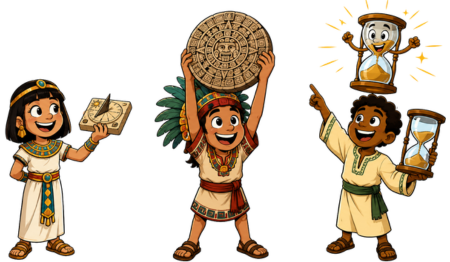
The Egyptians Had a Problem Measuring the Night
Yes, of course.
How do you measure the night?
Ancient Egypt gives us one of the most important pieces of the puzzle.
The Egyptians were deeply interested in the movement of the Sun and stars. Their society depended on agriculture, the Nile, religious ceremonies, and the cycles of the sky.
During the day, the Sun was available.
But at night, your enormous clock had disappeared.

So What Do You Do?
You look at the stars.
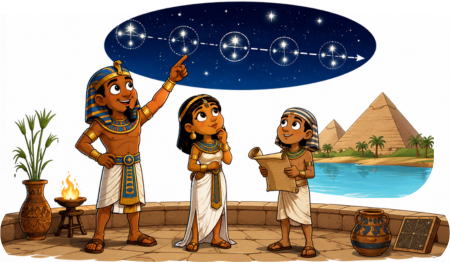
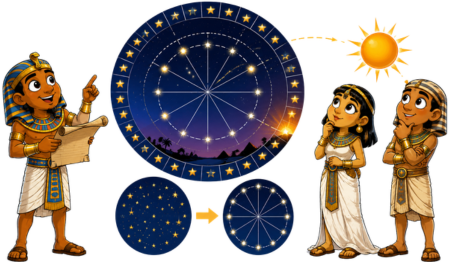
The Egyptians identified groups of stars known as decans. These appeared successively across the night sky and could be used to follow the passage of time.
The stars essentially became a kind of cosmic alarm clock.
Not exactly an Apple Watch.
But it worked.
How Did We Go From Ten to Twelve?
This is where the sky changed the game.
The Egyptians associated the year with 36 decans, which appeared successively throughout the year. But during the shorter summer nights, only 12 of these stellar markers could appear before sunrise.
That limitation eventually helped establish a division of the night into 12 parts.
And there it is.
Twelve.
The number that would eventually become half of our 24-hour day.
12: A Very Convenient Number
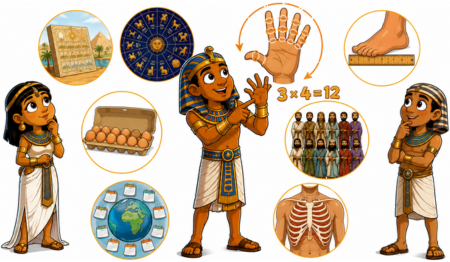
The interesting part is that twelve was already a pretty useful number. You can find it in all kinds of places: twelve months, twelve signs of the zodiac, twelve inches in a foot, a dozen eggs.
You can even count to twelve using the joints of your fingers. Use your thumb to touch the three joints on each of your four fingers:
3 × 4 = 12.
So perhaps twelve didn’t seem quite as strange to ancient people as it does to us.
The number shows up everywhere: the apostles, the signs of the zodiac, the months of the year, and the twelve pairs of ribs protecting your heart and chest.
Twelve Is Everywhere
Twelve: There It Is!
Always was.
Maybe twelve is as magical as seven. Maybe it isn’t. That’s not today’s argument.
But twelve became incredibly convenient for humans.
You can divide 12 by 2, 3, 4, 6, and 12. That makes it very useful for dividing things into equal portions.
Compare that with 10.
Ten divides nicely by 2 and 5.
But try dividing it by three.
Good luck.

Living in a World Dominated by Ten
We live in a world dominated by ten. Base-10 mathematics, ten fingers, ten toes. So twelve can seem like a strange choice.
But it wasn’t necessarily strange to people using different mathematical traditions.
And then another number appears.
A much stranger one.
60.
Maybe if we multiply 5 by 12, we get the answer.
But that’s a story for another conversation.
For now, let’s get back to the day.

From Twelve to Twenty-Four
Once the night had been divided into twelve parts, another possibility appeared.
If the night has twelve parts, why not divide the day into twelve as well?
That gives us:
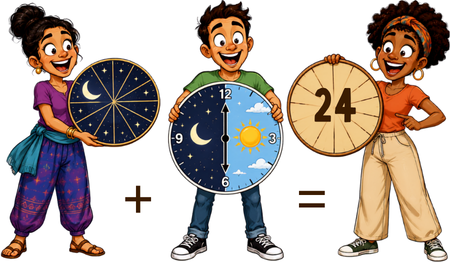
12 hours of night + 12 hours of day = 24 hours.
Simple.
But we still aren’t talking about the modern clock.
Back When the Hours Were Not Equal
The ancient “hours” were not necessarily equal in length throughout the year. The idea was to divide the cycle of darkness and daylight into twelve parts each, which meant that a daytime hour in summer could be longer than a daytime hour in winter.
So when we talk about ancient Egyptian “hours,” we have to be careful. They were divisions of time that we translate as hours, but they were not yet our perfectly equal blocks of 60 minutes.
Those would come later.
Much later.

But Why Twelve?
Now we have another question.
Why twelve?
Nobody left us a note saying:
“We chose 12 because it looked nice.”
Unfortunately.
That would have saved historians a considerable amount of work.

The Answer Appears to Involve Astronomy
The Egyptian calendar, and the observation of the stars were also part od the deal.
But there’s another reason twelve is such a useful number: it divides nicely.
And once a number becomes useful, people have a tendency to keep using it.
That’s one of the recurring themes of this whole story.
A system doesn’t necessarily survive because someone proved it was the best possible system. Sometimes it survives because it’s already there and everyone has learned how to use it.

Then the Greeks Wanted Something More Precise
As astronomy became more mathematical, Greek astronomers needed something more consistent.
If you’re studying the movement of stars and planets, it gets rather inconvenient when an “hour” changes length depending on the season.
Imagine trying to make precise astronomical calculations while your unit of time keeps changing.
Not exactly ideal.
The Idea of Equal Hours Is Born
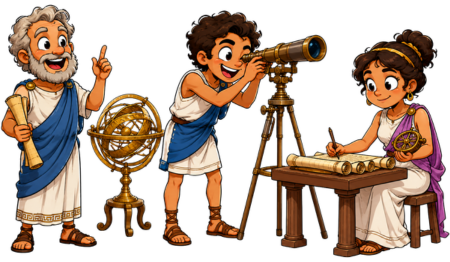
Greek astronomers developed the idea of equal hours—dividing the full cycle of the day into 24 equal parts.
The astronomer Hipparchus, who worked in the second century BCE, is associated with the use of 24 equinoctial hours, meaning hours of equal duration.
Now we’re getting much closer to the system we recognize.
But another question immediately appears.
If we have 24 hours, why does each hour have 60 minutes?
Why not 100?
And why does each minute have another 60 seconds?
That brings us to Babylon.
And that’s a story for our next meetup.
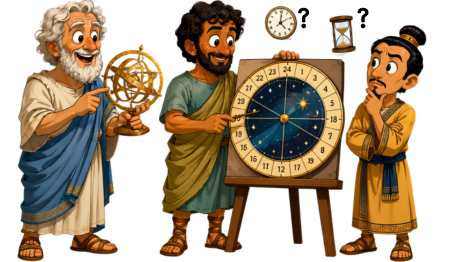
The Wall Clock Is Older Than It Looks
Modern clocks look modern.
Digital numbers, screens, smartphones, smartwatches, atomic clocks, GPS.
All incredibly advanced.
But underneath all that technology is a structure that is very, very old:
- 60 seconds.
- 24 hours.
- 60 minutes.
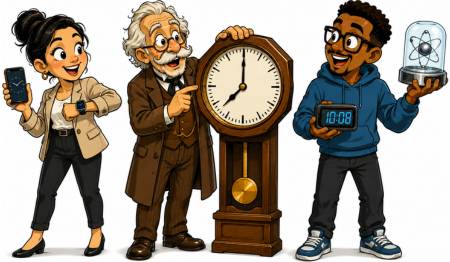
That Structure Is the Result of Layers of History
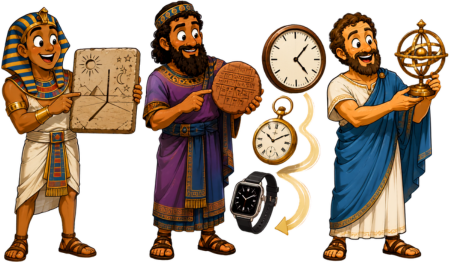
Egyptian observations of the day and night, stellar divisions of the night, Mesopotamian mathematical traditions, and Greek astronomical calculations.
Eventually, technology turned these ideas into something we could carry around, put on a wall, or wear on our wrists.
The clock may look modern.
Its ancestry is anything but.
The Clock Changed Everything
Once mechanical clocks became increasingly common and reliable, equal hours stopped being something primarily useful to astronomers.
They became practical for everyday life.
Now time could be measured, announced, scheduled, and coordinated.
You didn’t simply know that morning had arrived.
You could know that it was 6:00.
You didn’t simply know that it was getting dark.
You could know that it was 5:30.
And once you can measure something precisely, you can start organizing people around it.
Work, school, church, transportation, meetings, appointments—once clocks became reliable enough, practically everything could be organized around a number.
And eventually, those numbers started telling you what you were supposed to be doing.

The Time We Think Is Natural
This may be the most interesting part. We talk about time as if it were completely natural.
We say, “I don’t have enough time,” “I’ll do it tomorrow,” “The weekend is too short,” “It’s almost five,” or “I’m late.”
All of that sounds completely normal. But look closer. The Earth’s rotation is natural. Sunrise and sunset are natural. But a Monday is not sitting somewhere in nature.
Neither is 3:47 p.m. Neither is a workday. Neither is a weekend.
These are systems humans created to organize our experience of time.
And once those systems become old enough, they stop looking invented.
They look obvious. They look inevitable. They look like reality.

The Artificial Part of Measuring Time
This is why the 24-hour day is so fascinating. There is nothing physically magical about the number 24. The Earth doesn’t rotate 24 times. The universe did not hand humanity a clock and say:
“Here you go. Divide it into twelve and twelve.”
We developed a way of describing one rotation of the Earth.
That description became so deeply embedded in civilization that today it feels almost like part of nature itself.
That’s a pretty impressive trick. A human convention can become so familiar that we eventually forget it was a convention.
But the Earth Doesn’t Keep Perfect Time Either
And just when you thought the story was simple, it gets stranger.
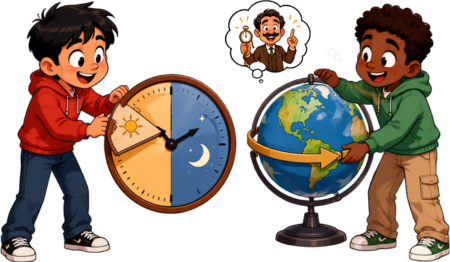
The Earth does not rotate at a perfectly constant speed. Its rotation changes slightly over time.
That doesn’t matter much when you’re trying to figure out whether it’s morning or afternoon.
But modern technology requires far more precision.
So scientists distinguish between different ways of defining time.

The Modern Scientific Method to Measure Time
The modern scientific second is no longer simply based on watching the Earth rotate.
Since 1967, the SI second has been defined using a specific frequency associated with the cesium-133 atom.
In other words, the modern second is based on atomic physics.
Think about how strange that is compared with where we started.
We began by watching the Sun and the stars. Thousands of years later, we’re defining the second by measuring an atomic transition.
And all of this eventually ends with you staring at your phone because you’re late for dinner.

We Inherited the System
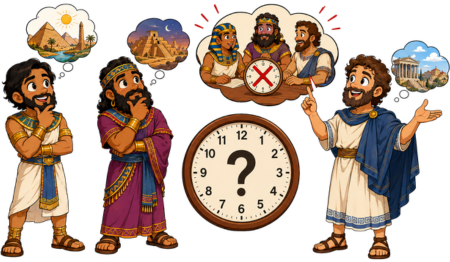
So who decided that the day should have 24 hours? The honest answer is:
Nobody. Not exactly.
There was no single inventor. There was no ancient “Father of the 24-Hour Day.”
There was no meeting where representatives from Egypt, Babylon, and Greece sat around a table and voted:
“Twenty-four. Everyone happy?”
The System Developed Gradually
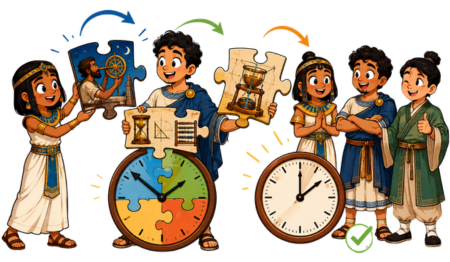
Different civilizations contributed different pieces. Some were astronomical, some mathematical, some practical, and some cultural.
Later generations inherited those ideas, adapted them, and standardized them.
The system survived because it was already there. And that may be the most important point.
A system doesn’t have to be perfect to survive. It just has to become familiar.
What If We Had Ten Hours?
Now let’s play with the idea.
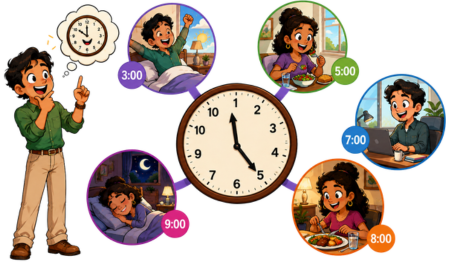
What if the day had ten hours?
Forget for a moment what those hours actually represented. Imagine simply learning from childhood that the day was divided into ten numbered parts.
You might wake up at 3:00, have lunch at 5:00, finish work at 7:00, have dinner at 8:00, and go to bed at 9:00.
Would that look strange?
Of course.
But only because you’re used to something else.
And this is where the thought experiment gets even more interesting.
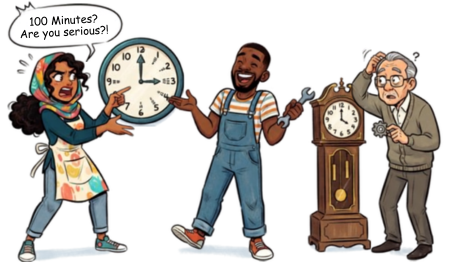
What If an Hour Had 100 Minutes?
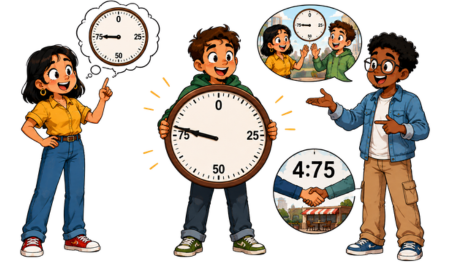
You could tell someone:
“See you at 4:75.”
Nobody would think that was strange.
Why?
Because if that were the system you had learned since childhood, 4:75 would be completely normal.
That’s the important part.
The numbers themselves aren’t doing anything magical.
We are.
That’s the Part We Forget
That’s the Part We Forget
Numbers don’t arrive with natural meanings attached to them. We learn what they mean.
- We learn that 12:00 means noon.
- We learn that 5:00 can mean the end of the workday.
- We learn that 11:59 feels like the final moment before midnight.
The numbers themselves aren’t doing any of that.
We are. And once everybody agrees on the same system, the agreement becomes almost invisible.
You don’t have to explain what 5:00 means. You just say:
“See you at five.”
Everyone understands. That’s the power of a shared convention.

What If the Day Really Had Ten Hours?
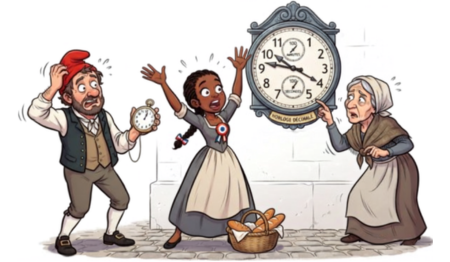
And as crazy as that may sound, revolutionary France actually tried to take decimal time seriously.
During the French Revolution, reformers attempted to redesign time according to the decimal system.
The day was divided into 10 hours, each hour into 100 minutes, and each minute into 100 seconds.
Very logical. Very decimal. Very French Revolution.
And Guess What?
It didn’t stick.
The decimal hours were abandoned after only about 17 months.
The larger Republican Calendar lasted considerably longer. It replaced the traditional calendar with months of 30 days, weeks of 10 days, and years counted from the beginning of the Republic.
That system survived for a little over 12 years before Napoleon abolished it.
We’ll talk about that another time. For now, let’s return to our 24.
But not yet to 24/7. Because if you start thinking about that one…

Twenty-Four Is Surprisingly Convenient
It would be easy to conclude that 24 is completely arbitrary. But that wouldn’t be entirely fair either.
Twenty-four is actually a pretty useful number. It can be divided exactly by 2, 3, 4, 6, 8, 12, and 24.
That makes it convenient for dividing a day into halves, thirds, quarters, sixths, eighths, or twelfths.

24 Hours May Not Be Accidental
So perhaps the success of 24 isn’t entirely accidental.
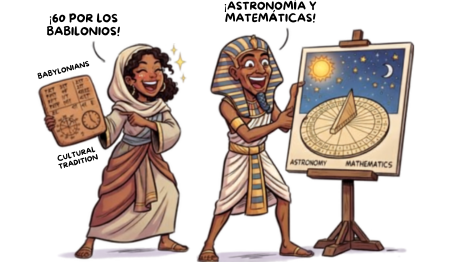
It sits at an interesting intersection of astronomy, mathematics, cultural tradition, and practical convenience.
The Egyptians didn’t pull 24 out of a hat.
The Babylonians didn’t pull 60 out of one either.
We inherited systems that worked reasonably well.
And then we built a civilization on top of them.
The Strange Thing About the Clock
The next time you look at a clock, pay attention to what you’re actually seeing.
You aren’t looking at time itself.
You’re looking at a system for measuring and organizing time.
The Earth keeps rotating whether we call the day Monday or Thursday. The Sun rises whether your alarm is set for 6:30 or 7:00.
But our experience of those events has been wrapped in a system of numbers, schedules, names, and expectations.
And after living inside that system for long enough, it’s easy to forget that the system is ours.

When Perception Starts Controlling Us
A minute doesn’t actually become longer because you’re bored, and it doesn’t become shorter because you’re having fun.
Although it certainly feels that way.
We’ve already talked about that when we looked at perception.
But there’s another layer here.
We created systems for measuring time because we needed to organize our lives. Then we became so dependent on those systems that we began experiencing life through them.

We Don’t Simply Experience a Morning
We experience 9:00 a.m.
We don’t simply experience the end of the day.
We experience 5:00 p.m.
We don’t simply experience a particular day.
We experience Monday, Friday, the weekend, the deadline, the meeting at seven.
Eventually, we forget that the clock is a tool.
We start treating it as if it were reality itself.
So… Why 24?
After thousands of years, the answer is surprisingly simple and surprisingly complicated at the same time.
We have 24 hours because ancient systems for dividing the day and night eventually developed into a structure of 12 + 12.
We have 60 minutes because Babylonian mathematical traditions and later astronomical practices gave us a powerful sexagesimal system for dividing units.
We have 60 seconds because that same mathematical tradition continued downward.
And we still use the system because history has an enormous amount of momentum.
Once billions of people depend on the same system, changing it becomes a little more complicated than saying:
“Hey, guys, let’s use 10 instead.”

Could We Change It?
Sure.
We could create a ten-hour day.
We could make each hour 100 minutes, as revolutionary France attempted to do.
We could redesign every clock on Earth.
Mathematically, we could.
In practice? Good luck.
And that’s the real question.
It’s not really:
“Why did someone choose 24?”
It’s:
“How did an ancient way of organizing the sky become the system that organizes our lives?”
That’s a much bigger question.
Because once you start asking it, you begin to notice that many things we call “natural” are actually agreements that have been repeated for so long that nobody remembers creating them.
The clock is one of them.
And tomorrow morning, when your alarm goes off at 7:00, you might want to remember something:
The Sun didn’t invent 7:00.
We did.