
Why Time Is Not Natural
Think about the last time you said, “I’m running out of time.”
Sounds normal, right?
You can waste time. Save it. Spend it. Lose it. Make time for something. Even kill it when you’re bored.
We talk about time as if it were a thing we own.
But time doesn’t come with a price tag, a schedule, or a warning label from nature telling you that Monday starts at midnight and Friday is supposed to make you happy.
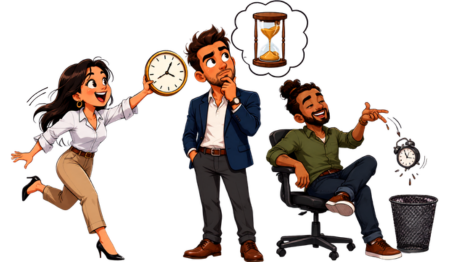
Those Rules Came from Somewhere
So did the clock.
So did the workday.
So did the idea that being late is a problem, that some hours are more valuable than others, and that a “productive” day is somehow better than one in which you did absolutely nothing.
None of this is accidental.
Over time, we didn’t just learn how to measure time.
We learned how to live by it.
And eventually, the clock didn’t need to tell us what to do.
We learned to do that ourselves.
And that leads us to the one-million dollar question …
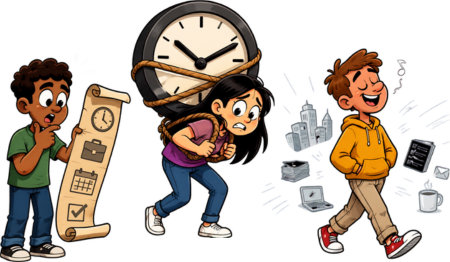
How Something Artificial Becomes a Tool of Control
The way you use time today is not natural. Nobody is born understanding what Monday is or feeling relieved because “it’s almost Friday.” You learn that… and you learn it pretty quickly.
From an early age, you get used to the idea that the day already comes divided.
There are hours to start, hours to stop, and specific moments when, in theory, you are supposed to be doing something useful. And you accept it without much trouble.
Because, of course, organizing time sounds reasonable. Productive, even.
The problem is that time doesn’t just organize what you do. Eventually, it starts defining how you behave.
You begin measuring whether your day “was worth it,” whether you did enough, or whether, basically, you functioned the way you were expected to.

But You Know What’s Even Worse?
What’s worse is that the strangest part is that it feels completely normal.
As if your time weren’t really yours, but you still had to justify what you did with it.
At that point, nobody needs to control you anymore.
You take care of that yourself.
And when that happens, something else appears—something remarkably common: you no longer quite know what to do when there is nothing to do.
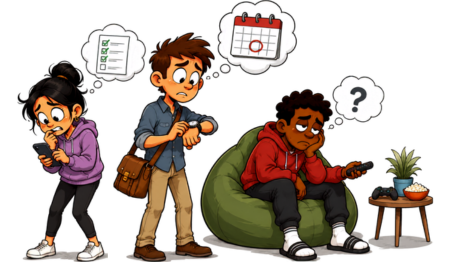
You Were Not Born with This Idea of Time
Time seems like something basic. But what you call “time”—hours, minutes, punctuality—doesn’t come directly from nature. It comes from a particular way of organizing society.
Nobody is born understanding what it means to “be late” or “make the most of the day.” Those ideas are learned. And they aren’t learned in the abstract. You learn them because they are necessary for certain things to work.
Take school.
There is a time to arrive, a fixed length for classes, a scheduled break. None of this is accidental. It is a way of teaching you to coordinate with other people by using time as a common reference.

That’s Where It Gets Interesting
Because, as Norbert Elias explains, time is not simply a measurement. It is a tool of social coordination. It allows many people to do different things… but to do them in sync.
It is how you get millions of people to do what they are supposed to do without having to tell them every few minutes.
Without that coordination, systems such as schools, workplaces and public transportation simply would not function.
So, without question, it works.

Measuring Time Is Not Neutral
Once you learn to use time this way, you start seeing it as something completely “normal.” But measuring time in this particular way has consequences.
When you divide the day into hours, everything becomes comparable.
You can say how long something takes. You can decide whether it took “too long” or “not long enough.” You can evaluate whether something was productive or a waste.
And that changes how you behave, even when you don’t notice it.

When the Clock Gets Inside Your Head
Doing a task until it is finished is not the same as doing it inside a sixty-minute block. In the second case, time stops being merely a framework and becomes a limit.
And once there are limits, pressure appears.
If you don’t finish on time, you failed.
If you take longer than someone else, you are behind.
If you rest too much, you are “using your time badly.”
The system works because eventually you start evaluating yourself.
And yet you still think you’re the one controlling your time.
Ha!

There Were Other Ways of Experiencing Time
It wasn’t always like this.
In many premodern societies, time did not come divided into tiny boxes called hours. Everyday life was organized around activities and cycles.
People worked until a task was finished, not until the clock said they had completed a certain number of hours. The rhythm was determined by daylight, weather and the seasons.
That doesn’t mean there was “no time.” It means time wasn’t constantly being used as a measurement.

The Difference Matters
When time isn’t divided with such precision, it becomes harder to compare it, optimize it or turn it into a measure of performance.
And for that reason, it was harder to turn every minute into an evaluation of what you were doing.
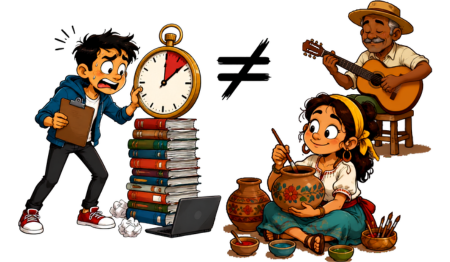
The Point Is Not to Idealize the Past
The point is to understand something much more basic: the way you understand time today is not inevitable. It is the result of a historical process.
And it works very well.
So well that it no longer looks like a system.
It simply looks like… reality.
But if something had to be constructed, it also had to be learned. And for it to work, people had to be brought into that system.
That is where the story gets more interesting.

Time Had to Be Disciplined
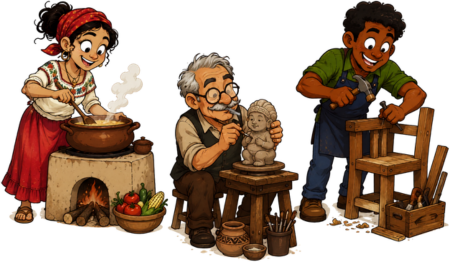
Before: Work Meant Finishing, Not Counting Hours
For a long time, working did not mean completing a fixed number of hours.
The idea of “working eight hours” seems so normal today that it is difficult to imagine that it wasn’t always the way work was organized.
A farmer didn’t necessarily watch the clock waiting to complete his working day. He worked according to what needed to be done.
An artisan didn’t think in blocks of time; he thought in terms of things that had to be finished.

The Activity Itself Determined the Rhythm
This has an important consequence: there wasn’t the same constant pressure to “optimize” every minute. If a task took longer, it simply took longer. That wasn’t automatically considered a problem.
Today, that idea sounds strange.
Suspicious, even.
Because we are accustomed to a different logic: if something takes longer than expected, something must be corrected. Adjusted. Improved.
That idea doesn’t appear by itself.
It is built.
When the Clock Becomes Necessary
So when does measuring time begin to serve as a way of controlling people?
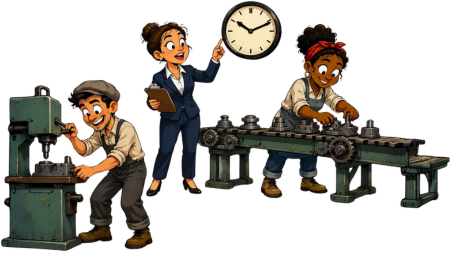
With industrialization, the problem is no longer simply producing something.
Now you have to coordinate many people doing different things, often at the same time.
And for that, you need a common reference.
That is where the clock stops being merely useful…
and becomes necessary.
When Work Starts Running on the Clock
E. P. Thompson describes this as a significant shift: from work organized around tasks to work organized around time.
It is no longer enough to ask what you are doing.
Now it matters how long you take to do it.
And that opens the door to something much more interesting.
Measure It, Compare It, Control It
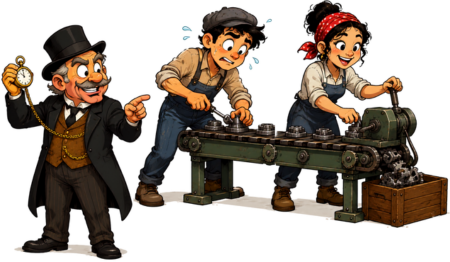
If you can measure time, you can compare.
If you can compare, you can evaluate.
And if you can evaluate, you can correct.
Suddenly, time becomes a remarkably convenient tool for organizing—and adjusting—human behavior.
Not necessarily because someone is directly forcing you to do something, but because there is now a clear way of deciding whether you are doing “enough.”
And that changes everything.
Time is no longer simply a way of organizing work.
It becomes a way of organizing people.
When Control Stops Coming From Outside
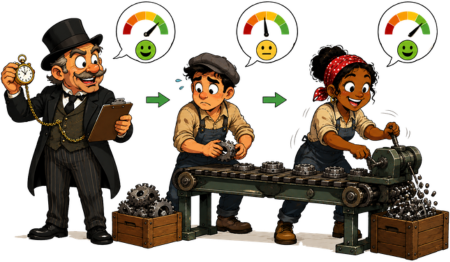
The result is that constant surveillance is no longer necessary.
At first, this system relies on fairly visible external rules: strict schedules, supervision and penalties.
You arrive late, there is a problem.
You don’t comply, there are consequences.
But that model has a limitation.
Someone has to be watching.
And watching people all the time is expensive, inefficient… and exhausting.
So the system improves.

When You Start Supervising Yourself
Instead of depending entirely on constant surveillance, it begins producing something much more useful: people who supervise themselves.
This is where Foucault’s analysis of discipline becomes relevant. Discipline stops being something that comes entirely from outside and becomes something you apply to yourself.
You start checking the time without anyone asking you to.
You calculate whether you are being productive enough.
You become uncomfortable when you feel that you have “wasted time.”
In everyday language, you know this as being responsible, making good use of your time or not wasting the morning.
Nobody needs to tell you anything.
You already know.
And you act accordingly.

It Works So Well That It No Longer Looks Like Control
The result is remarkably efficient. You don’t need constant supervision because each person does part of the work themselves. They organize themselves, correct themselves and pressure themselves.
Basically, you do your boss’s job for free.
And you do it convinced that it is the right thing to do.
If you arrive late, it bothers you.
If you aren’t productive, you feel guilty.
If you rest too much, you feel that you have to justify it.
All of this happens without anyone having to intervene directly.

When Control Starts Feeling Like Common Sense
And that is the crucial point: it doesn’t feel like control.
It feels like common sense.
- “You have to be disciplined.”
- “Time is valuable.”
- “You can’t waste the day.”
All of that sounds reasonable.
Until you notice something fairly simple:
You are not just using time.

Time Is Organizing You
And yes, it works extremely well.
Because when a system manages to make you reproduce it yourself without questioning it, it no longer looks like a system.
The power you feel the least is often the most efficient.
Foucault would probably agree.

Time as Economic Value
From Organizing Life to Measuring Work.
In the previous sections, we saw how time went from being a way of coordinating activities to becoming a tool for organizing behavior.
First, we learned to live according to schedules.
Then we learned to evaluate ourselves according to those schedules.
But there was another important transformation: time began to acquire economic value.
According to Jacques Le Goff, during the late Middle Ages, a new way of understanding time emerged, particularly with the growth of cities, commerce and urban trades.

When Time Started Being Calculated
Time stopped being simply something that passed.
It became something that could be calculated.
And if it could be calculated, it could also be exchanged.
With the development of cities, commerce and urban occupations, something changed.
Now what mattered was how much time you worked.
And that time could be recorded, compared and, above all, paid for.
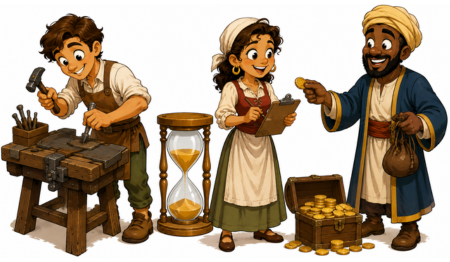
The Trick: Make Your Time Worth Something—and Then Buy It
This is where Jacques Le Goff becomes particularly interesting.
At some point, time stops being only a way of organizing life and begins to function almost like a kind of currency.
Not as a pretty metaphor. As an economic reality. Your time has a value per hour.
Other people’s time does too. And now those units can be exchanged.
You give time.
You receive money.

The Birth of an Equivalence: Time = Money
When time becomes measurable—and urban life becomes increasingly organized around the clock—a new equivalence emerges:
time can become economic value.
This doesn’t simply mean that “time is important.” It means something much more concrete: your time can be translated into money.
You work eight hours. You receive payment for those eight hours. Then you use that money to buy things that someone else produced with their time.
Everything fits together rather neatly.
Almost suspiciously neatly.
And because it works so well, it stops looking like a historical construction. It starts looking like the natural way things are supposed to work.

When Your Time Gets a Price
Once labor time becomes measurable, it can also become part of the economic calculation.
You are no longer paid only for what you produce. The time you spend producing it becomes part of what is being valued.
An hour becomes a unit.
Your work can be measured in hours, compared with other people’s work and exchanged for money.
And that changes the relationship between you and your own time.
Your time is no longer simply something that passes while you work.
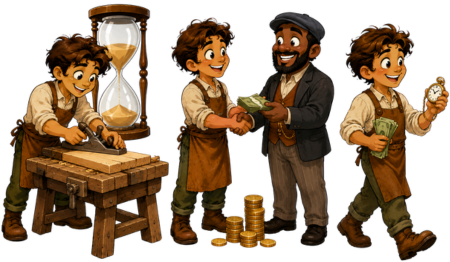
It Is Something You Sell
That may sound completely normal today.
And that’s precisely the point.
The idea that your labor time can be turned into a monetary value became fundamental to the development of wage labor.
The clock didn’t just tell you when to work.
It helped make your working time countable, comparable and sellable.

Not All Time Is Worth the Same
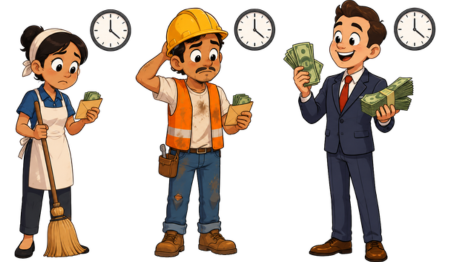
If time becomes an economic measure, then not everyone’s time can have the same value.
Two people can work the same number of hours and receive completely different amounts of money.
Why?
Because the value isn’t actually contained in time itself. It depends on the type of work, the skills required and the position a person occupies within the economic system.
So time becomes a measure—but an unequal one.
And that inequality isn’t accidental.
It is part of how the system works.
So You Try to Make Your Time Worth More
And you adapt.
You train. You specialize. You improve your skills.
The goal is fairly obvious: make your time more valuable.
You don’t just want to work more hours. You want each hour to be worth more than it was before.
Basically, you start trying to increase the price of your own life per hour.
Sounds reasonable.
After all, who wouldn’t want to be worth more per hour?
But something else happens along the way.
You start looking at your time the same way the system does.

When Everything Has to Be Worth It
You don’t just sell your time.
You start thinking in those terms all the time.
- “Is this worth my time?”
- “I’m wasting time.”
- “I need to use my time better.”
None of this sounds particularly strange. In fact, it sounds responsible.
Until you stop and think about what it implies. Rest is no longer simply rest.

It Becomes Time That Isn’t Being Monetized
A slow afternoon can start to feel like wasted potential. A conversation needs to be worth having. A walk needs a purpose. Even free time can start looking like an investment opportunity.
And that’s when the logic gets interesting.
You begin optimizing things that never needed to be optimized.
Even your free time.
Everything has to justify its existence.
Everything has to be worth it.

Internalizing the Calculation
This is where the transformation stops being merely economic and becomes personal.
The system isn’t the only thing measuring time anymore.
You are doing it too, often without realizing it.
It slips into the way you speak and the way you think. It becomes completely normal to talk about:
- “wasting time”
- “making the most of your time”
- “getting more out of your time”
These expressions sound harmless.
But they all rest on the same basic assumption:
Time is supposed to produce something.
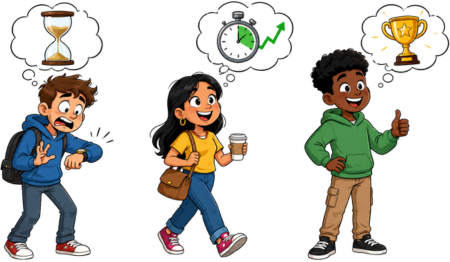
Until Then, Everything Sounds Reasonable
And that is precisely the point. The logic works because it makes sense.
Organizing yourself better, taking advantage of opportunities and managing your time responsibly can all be useful things.
The problem appears when that same logic stops being applied only to work and starts being applied to the person.
You no longer ask only:
- “What did I do today?”
You also start asking:
- “Did I use my time well?”
- “Was it enough?”
- “Was it worth it?”

Using Time to Evaluate Yourself
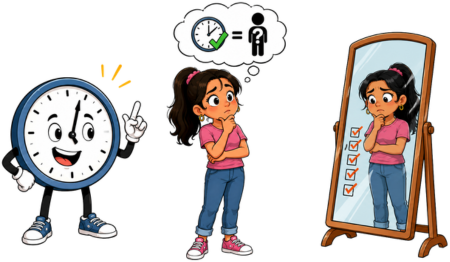
Time stops being simply a tool for organizing activities and becomes a way of evaluating yourself.
And that is where something interesting happens: control no longer has to come entirely from outside.
After years of learning to think this way, we often become the ones doing the calculation.
And the strange thing is that today this feels completely normal.
So normal that we barely question it.
As if it had always been this way.
Even though it wasn’t.
Today, Time Controls Us
The Modern Paradox: More Speed, Less Time.
In theory, all of this was supposed to help us make better use of time.
And yet, somehow, we still don’t have enough of it.
Today we have more tools for organizing ourselves than ever before. Calendars, apps, reminders, productivity systems…
We can plan our day down to the minute.
We can measure what we do.
We can even get a notification reminding us to do something we ourselves decided to do.
Very efficient.
And somehow, still not enough.

The Day Comes With a To-Do List
There is always something unfinished.
Something missing.
Something we could have done better.
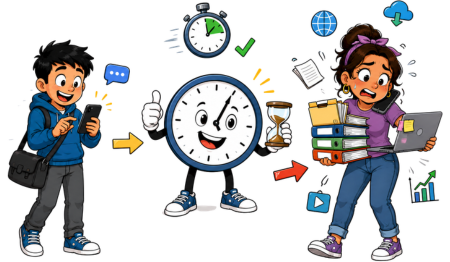
The problem is no longer simply how much time we have. It’s how much we keep trying to fit into it.
An activity used to end when it ended.
Today, it competes with messages, emails, new tasks, new goals and the constant feeling that you could be doing something else.
Answer something quickly. Learn something new. Improve your work. Don’t fall behind.
The day still has twenty-four hours.
The difference is that those twenty-four hours now seem to arrive with a to-do list attached.

When Saving Time Creates More Things to Do
And here is the modern paradox.
We keep inventing ways to save time, only to use that saved time to do more things.
Technology makes communication faster, so we communicate more.
It makes work faster, so we expect more work. It makes information easier to access, so we consume more of it. Congratulations. We saved time.
Now we have more things to fit into it.
Hartmut Rosa describes this as one of the paradoxes of modernity: we develop technologies that accelerate life and save time, yet we often end up feeling that we have less of it.
The clock isn’t moving faster.
We’re just asking it to carry more.
When Control No Longer Needs a Controller
Byung-Chul Han adds an even more uncomfortable idea: the problem is no longer simply that society demands more from us.
It is that we have learned to demand more from ourselves.
In the past, control depended more visibly on supervisors, strict schedules and someone telling you what to do.
There was an external figure who established the rhythm and set the limits.
You knew who was in charge. You knew what was expected.
And if you didn’t do it, someone would probably let you know.
Today, the system works in a much more efficient way.
Very often, we do that work ourselves.

When You Become Your Own Supervisor
You no longer need someone telling you to work harder.
The message is already installed.
You have goals, targets and to-do lists that, strangely enough, seem capable of growing on their own.
You finish one task and three more appear.
You answer your emails and there are more waiting.
You reach one goal and immediately need another.
It’s almost as if tasks have discovered how to reproduce.
And this is where one of Han’s most interesting observations appears: the pressure no longer comes only from outside.
We have incorporated it.

The Boss Who Now Lives Inside Us
We want to be more productive, organize our time better and make the most of every moment.
Even rest has to justify itself.
We don’t simply rest because we are tired.
We rest so we can come back with more energy, perform better and keep going.
Because apparently, even doing nothing now needs a business case.
A small modern irony: you can spend an afternoon doing absolutely nothing and still feel that you should have done something.
And this is where Byung-Chul Han’s paradox becomes interesting.

When We Think We Are Free
We think we are freer because nobody is directly forcing us to do anything. There is no supervisor standing behind us watching the clock. Nobody is telling us every five minutes to work harder.
And yet we still count the hours.
We still measure the results.
We still feel guilty when we think we have “wasted time.”
The pressure has changed.
The old boss was outside.
Now, quite often, he has our name.

But It Wasn’t Always Like This
Time Wasn’t Always Your Boss.
Today, time is in charge.
You don’t question it.
You obey it.
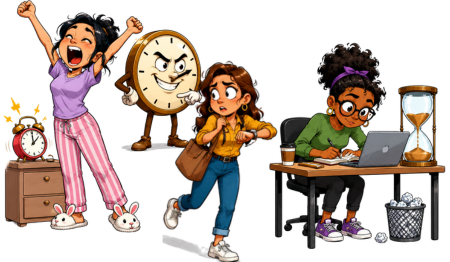
You wake up to an alarm. You eat at a certain time. You work in blocks. You measure your days in terms of productivity.
And if you “waste time,” that little feeling of guilt appears—the one we all know.
But here comes the uncomfortable part.
None of This Is Natural
After everything we’ve just seen, there is something important to remember: our current way of experiencing time is not the only possible one.
Today we think of time as something that can be measured, divided, organized and optimized.
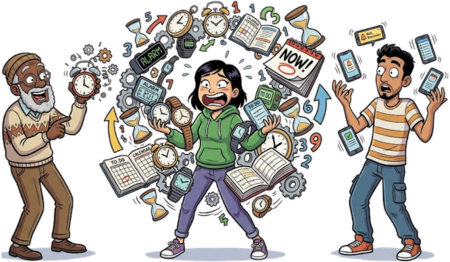
We have clocks, calendars, planners and apps that can even remind us what we are supposed to be doing.
It seems completely normal.
But it wasn’t always this way.
How Other Cultures Perceived Time
Many cultures understood time differently. Not as a resource that had to be constantly managed, but as something connected to cycles, nature, community and the rhythms of the world.
The Egyptians observed the cycle of the Nile.
Mesopotamian societies watched the movements of the heavens.
The Maya developed systems in which different cycles of time existed alongside one another.
In the Andes, time was deeply connected to nature and the organization of society.
These societies weren’t simply using “less accurate” versions of our modern clock.
They were operating with different relationships to time.
And that’s the important part.

It Isn’t Better: It’s Different.
This doesn’t mean those societies were better.
It doesn’t mean we chose the wrong path.
It means something more interesting:
Time was never only a measurement.
It was also a way of understanding our relationship with the world.
Perhaps the question isn’t whether we have more or less time than people did in the past.
Perhaps the question is:

What Kind of Relationship We Want with Time?
Because after centuries of trying to measure it, organize it and make it more efficient, maybe it is worth remembering something fairly simple:
Time isn’t only something we count.
It is also something we live.