Today We Have 12 Months
January opens the year, December closes it, and between them we have ten more months we’ve learned to recite since childhood. Nobody usually stops to think too much about it.
We know that April is followed by May, that July shows up around the middle of the year, and that December arrives just in time to remind us that we probably left too many things until later.
But we never really ask why the year has twelve months and not thirteen. Why is thirteen unlucky? Who came up with that brilliant idea?
It seems like a pretty natural system.

But It Isn’t!
The Earth travels around the Sun. That’s the natural phenomenon. The year is our way of measuring that cycle. Months, on the other hand, are a human construction that has changed several times throughout history.
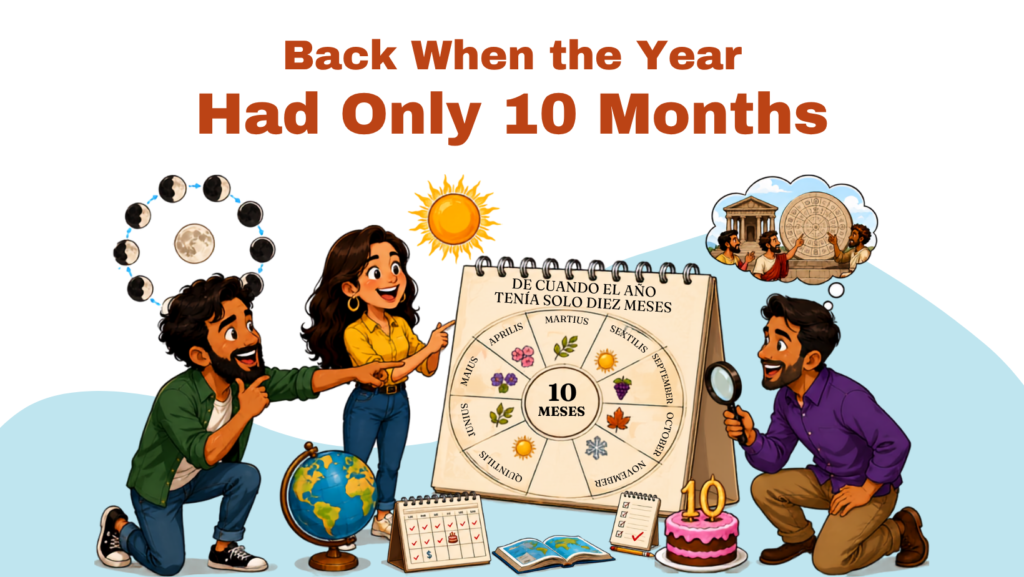
And here’s something that gets pretty strange once you stop and think about it: there was a time when the year had only ten months.
Yes! In the traditional story of early Rome, they only needed ten months a year. Why would they need more? Seriously. And what did they do for the rest of the year? Hibernate? Pretty much!

Not Twelve: Just Ten
That means January and February, two months that seem so essential today that it’s hard to imagine a year without them, weren’t always there.
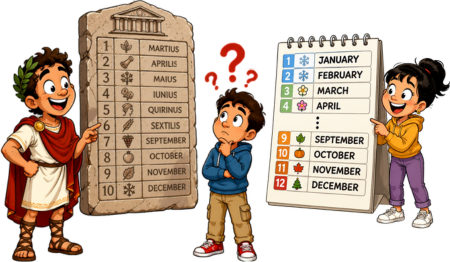
And we still have a pretty obvious clue pointing back to that older calendar. September comes from the Latin septem, “seven.” October comes from octo, “eight.” November comes from novem, “nine.” December comes from decem, “ten.”
Yet today September is the ninth month, October the tenth, November the eleventh, and December the twelfth.
Something clearly moved.
And It Wasn’t September
To understand what happened, we have to go back to a time when organizing time didn’t mean opening an app, checking Google Calendar, and accepting that someone had scheduled a meeting for 7:30 in the morning.
You literally had to decide how to divide the year.

The Year Doesn’t Come Divided into Months
This is worth starting with because we tend to talk about months as if they were a feature of nature.
The year does have a fairly clear astronomical basis. Earth takes about 365 and a quarter days to complete its orbit around the Sun.
But nature doesn’t hand us twelve perfectly packaged months inside those 365 days.

Months Have a Different Story
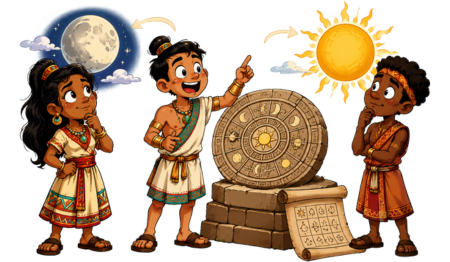
The word “month” is connected to the Moon because, for a very long time, the lunar cycle was one of the most obvious ways to measure relatively long periods of time.
In fact, both “month” and “Monday” have a connection to the Moon. The English word month ultimately comes from an old root connected with the Moon, just as the Latin “mensis” was associated with measuring time through the lunar cycle.
Monday literally comes from Old English meaning “Moon’s day.”
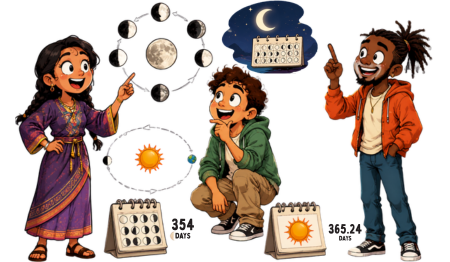
The Moon changes phase in a visible and regular way, and a complete cycle lasts about 29.5 days.
That’s a pretty practical unit of time.
The problem appears when we try to make that lunar cycle fit neatly into the solar year.
Twelve lunar months add up to about 354 days. A solar year is about 365.24.
The Difference Is About Eleven Days
Eleven days may not sound like much, but calendars don’t have much patience for small errors repeated over and over.
After three years, the accumulated difference is roughly a month. After several years, the seasons begin drifting away from their calendar dates.
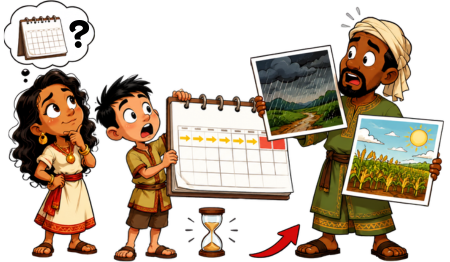
If a society wants a particular time of year to continue matching the rainy season, the harvest, winter, or any other seasonal event, simply ignoring that difference isn’t very practical.
Trying to Line Up the Moon and the Sun
So many civilizations faced the same problem: how do you make a calendar based on cycles that don’t fit together perfectly actually work?
Some solutions were solar. Others were lunar. Others combined both systems and periodically added an extra month.
From the beginning, then, there was a pretty interesting tension: the sky wasn’t designed to fit our calendar pages.
We had to make the calendar fit the sky.
And in the process, we made quite a few changes.
When March Was the Beginning of the Year
One of the first things we have to forget is the idea that January was always the obvious beginning of the year.
It wasn’t.
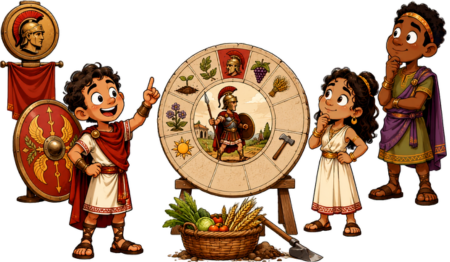
In the traditional account of early Rome, the year was organized around ten months, beginning with Martius, the month dedicated to Mars.
Mars wasn’t simply the god of war in the modern sense we usually imagine. He was also associated with agriculture and the beginning of a new season of activity.
And that gives us a pretty practical reason for putting March first.
Winter Was Basically an Interruption
So, did they actually hibernate? It sure sounds like it!
In early Roman society, winter represented something of an interruption. With the arrival of spring, agricultural activity increased, and the military season also began. March marked the return to a more active life after winter.
So starting the year in March wasn’t nearly as strange as it seems to us now.
In fact, we can still see traces of that arrangement in the names of the months.
If March was first, April was second, May third, and June fourth. Then came Quintilis, “fifth”; Sextilis, “sixth”; September, “seventh”; October, “eighth”; November, “ninth”; and December, “tenth.”
Suddenly everything makes sense.
September isn’t badly named.

Our Calendar Is What Changed
The names simply survived.
It’s one of those little historical oddities sitting in front of us every day without us paying attention.
When you say “September,” you’re using a word that still carries the memory of a time when September occupied a different position.
The modern calendar is full of these little scars.

So What Happened to January and February?
Now we have to enter Roman territory, but without falling into the trap of imagining that there was one particular day when someone woke up, grabbed a ruler, and announced:
“Okay, everyone, I think we need two more months.”
The story was considerably more complicated.
Roman tradition attributed an important calendar reform to Numa Pompilius, the second legendary king of Rome, who was said to have added January and February to the ten-month system.
The ancient sources aren’t reliable enough for us to treat every detail of that tradition as if we were reading official paperwork from the seventh century BCE.
But the tradition does reflect something important: the Roman calendar was reorganized, and the two months we now know as January and February eventually became part of the year.
How January and February Finally Showed Up
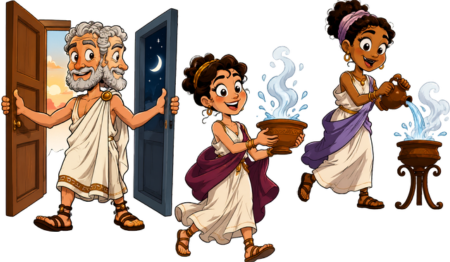
January got its name from Janus, a Roman deity associated with doors, beginnings, transitions, and passages.
And the name is pretty appropriate. A door connects one space to another, and January eventually occupied exactly that position between one year and the next.
February had a different association. Its name comes from Februa, connected with purification rituals performed in Rome.
So the two months that eventually took their place at the beginning of the year didn’t arrive with random names. Each had a connection to Roman religious and cultural ideas.
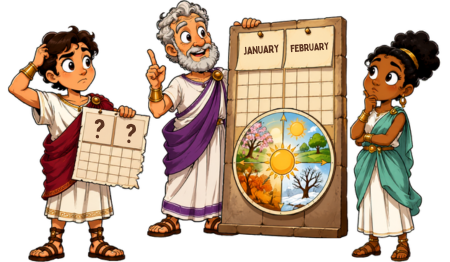
Adding January & February Didn’t Solve the Problem
But adding January and February didn’t mean the calendar had finally reached its definitive form.
The problem was that adding January and February solved one thing, but it didn’t solve the relationship between the calendar and the seasons.
If the year was supposed to follow the Sun, there still had to be a way to compensate for the difference between the calendar and the solar cycle.
The Little Problem of the Days Left Over
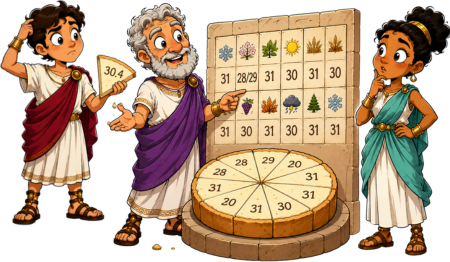
This is where one reason for our 28-, 29-, 30-, and 31-day months appears, instead of twelve perfectly equal blocks.
If we could divide 365 days equally into twelve parts, each month would have about 30.4 days.
But we can’t have 30.4 days.
It wouldn’t be very convenient to say:
“This month ends Tuesday at 4:36 in the afternoon.”
So calendars had to distribute the days somehow.
And the Romans kept modifying the lengths of the months in attempts to keep the calendar aligned with the solar year.
The problem became particularly important because the calendar wasn’t simply a tool for knowing what day it was.
The Calendar Had to Organize Society
It organized religious festivals, agricultural activities, political affairs, civil obligations, and military events.
If the calendar drifted too far, you didn’t just have a problem with the date of your next meeting.
You had a problem with when a religious ceremony was supposed to happen, when a particular agricultural activity should begin, or how the political calendar was organized.
That’s why controlling the calendar also meant, in a sense, controlling the organization of society.
And this is where the history of time starts getting considerably more interesting.

The Calendar Was Political Too
It’s easy to imagine the calendar as a purely mathematical issue: there’s a Sun, there’s a Moon, we do some calculations, and that’s it. But calendars have always had a social and political dimension.
Someone decides when the year begins, when a festival is celebrated, which days are working days, and when certain obligations begin. In Rome, those decisions could have very concrete political consequences.
The Roman calendar underwent modifications and, over time, became considerably out of sync with the solar cycle.
Extraordinary adjustments could be made to bring the calendar back into alignment with the seasons, but those mechanisms weren’t always applied in a perfectly regular way.
The Calendar’s Role, Literally
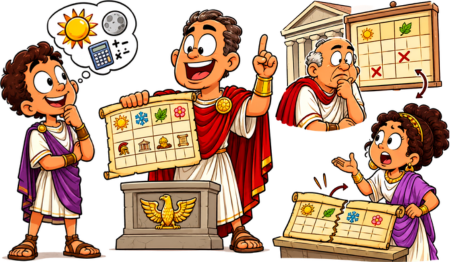
During the Republic, the pontiffs played an important role in administering the calendar and could make adjustments by inserting an extra month when necessary.
The problem was that this system wasn’t based on mathematics alone. It could also be affected by political decisions.
When a calendar determines when official terms, obligations, or periods begin and end, having some control over it means having some control over political time.
The result was a pretty complicated system.
And then Julius Caesar showed up.
Julius Caesar Decides to Fix It
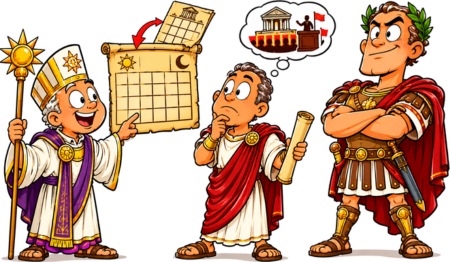
By the middle of the first century BCE, the Roman calendar needed a major reform.
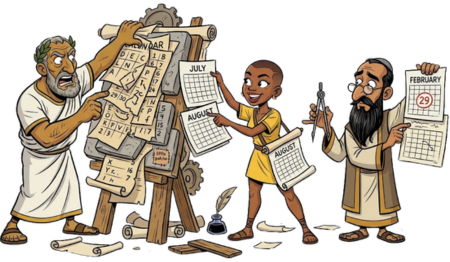
Julius Caesar, with the help of the Alexandrian astronomer Sosigenes, pushed through a reorganization based on the solar year.
The result was the Julian calendar, which began being used in 45 BCE.
The basic idea was much more stable: a normal year would have 365 days, and periodically an extra day would be added to compensate for the additional fraction in the solar year.
The Leap-Year System
The reform solved much of the calendar drift that had accumulated in Rome.
But it also left a considerably more personal mark.
The month then called Quintilis, “fifth,” was renamed Julius in honor of Julius Caesar after his death.
That’s where our July comes from.
And here’s something worth remembering when we talk about calendars: names of time can become monuments.
We don’t need a statue to remember Julius Caesar.
We just have to wait a few weeks every summer.
And Augustus Didn’t Want to Be Left Out
After Caesar came Augustus.
And, as you may already be suspecting, the calendar got another name change.
The old Sextilis, “sixth,” became Augustus, from which we get August.
Here we should be careful with a popular story you may have heard: that Augustus supposedly stole a day from February so that August would have as many days as July because he didn’t want Caesar’s month to look more important.
It’s a great story.
It’s also very likely false, or at least a later simplification.
The current distribution of days among the months has a more complicated history, and we don’t need to invent a little ego battle between Caesar and Augustus to make it interesting.
When Important People Need to Be Remembered
The really interesting part is already sitting there in front of us:
Two Roman rulers still appear in our calendar two thousand years later.
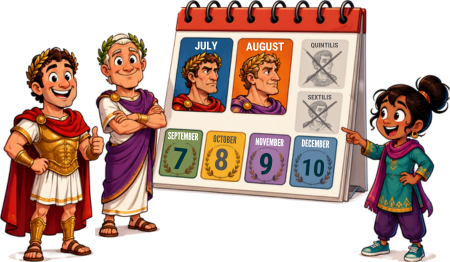
Quintilis and Sextilis disappeared.
July and August stayed.
And September, October, November, and December kept dragging around numerical names that no longer matched their positions.
Our calendar is, quite literally, a mixture of different eras layered on top of one another.
So Why 12?
At this point we can return to our original question.
Why does the year have 12 months?
The most honest answer is that there isn’t one single reason.
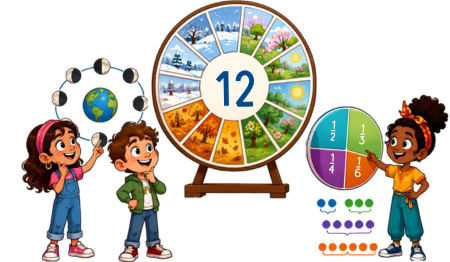
The number 12 has an interesting relationship with lunar cycles because a solar year contains roughly twelve lunar cycles, although not exactly.
And 12 is a very practical number to divide. It can be divided by 2, 3, 4, and 6 without producing awkward fractions.
That makes it useful for organizing seasons, quarters, and other divisions of the year.
Did Nature Decide?
No. We can’t really say nature “chose” 12.
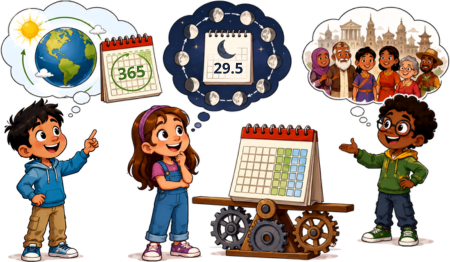
Nature gave us about 365 days.
The Moon gave us cycles of roughly 29.5 days.
We had to build something that worked between the two.
And once a society uses a particular structure for generations, that structure acquires enormous strength.
Not because it’s perfect.
Because everyone is used to it.
What If There Were 13?
And now we arrive at a question that sounds completely absurd until you look at history.
What if we had 13 months?
Astronomically speaking, it wouldn’t be that crazy.
In fact, as we saw earlier, a solar year contains about 12.37 lunar cycles. Lunisolar calendars have historically used extra months to compensate for the difference between lunar cycles and the solar year.
So a thirteenth month can make sense as a calendrical solution.
But now comes the fun part.
Suppose tomorrow we decide to adopt a 13-month calendar.
What Do We Do With That Month?
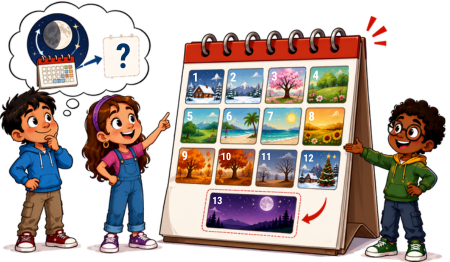
We could make all the months exactly four weeks long and create a much more regular system. In fact, calendars like this have been proposed.
Mathematically, it sounds pretty nice.
Socially, good luck.
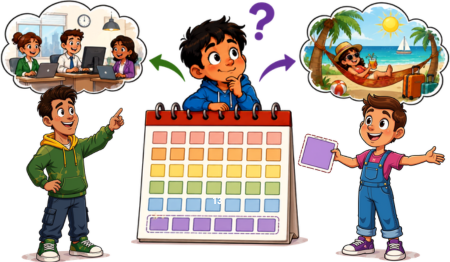
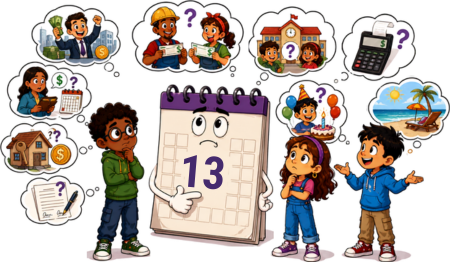
Because someone would have to decide whether that month is a working month.
And if it is, congratulations: we’ve just given humanity several extra weeks of obligations.
If it isn’t, we’ve just created an entire month of vacation. Whatever you like the most.
The Real Problem With Month 13
It’s not that it might be an unlucky month and everyone would have to avoid it. If that were the problem, we’d have to eliminate every 13th of every month.
The real problem is…
Who pays for it?
Do companies pay salaries during that month?
Do workers get an additional paycheck?
Do rents have to change?
Would a twelve-month contract become a thirteen-month contract?
Would schools add another academic period?
Would taxes be paid thirteen times?
And if someone is born during month 13, what do we do with their birthday?
The problem is no longer astronomical. It’s administrative.
And we’d probably discover something pretty uncomfortable: a lot of the time, when we say we want “more time,” what we really want is more free time.
Nobody seems particularly interested in receiving an extra month if it comes with four more weeks of work.
The Calendar Nobody Wants to Change
This explains something important about time.
Once a society organizes its life around a calendar, changing it becomes extremely difficult.
It isn’t enough to prove that the new system is mathematically better.
You have to get millions of people, companies, governments, schools, and organizations to simultaneously change the way they record contracts, salaries, vacations, taxes, birthdays, seasons, statistics, and dates.
And that helps explain why we can continue using a structure containing little oddities inherited from thousands of years ago.

Not Because It’s Perfect
Because changing it would cost far more than putting up with its imperfections.
Think about the names of our months.
September means seven, but it’s the ninth.
October means eight, but it’s the tenth.
November means nine, but it’s the eleventh.
December means ten, but it’s the twelfth.
It’s almost as if the calendar is leaving little notes in the margin saying:
“This wasn’t always organized this way.”

And It’s Right
Our calendar isn’t a photograph of how the universe works. It’s the result of thousands of years of trying to make the universe, society, and our own needs fit inside the same system.
And maybe that’s why we still have 12 months. Not because it’s the only way to organize a year, but because after so much time, it’s simply too difficult to imagine another one.
Although, if a month 13 ever shows up, I hope they at least give us vacation.

The Year We Inherited
Today January seems like the obvious beginning. December seems like the obvious end. Twelve months seems like the obvious number.
But when we look back, we find a calendar that was much less orderly than we imagined.
First came systems based on observations of the Moon. Then came different ways of reconciling the lunar cycle with the solar year.
In the Roman tradition, the year was organized around ten months and began in March.
Then January and February appeared. The beginning of the year changed. The months were adjusted.

The Roman Calendar Fell Out of Sync
Julius Caesar reformed it. July and August received names we still use.
And many centuries later, the Gregorian calendar made further adjustments to correct a small difference that, accumulated over generations, once again pushed the calendar out of alignment with the solar year.
What looks today like a perfectly stable structure is actually the result of thousands of years of adjustments, decisions, reforms, traditions, and little patches.
So the interesting question isn’t only:
“Why do we have 12 months?”
The more interesting question is:
“How Did We Get Used to These 12?”
Because we could have inherited another system.
We could have kept a ten-month year.
We could have developed a calendar with 13 months.
We could have organized the months differently.
And probably, after a few generations, any of those systems would seem completely normal to us. That’s perhaps the strangest thing about the calendar.

When a Choice Becomes a Fact
It’s not that January has to be first.
It’s not that December has to be last.
It’s not that 12 is some magical number of months that nature decided to hand us.
It’s simply the system we inherited.
And once everyone learns to live inside it, it stops looking like a decision.
It starts looking like a fact.
Until someone stops and asks:
Why?