

How Spanish Has Contributed to American Identity
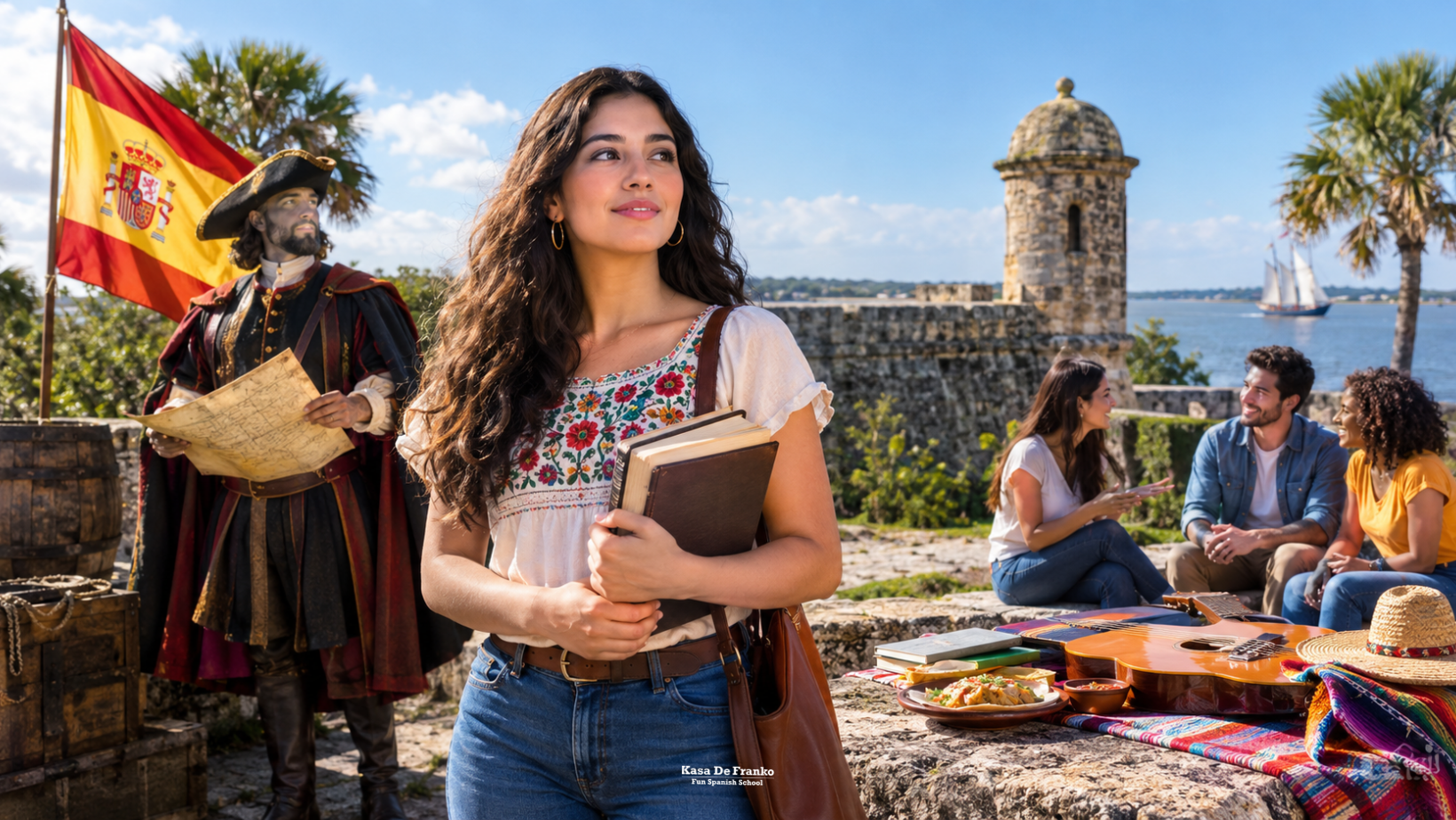
Online Spanish Socials$35.00
Conversational Spanish
Tuesday, 10-27-2026 (PT)
07:00 pm to 08:30 pm (PT)
Level: Int. – Adv.
Before English Became “American,” Spanish Was Already Here
Wait… Spanish Is Part of American Identity?
When you think of American identity, what comes to mind?
The flag? The Constitution? Baseball? Apple pie? English?
Especially English.
After all, this is America. Shouldn’t Americans speak American?
Well… what exactly is American?
And what if I told you that Spanish was being spoken in parts of what is now the United States
long before the country declared its independence?
Spanish Was Here Before English
In 1565, the Spanish established St. Augustine in present-day Florida. That was 42 years before the English founded Jamestown in 1607, and more than two centuries before the Declaration of Independence in 1776.
So, while the future United States was still a twinkle in somebody’s colonial eye, Spanish was already part of the story.
And it never really left.
Wait… Isn’t America Supposed to Speak English?
English dominates American public life, but does that mean American identity belongs exclusively to English speakers?
Think about it.
California. Florida. Nevada. Colorado. Montana.
These names aren’t exactly hiding their Spanish connections.
And place names are only the beginning. Spanish has left its mark on American vocabulary, geography, food, music, culture, and everyday life.
Yet Spanish speakers are sometimes treated as if they had just arrived yesterday.
Funny how that works, isn’t it?
So… Who Gets to Be American?
Does speaking English make you American?
Does speaking Spanish make you less American?
What about someone whose family has spoken Spanish in the United States for generations? Or someone who speaks English with a Spanish accent? Or someone who speaks neither language particularly well?
Is American identity about language, ancestry, citizenship, culture, or something else entirely?
And who gets to decide?
Because the moment we start asking who belongs, language stops being just a way to communicate. It becomes a question of identity, power, and belonging.
Spanish, English, and the American Story
The United States did not develop in a linguistic vacuum.
Its history includes Indigenous languages, Spanish, English, French, and many others spoken by the people who have lived here.
Spanish is part of that history—not merely as a language spoken by immigrants today, but as a language with centuries of presence in what is now the United States.
And yet, when people talk about American identity, Spanish often gets treated as an addition to the story rather than part of the story itself.
Why Is That?
Is it because English became dominant? Because of immigration politics? Because of the way American history is taught? Or because language has become one more way to draw a line between us and them?
Perhaps it’s time to look at the story from a different angle.
Let’s Explore It
We’ll explore how Spanish has contributed to American identity, from its historical presence in the United States to its influence on the language, culture, and everyday life of the country.
We’ll also look at the relationship between language and belonging—and why speaking Spanish can sometimes become a political statement, even when all you’re trying to do is order lunch.
And, of course, we’ll do it in Spanish too.
Practice Spanish & Discover Something New
You will practice Spanish while discussing:
- 🇺🇸 Spanish in American history: What was happening before the United States existed?
- 🗺️ A country full of Spanish names: What do American place names reveal about the past?
- 🗣️ Do Americans speak American? What makes a language—or a dialect—American?
- 🌎 Spanish and American identity: Is Spanish a foreign language in the United States?
- 🤔 Language and belonging: Does speaking Spanish make someone more or less American?
- 🧠 Who gets to decide? Language, politics, immigration, and the meaning of being American.
- 💬 The bigger question: Can a country have a national identity without having just one language?
📢 Join Us
Bring your Spanish, your curiosity, and your ideas about what it means to be American.
You don’t need to be a historian, a linguist, or a walking encyclopedia. You just need to be willing to question a few assumptions—and perhaps discover that the story of American identity is a little more complicated than you thought.
Let’s talk. ¡Hablemos!
👥 Group Size Policy
🕗 1 attendee: 07:00 p.m. – 07:45 p.m.
🕗 2 attendees: 07:00 p.m. – 08:00 p.m.
🕗 3+ attendees: 07:00 p.m. – 08:30 p.m.