

You Aren’t Born Peruvian, You Become One!
Online Spanish Socials$35.00
Conversational Spanish
Tuesday, 11-24-2026 (PT)
07:00 pm to 08:30 pm (PT)
Level: Int. – Adv.
On Identity, Belonging, and What It Really Means to Be Peruvian
Wait… You Can Become Peruvian?
What makes someone Peruvian?
Being born in Peru? Having a Peruvian passport? Speaking Spanish? Eating ceviche? Dancing the marinera? Knowing who Túpac Amaru was?
And what if you were born somewhere else? Can you still become Peruvian?
Well, apparently, things aren’t quite as straightforward as we might think.
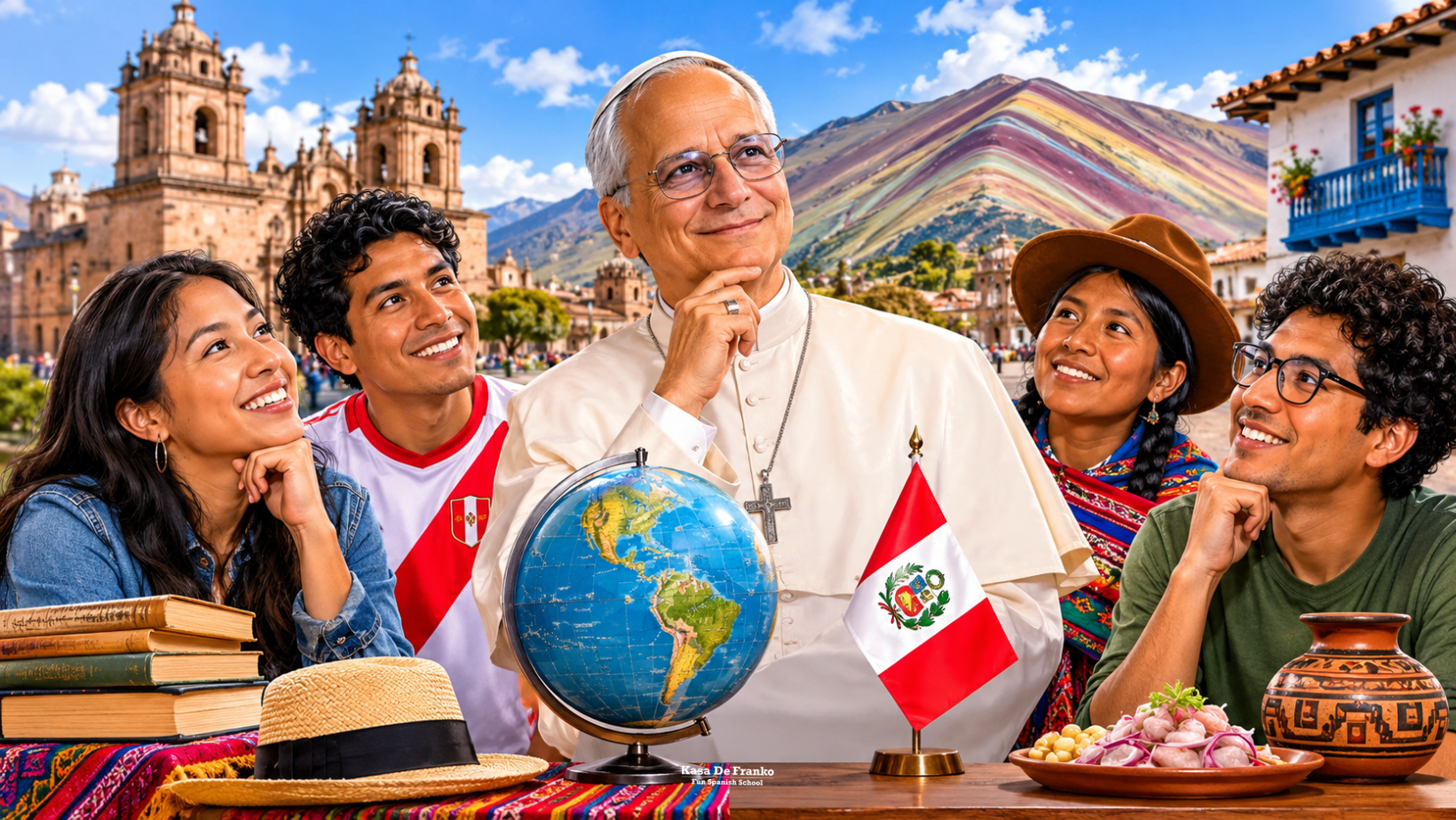
The Pope: More Peruvian than a Potato
Take Pope Leo XIV, for example. Born in Chicago, he spent a significant part of his life in Peru and now openly refers to this country as his homeland. So, is he Peruvian? And if so, what makes him one?
Meanwhile, someone born in Peru might spend most of their life abroad, grow up in another culture, speak another language, and identify more closely with the country where they built their life.
Funny how identity works, isn’t it?
Born Here, But Do You Belong Here?
We often assume that nationality, identity, and belonging are interchangeable. They’re not.
Being born in a country establishes a legal connection under certain conditions, but does it automatically determine how we identify ourselves? Does having a passport mean we feel connected to the culture, history, and people represented by that little blue or red booklet?
And what about those who acquire another nationality? Do they stop being who they were before?
Think about Peruvians who emigrated as children, those who grew up abroad in Peruvian families, and those who returned after decades away.
Are they all equally Peruvian? Does geography have the final say?
So… Who Gets to Decide Who Is Peruvian?
Here’s where things get interesting.
Do you have to speak Spanish without an accent? Eat ceviche? Handle ají without reaching for a glass of water? Dance the marinera? Recognize every national symbol?
What about Peruvians who don’t identify with Lima’s culture, Andean traditions, Amazonian customs, or any particular expression of Peruvian folklore?
Is there a single recipe for being Peruvian? And who gets to hand out those certificates of authenticity?
After all, Peru is considerably more than Machu Picchu, a plate of ceviche, and a collection of tourist postcards.
One Country, Many Identities
National identity isn’t necessarily something we inherit in its entirety at birth. It is also shaped by our experiences, relationships, memories, cultural influences, and the communities we become part of.
French thinker Ernest Renan explored the idea of a nation as a shared historical experience and a continuing collective will.
Political scientist Benedict Anderson, meanwhile, examined how people can feel connected to a national community even without personally knowing most of its members.
But what does that mean in everyday life?
Can we belong to more than one country? Can we embrace another culture without abandoning our own?
And can a nation remain united without expecting everyone to think, speak, or live in exactly the same way?
Let’s Explore It!
We’ll explore what makes someone Peruvian and whether national identity is something we’re born with, something we acquire, or something we build throughout our lives.
We’ll look at examples from Peru and around the world, question familiar assumptions about nationality and cultural authenticity, and examine the sometimes complicated relationship between personal identity and collective belonging.
And, of course, we’ll do it in Spanish too!
Practice Spanish & Discover Something New
You will practice Spanish while discussing:
- 🇵🇪 What Makes Someone Peruvian? Is national identity determined by birthplace, citizenship, ancestry, culture, or personal experience?
- 🌎 Born Here or Made Here? Can someone become part of a country without being born there?
- 🛂 Nationality vs. Identity: What’s the difference between having a nationality and actually identifying with a country?
- 🎭 Cultural Authenticity: Do you need to follow certain traditions, speak a particular language, or share specific customs to belong?
- 🌍 More Than One Homeland: Can we identify with two or more countries without having to choose between them?
- 🧠 Who Gets to Decide? Does belonging depend on how we see ourselves or how others perceive us?
- 💬 The Bigger Question: Are nations inherited communities, imagined communities, or communities we build together?
Join Us!
Bring your Spanish, your curiosity, and your own ideas about what it means to belong.
You don’t need to be Peruvian, a historian, a philosopher, or an expert in national identity. You don’t even need to agree with us!
Whether you were born in Peru, grew up somewhere else, have lived in several countries, or simply find the whole business of national identity fascinating, there’s room for you in this conversation.
After all, perhaps the real question isn’t where you were born, but what makes a place feel like home.
And if you happen to be Peruvian, don’t worry. Nobody’s going to ask you to prove your ceviche credentials at the door.
Let’s talk. ¡Hablemos!
👥 Group Size Policy
🕗 1 attendee: 07:00 p.m. – 07:45 p.m.
🕗 2 attendees: 07:00 p.m. – 08:00 p.m.
🕗 3+ attendees: 07:00 p.m. – 08:30 p.m.