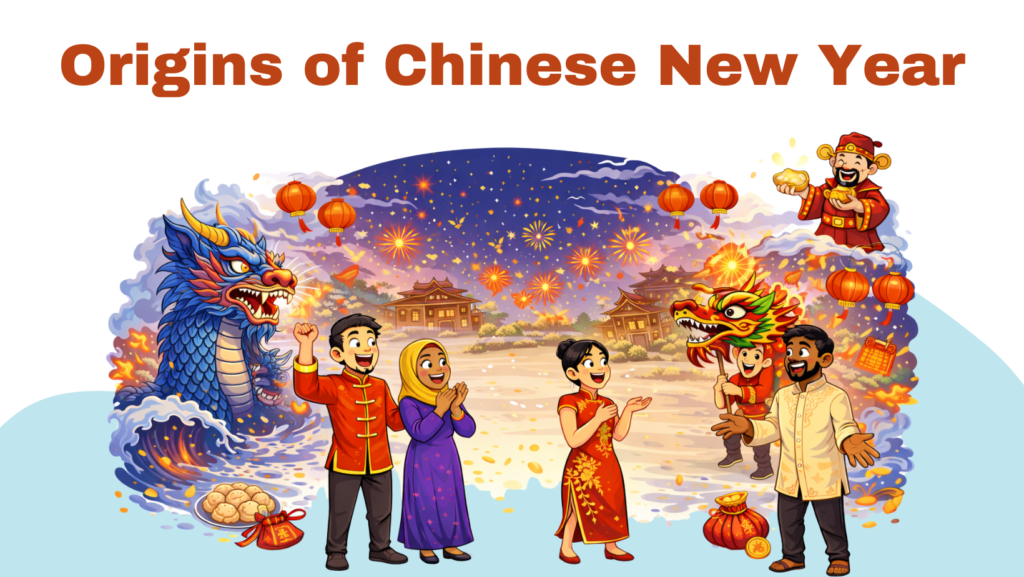
Happy Lunar New Year in Spanish?
The Lunar New Year doesn’t belong to January 1st. It arrives on its own schedule — guided by the moon, wrapped in red lanterns, carried by drums, firecrackers, and family rituals that have survived for centuries. And if you’re wondering how to say Happy Lunar New Year in Spanish, the answer is simple — but the meaning behind it is much bigger than a direct translation.
Because this isn’t just about words.
It’s about understanding what people are really celebrating when they say 新年快乐 — and why “Feliz Año Nuevo” only tells part of the story.
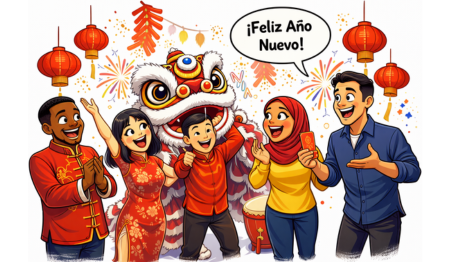
How to say Gong Xi Fa Cai in Spanish
Say It Like a Pro: Now that you’ve covered the basics, let’s talk about the phrase that really carries weight: 恭喜发财 (Gōngxǐ fācái).
This isn’t just “Happy New Year.” It’s a wish for prosperity — for success, growth, forward movement. It reflects a cultural understanding that a new year isn’t only about joy, but about momentum. So how do you express that in Spanish?
You could say:
| Spanish | English |
|---|---|
| Te deseo prosperidad. | I wish you prosperity. |
| Que tengas prosperidad. | May you have prosperity. |
The first is direct — “I wish you prosperity.”
The second feels more like a blessing — “May you have prosperity.”
Both work. Both carry intention. And that’s the point. Because when you say 恭喜发财, you’re not just being polite. You’re participating in a tradition that ties language to aspiration — something Spanish understands very well.
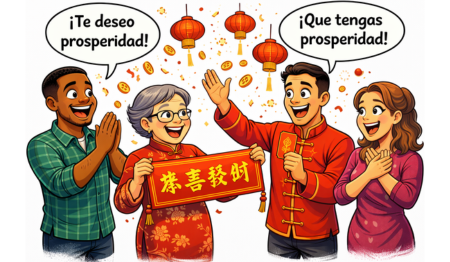
Happy Lunar New Year to All!
Whether you’re ready to celebrate with a confident “¡Feliz Año Nuevo!” or simply want to understand what the Lunar New Year truly represents, you’re in the right place. This isn’t just another date on the calendar — it’s a reset shaped by lunar cycles, family rituals, and traditions that have traveled far beyond their place of origin.
Yes, there will be red envelopes. Yes, there will be dancing. But behind the color and the sound is something deeper: renewal, continuity, and hope for what comes next.
And if we’re going to celebrate it — we might as well say it properly.
En español.
Now, let’s go back to where it all began.
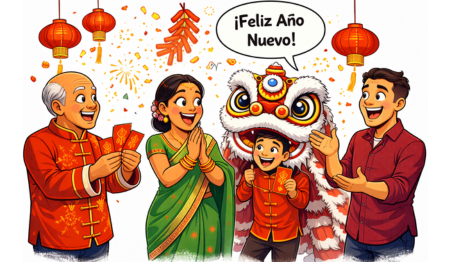
The Lunar New Year’s Ancient Origins
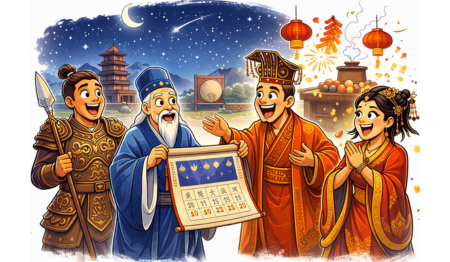
Long before calendars were neat little grids on a wall, people in ancient China were already having parties… I mean, marking time according to the moon. And trust me, they did it with style.
The Lunar New Year stretches back more than 3,000 years to the Shang Dynasty — a time when astrology, politics, and ceremonial drama all collided. Imagine robes, drums, and maybe a little magic sprinkled in.
History & Legend Intertwined
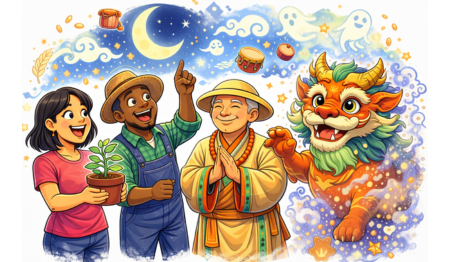
These celebrations weren’t just about planting crops or checking the stars. Nope, they were starring ghosts, monsters, and celestial shenanigans. One minute you’re offering rice to your ancestors, the next you’re dodging chaos incarnate.
And somehow, this crazy cocktail of ritual, myth, and a pinch of cosmic absurdity has survived for millennia.
Spring Festival & the Lunisolar Calendar
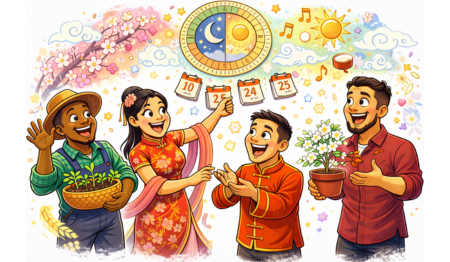
Also called the Spring Festival (fancy, right?), Chinese New Year isn’t just a calendar thing — it’s a full-on cosmic production. Lunar cycles meet solar cycles like a perfectly choreographed duet, keeping farmers, families, and fortune-tellers all in sync.
It’s not “new year = January 1st.” Nope. It’s “new year = cosmic timing, moon vibes, and maybe a dragon parade.”
Symbols, Zodiac, & the Spirit of Renewal
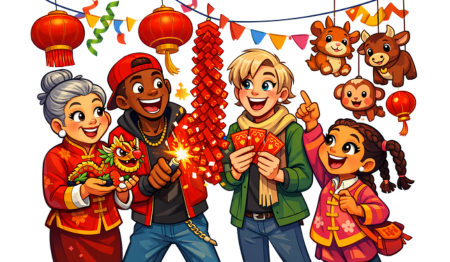
Dragons, tigers, rats… oh my! Every year, a new zodiac animal struts its stuff, bringing personality, chaos, or protection, depending on how you read it. Firecrackers scream through the streets, dragons twirl like they just had an espresso, and everyone gets a shot at renewal — spiritual, familial, and sometimes just aesthetic.
Say “Feliz Año Nuevo Chino” or “Feliz Año Nuevo Lunar,” and you’re not just greeting someone — you’re joining the party of the cosmos.
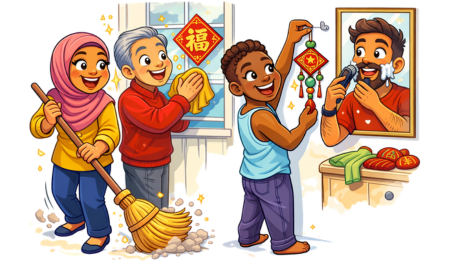
Spring Cleaning as Ritual Renewal
Before there were Marie Kondos or minimalist Pinterest boards, ancient Chinese households were throwing down with a year-end clean-up that would make any OCD neat freak blush.
This wasn’t about dusting the shelves; it was about purging bad luck, fixing doors, swapping decorations, and even scrubbing yourself (yes, literally). Fresh vibes only!
By the time they finished, homes sparkled, spirits lifted, and the universe got a polite nudge: “We’re ready for a prosperous new year, thanks very much.”
From Gods to Rituals
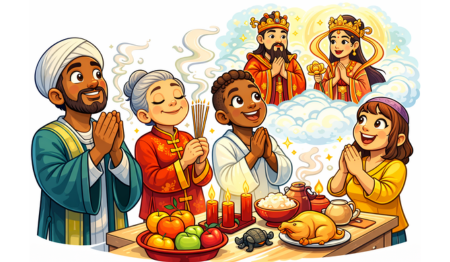
When the Heavens Had to Be Managed
Back in the day, this was all about pleasing the gods. Bow, chant, repeat. But as time went on, people realized that celebrating tradition could also be… fun. And crops don’t plant themselves, right?
As agriculture grew, the Spring Festival turned into a full-blown party. Warm weather? Check. Planting season? Check. Red lanterns, drums, and snacks everywhere? Check, check, check. Tradition, crops, and good fortune — all wrapped up in one epic annual vibe.
From Rituals to Crops
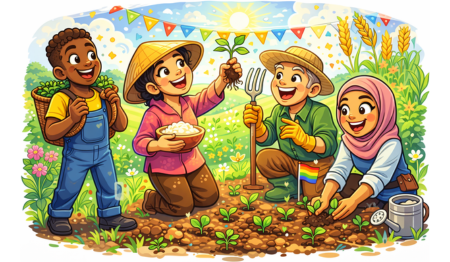
When Survival Became the Celebration
As society dug deep into agricultural life, the festival got a major upgrade. No more intense divine negotiations (though the gods probably filed complaints). Now it was all about something everyone could get behind: warmer weather and planting season.
Spring meant crops.
Crops meant food.
Food meant people could finally stop worrying and start celebrating.
And just like that, a ritual-heavy, ghost-and-god-laden affair morphed into a full-on fiesta of renewal, resilience, and the eternal hope that this year’s harvest won’t stab you in the back.
Why It Falls in Winter & Not in Spring?
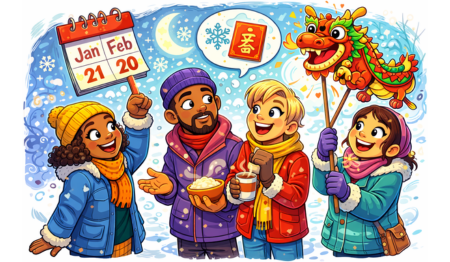
Wait, hold on — why is the Spring Festival in the middle of winter? Isn’t that… weird?
Here’s the deal: the lunar calendar doesn’t care about snow boots. The festival falls between January 21 and February 20, smack in the dead of winter, but it’s all about anticipation of spring. Think of it as spring’s VIP pre-party.
Winter is cold, yes, but in the lunar calendar, this is the season of renewal, growth, and plotting your future crop domination. So, even if your nose is freezing, the vibe is all fresh starts. And speaking of creatures who start it all… let’s meet Nian.
What “Spring” Actually Means
In the lunar system, this moment marks the transition — the turning point when winter begins to loosen its grip and the agricultural cycle prepares to reset.
Spring here isn’t about immediate warm weather.
It’s about renewal.
About growth.
About the promise that frozen fields won’t stay frozen forever.
To one calendar, it looks premature.
To the lunar calendar, it’s perfectly timed.
And speaking of dramatic seasonal shifts… let’s talk about the legendary creature that supposedly started it all: Nian.
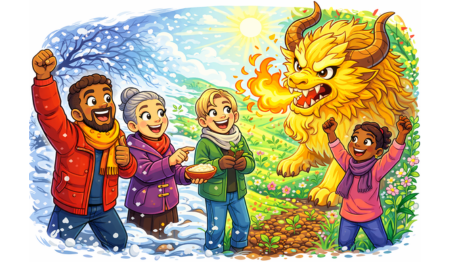
A Celestial Affair
Long ago — before fireworks were recreational and red was considered festive — there was a mythical beast named Nian.
Every New Year’s Eve, this charming creature would crawl out from the depths of the sea and terrorize villages. Crops? Devoured. Livestock? Gone. Peaceful celebrations? Absolutely not.
Year after year, Nian showed up like an uninvited seasonal subscription nobody asked for.
But eventually, the villagers had a breakthrough. Not a formal strategy session. Not a neatly scheduled council meeting over tea and dumplings. More like a collective realization that maybe — just maybe — this monster had weaknesses.
And once they figured that out? Everything changed.
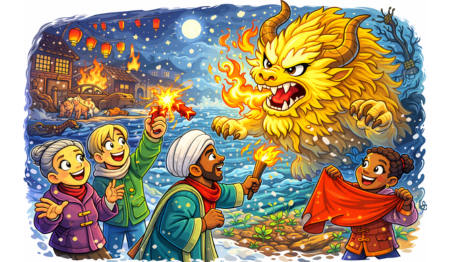
A Eureka Moment: Red & Clapping!
Some clever soul might have accidentally dropped a bright red cloth near Nian—and suddenly, the monster flinched. Or maybe someone had a true eureka moment, clapping their hands just to see what would happen—and Nian jumped back like, “Whoa, nope.”
Whatever the exact moment was, the villagers quickly realized something amazing: Nian had two big fears—red and loud, chaotic noise. And just like that, a tradition was born: decorations, firecrackers, and all things loud and red to keep Nian far, far away.
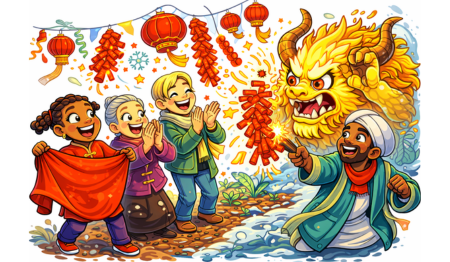
Turning the Village into a Crimson Sea
Armed with their newfound Nian-proofing wisdom, the villagers cooked up a plan that was part fashion show, part fireworks extravaganza. Red lanterns went up everywhere—doors, windows, maybe even on the dog—turning the village into a crimson sea that could blind any monster with style alone.
And with their village glowing red, it was time to add the next ingredient: a whole lot of noise.
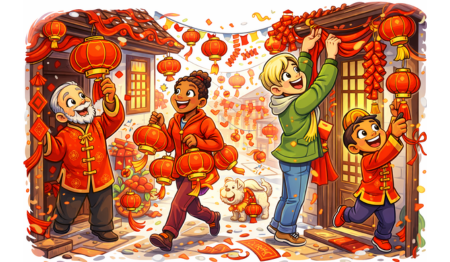
The Symphony of Noise
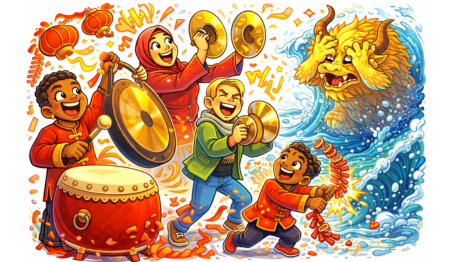
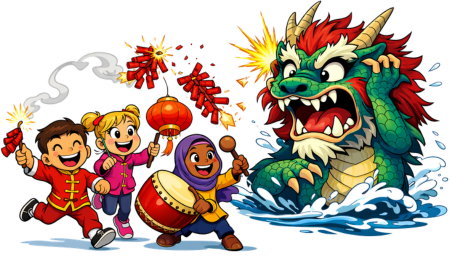
Next came the cacophony of a thousand drummers—firecrackers exploded, gongs banged, and every clap and stomp combined into a symphony of noise that rattled through every corner of the village.
And there he was: Nian, the once-mighty terror of the coast, now shrieking and slinking back into the depths of the sea, probably regretting every life choice that led him to mess with humans.
A miraculous victory! And just like that, a legendary recipe was born:
- A flood of red
- Tons of noise
- Voila—no more Nian troubles!
Spring Festival & Lunar Calendar
As Nian’s terrifying reign faded into legend, the villagers’ clever red-and-noise trick lived on—and with it, a celebration began to take shape. Today, we know it as the Spring Festival, or Chinese New Year, a time when families gather, lanterns glow, and firecrackers snap through the night.
It also marks the start of the lunar new year, following the moon’s cycles instead of the sun’s. The lunar calendar, steeped in ancient Chinese traditions, gives the holiday its rhythm, its charm, and that special sense of timing only the moon can deliver.
That’s How It Started!
And just like that, the legend of Nian became the cornerstone of Chinese New Year—a reminder that clever humans, working together, can face even the scariest monsters.
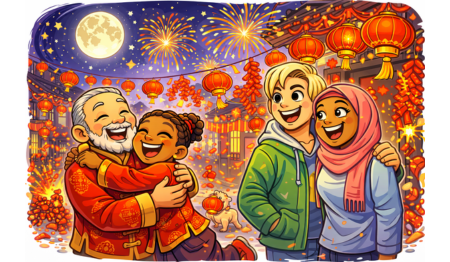
As the years rolled on, the celebration grew, flowing like a mighty river, winding its way through generations. Lanterns, firecrackers, family reunions, and all the vibrant traditions we know today became an annual ritual, deeply rooted in both cultural pride and familial love.
And somewhere, far beneath the waves, Nian still grumbles, muttering about that sea of red and thunderous noise that chased him off… proving that even monsters can’t resist a good legend.
Who celebrated it First?
Ah, the question of who celebrated first… well, that’s a story lost in the mists of time. The Chinese New Year is ancient—older than most of the hills—and different regions and communities caught on at different times, each adding their own little spark of magic.
What we do know is this: over centuries, this lunar celebration traveled far and wide, crossing continents and cultures, spreading joy, luck, and prosperity wherever it landed.
Across Continents and Generations
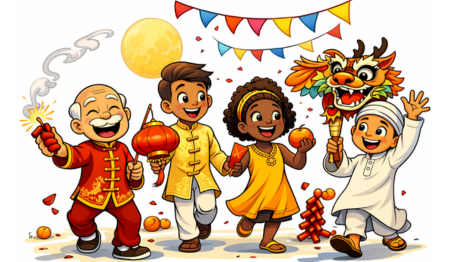
So whether you’re in the heart of China, dancing with dragons in a bustling street, or across the seas, savoring dumplings at a family table, the Chinese New Year brings us together in a tapestry of tradition, resilience, and renewal.
And may your festivities be as bright as a red lantern and as joyous as Nian’s legendary defeat—proof that even monsters can’t stop a good celebration.
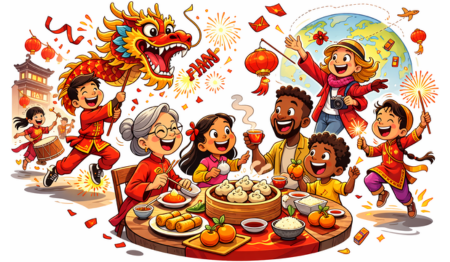
How the Celebrations Spread?
Our wise ancestors loved a good party, and they weren’t about to keep it to themselves. How did they share the joy? Think of it like ancient Amazon Prime, but instead of boxes, they delivered red lanterns, dragon dances, and good luck—all with extra cultural flair.
Chinese merchants, traders, and travelers along the Silk Road became the ultimate party couriers. They carried the spirit of the lunar celebration far and wide, leaving traces of prosperity, red decorations, and festive cheer wherever they went.
Sailing to distant lands, spreading traditions, and sharing the joy of dragons, firecrackers, and red envelopes, they made sure everyone got a slice of the celebration—even thousands of miles from home.
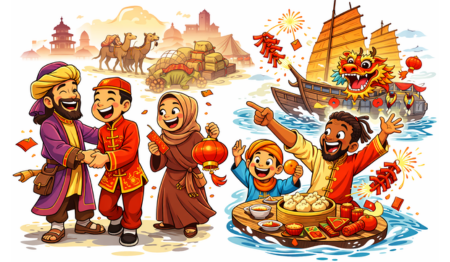
The Spring Festival Became a Global Sensation
The Spring Festival didn’t stay in one place for long—it became a global sensation, uniting communities far and wide in joy, color, and celebration. Chinese communities carried these traditions across oceans, turning the Chinese New Year into a cultural phenomenon that everyone wanted a piece of.
This tale is really about cultural exchange, dumpling diplomacy, and the universal love for a good party.
May your celebrations be as lively as a dragon dance and as delightful as a plate of freshly made dumplings—because some traditions are just too good not to share.
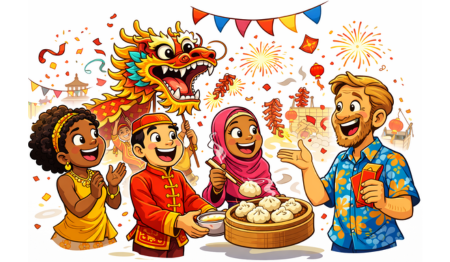
A Global Celebration
Chinese New Year isn’t just a Chinese affair anymore. Over the centuries, this celebration packed its bags and crossed borders, becoming a global phenomenon that even Marco Polo would envy.
From dragon dances to vibrant parades, from delicious dumplings to the promise of good fortune, the festival has captured hearts everywhere, showing that some traditions are just too joyful not to share.
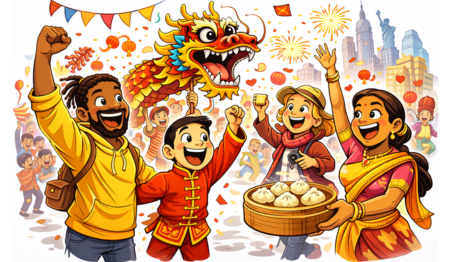
A Celebration Without Borders
What began as a seasonal ritual tied to harvest cycles and village survival didn’t stay there.
Over centuries, Lunar New Year crossed oceans. It followed migration routes. It settled into Chinatowns and blended into multicultural cities. Lanterns glowed in San Francisco. Lion dances echoed through Lima. Firecrackers cracked against unfamiliar skylines.
The celebration adapted.
But it never lost its core: reunion, renewal, and the wish for prosperity in the year ahead.
And when a tradition travels, its greeting travels too.
Which brings us to a simple — but important — question.
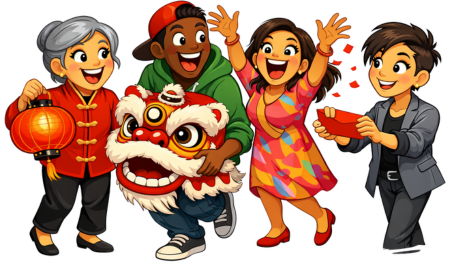
How to Say Happy Lunar New Year in Spanish
If Lunar New Year is being celebrated in Spanish-speaking communities, the words shift — even if the intention does not.
| The most direct translation is: | Feliz Año Nuevo Lunar |
| You may also hear: | Feliz Año Nuevo Chino |
Both are linguistically correct. But as you’ve seen throughout this story, Lunar New Year isn’t just a date. It’s a wish — for renewal, momentum, prosperity.
So when you say it in Spanish, you’re not just translating a phrase.
You’re carrying forward a tradition that has already traveled across centuries and continents.
The language changes. The hope remains the same. But a single greeting is only the beginning.
Trilingual Lunar New Year Vocabulary
As the celebration crossed borders, so did its language.
We’ve seen how Lunar New Year evolved — from ancient ritual to global festival — and how its greeting adapts in Spanish. But the spirit of the season lives in more than one phrase.
It lives in the words people repeat at dinner tables, in crowded streets, and in quiet family reunions.
Here are some of the most meaningful Lunar New Year expressions in Chinese, Spanish, and English — side by side.
| Chinese (Simplified) | Pinyin | Spanish | English |
|---|---|---|---|
| 新年快乐 | Xīnnián kuàilè | Feliz Año Nuevo | Happy New Year |
| 恭喜发财 | Gōngxǐ fācái | Te deseo prosperidad | Wishing you prosperity |
| 春节 | Chūnjié | Festival de Primavera | Spring Festival |
| 红包 | Hóngbāo | Sobre rojo | Red envelope |
| 团圆 | Tuányuán | Reunión familiar | Family reunion |
| 年年有余 | Niánnián yǒu yú | Que tengas abundancia cada año | May you have abundance every year |
| 万事如意 | Wànshì rúyì | Que todo te salga bien | May everything go as you wish |
| 吉祥如意 | Jíxiáng rúyì | Buena fortuna y éxito | Good fortune and success |
| 福 | Fú | Prosperidad / Buena suerte | Blessing / Good fortune |
| 舞龙 | Wǔ lóng | Danza del dragón | Dragon dance |
These aren’t just vocabulary terms.
They reflect what the season values: prosperity, harmony, abundance, reunion, and hope for what comes next.
Different languages. Same intention.
And if history has taught us anything, language can be a surprisingly powerful defense.
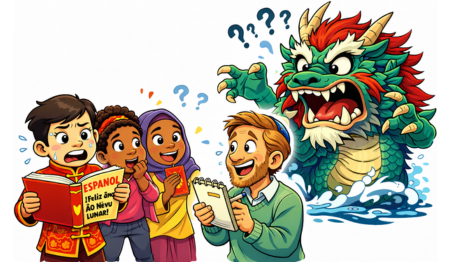
Nian Doesn’t Know Spanish
Now here’s the good news: Nian definitely does not know how to say Happy Lunar New Year in Spanish.
Which gives you a slight advantage.
So hurry up. Learn it before he does.
Because the last thing you want is a mythical sea beast expanding his language skills, showing up bilingual, and politely wishing you prosperity right before devouring your crops.
Stay ahead.
Stay multilingual.
Stay uneaten.
Time to Spread the Lunar Love in Spanish!
Now that you know how to say Happy Lunar New Year in Spanish, go wish it to everyone.
Being Spanish now the most popular foreign language in China, we want to invite you to learn more about the Spanish culture and how we celebrate New Year by visiting our KDF’s Blog categories Holidays.
P.S: Avoid saying ¨Feliz Ano Nuevo¨; otherwise, you might get in trouble. Find out why by clicking on Language Bloopers.
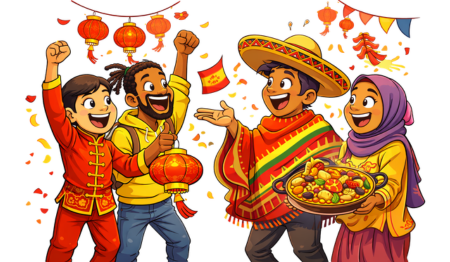
Eager to Explore More in Spanish?
After delving into the realm of language quirks, don’t overlook ‘Spanish is Sexy’ and ‘Dancing with Words.’ They’re sure to elevate your sizzling Spanish vocabulary.
For those intrigued by legends, traditions, and folktales in Hispanic culture, begin your journey by exploring our Folktales & Legends category. Immerse yourself in our saga El Sexi Chupacabras and tales of La Llorona, La Ciguapa, or La Santa Muerte.
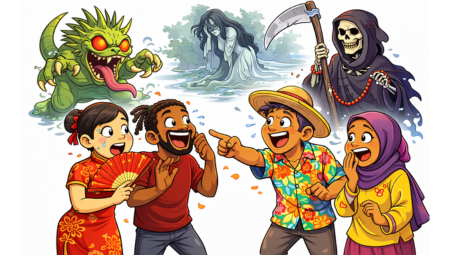
Unlock Free Classes at KDF!
Grab a complimentary session at Kasa de Franko to master those everyday phrases. Our classes go beyond slang; Spanish is a treasure trove of awesomeness. Claim your free Spanish session today and join fellow language enthusiasts.
Hit the button below to kick off your language-learning extravaganza: Check out our crazy discounts for Chinese New Year! So you can wish someone a Happy Chinese New Year in Spanish while offering a present. We strongly recommend KDF Gift Cards.
Now that you know how to say Happy Lunar New Year in Spanish, dive into the enchantment of Spanish and its limitless possibilities, always keeping in mind: