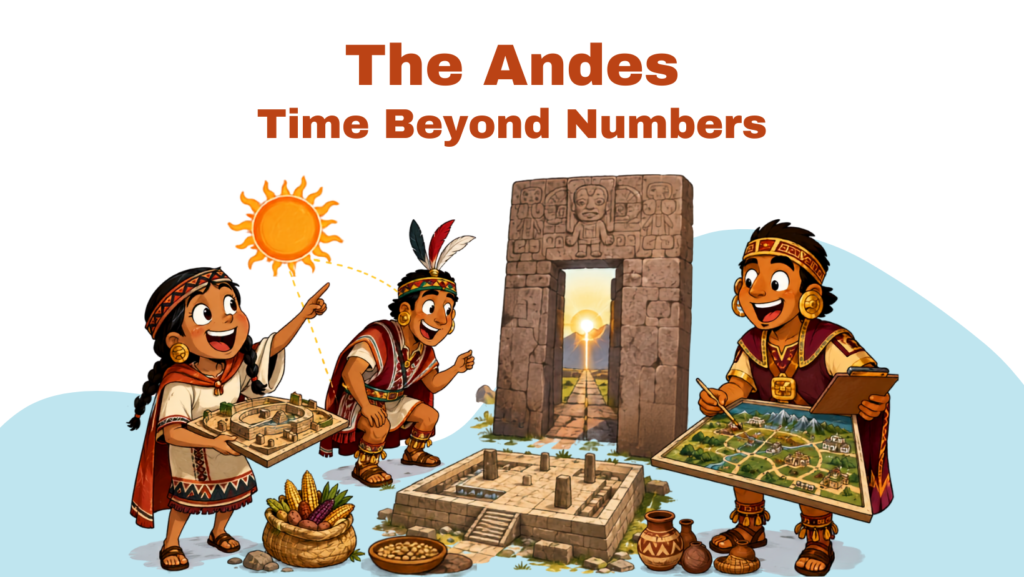
Long Before the Maya, There Were the Andes
In the previous article, “Time in the Ancient Americas: Cycles Within Cycles,” we looked at how Mesoamerican civilizations—especially the Maya—turned time into something much more complicated than just counting days.
And to be fair, they earned that reputation.
Their calendars were so detailed and so precise that they basically became the example everyone remembers. Mention “ancient timekeeping,” and the Maya show up almost immediately.
Which creates a small problem.
The Story Does Not Start with the Maya
Because it becomes very easy to assume—without really noticing—that this is where the story begins.
That before the Maya, people were just… what? Guessing the seasons?
Waiting around and seeing what happens.
Or just hoping the rain showed up on time.
History, as usual, is a bit less convenient than that.

Not a Different Calendar — A Different Problem
The interesting part is that the Andes were not simply creating another calendar to add to the collection.
They were looking at the problem differently. Almost as if they were not trying to solve the same problem in the first place.
In Mesoamerica, time becomes something you calculate. You organize it, track it, give it structure.
In the Andes, the Focus Shifts
It’s less about measuring time and more about recognizing it.
Not:
“How do we count the days?”
But:
“How do we know when the moment is right?”
It sounds like a small difference. It isn’t.
When the World Was Doing the Talking
In the Andes, time wasn’t something sitting outside of life, waiting to be written down.
It was there all along.
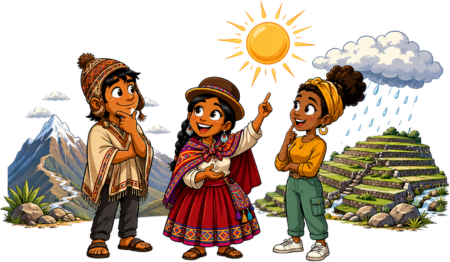
In the mountains. Then in the movement of the sun. Finally, in the rains that arrived—sometimes on time, sometimes not. Those were the cycles that truly mattered if you wanted crops to grow and people to eat.
So no, the landscape wasn’t just “the environment.”
It was constantly telling you things. You just had to pay attention.
Which means the real question wasn’t:
“What day is it?”
It was:
“Is this the right moment?”
This Didn’t Start with the Inca Either
And here’s the part that usually gets skipped. This way of thinking about time didn’t start with the Inca.
It was already there much earlier—before the empire, before the roads, before the names that tend to dominate history books.
On the Peruvian coast, there was already a society doing exactly this.
Not trying to control time.
Just trying not to miss it.
Its name was Caral.
Caral: Before the Great Calendars…
Time Already Mattered.
If this relationship with time existed before the Inca, the obvious question is:
How far back does it go?
The answer takes us much further back than most people expect.
Around 5,000 years ago, on the Peruvian coast, a civilization was already building cities, organizing society, and paying close attention to the rhythms of the world around them.
Caral.
The Origin of the Americas
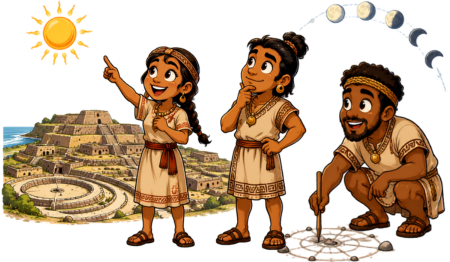
Caral is considered the first civilization of the Americas.
Which is already a pretty impressive title.
While early urban societies were forming in Mesopotamia, a society was taking shape in the Supe Valley on the central coast of present-day Peru, with monumental architecture, urban planning, and a very particular relationship with the environment.
And here comes the interesting part.
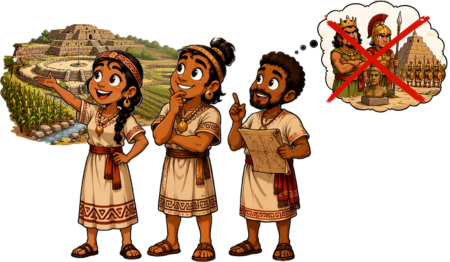
When we imagine the first civilizations, we often expect the usual package: kings, armies, huge monuments, and someone important enough to end up in every history book.
Caral Is a Little Different
It reminds us that a civilization does not need a famous emperor, a giant empire, or a movie-worthy battle scene to be complex.
And here an interesting question appears:
If Caral was one of the first great civilizations of the Americas, how did they understand time?
The answer is different from what we might expect.
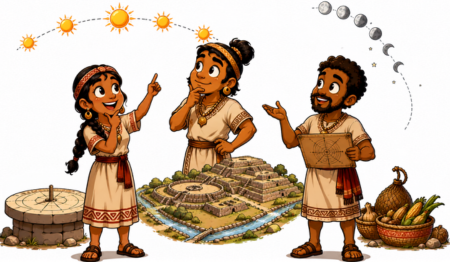
When Time Was Not Written Down
We do not find a written calendar like that of the Maya, with clearly recorded day names and cycles.
No ancient planner where someone could simply write:
“Tomorrow: plant crops.”
Unfortunately, ancient civilizations were not kind enough to leave us a “How to Understand Caral Time” guide.
Instead, what we find is evidence of a society that observed patterns, recognized cycles, and organized life around the rhythms of the environment.
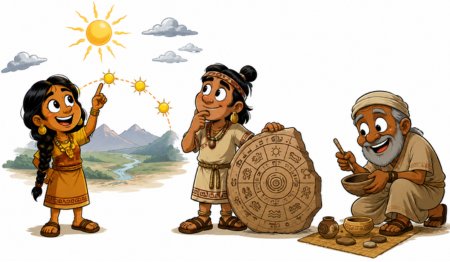
When Architecture Becomes a Calendar
For the people of Caral, time was not separate from space.
Today, we usually think of time as something outside of us. Something we measure with clocks, calendars, and screens. We check it, organize it, and occasionally panic because it is moving faster than we would like.
Time is out there, and we simply try to capture it.
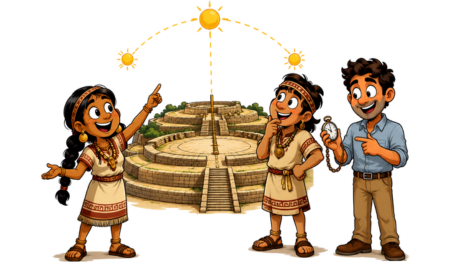
In Caral, the Relationship Was Different
The landscape, architecture, and movements of the sky were not separate things. They worked together as part of the same system.
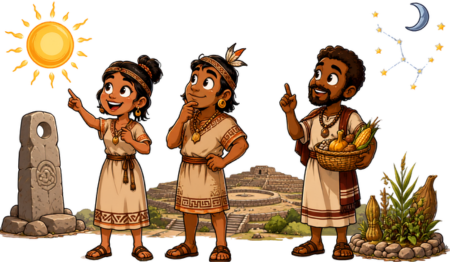
Some structures appear to be connected with astronomical phenomena, especially the position of the sun at important moments of the year.
In other words, the buildings were not only places where people lived, gathered or perform ceremonies.
They were also helping people read the world around them.
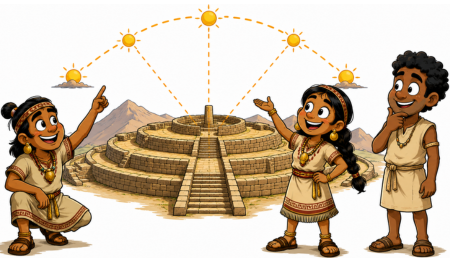
Reading Time Through Architecture
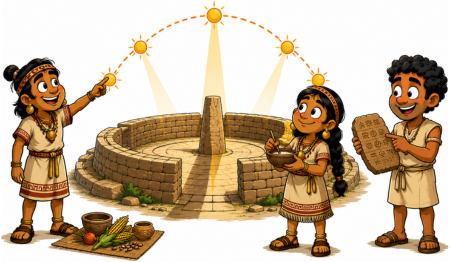
A structure could mark a moment in the solar cycle. A shadow could reveal a change in the season. The position of the sun could signal when certain activities needed to happen.
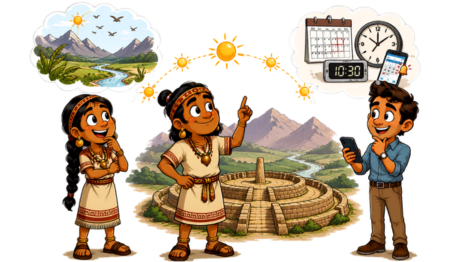
Today, we put calendars on walls, check apps, and set reminders because we do not want to miss anything important.
Caral did not have an app reminding them that planting season was approaching. The landscape was already sending the notification.
In other words, there was no need to separate a calendar from daily life. The calendar was not something outside the world they lived in.
It was part of it.
A Time Without Numbers, but With Rhythm
What is most interesting about Caral is that it forces us to rethink what we mean by “measuring time.”
We are used to thinking that knowledge means turning everything into numbers: days, months, years, seconds.
If it can be counted, measured, and probably added to a spreadsheet, we feel like we understand it better.
But that is only one way of understanding time. The people of Caral did not leave behind a calendar system like the Maya, with clearly recorded dates and cycles.
They did something different. They paid attention—and organized their lives around what the world was telling them.
Time Was Not Simply Passing
For Caral, time was not just something that moved forward. It was something people had to pay attention to.
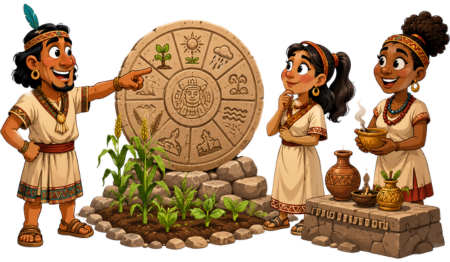
The important moments were connected to agriculture, ceremonies, and the changing conditions around them.
And this is where the difference becomes hard to ignore.
A Different Way of Relating to Time
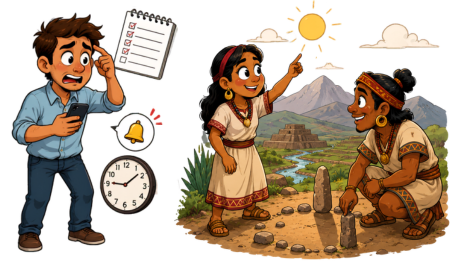
We use calendars to organize almost everything. We schedule, set reminders, and sometimes need our phones to tell us what day it is.
Caral did not try to control time. They paid attention to it.
And this relationship between time and landscape did not disappear. It continued to evolve across the Andes.
Tiwanaku: A More Structured Reading of Time
If Caral shows us an early relationship between time and landscape, Tiwanaku shows what happens when that relationship becomes more deliberate—more intentional.
Located in the highlands near Lake Titicaca, Tiwanaku developed in an environment where cycles were not abstract ideas, but conditions for survival.
The alternation between dry and rainy seasons, the behavior of crops, and even the movement of the sun across the horizon were not distant phenomena.
They were signals.
And people had to recognize them. Missing them was not really an option.
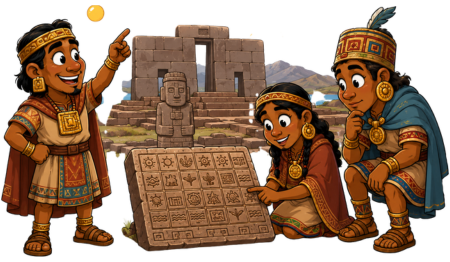
Architecture as Observation
In Tiwanaku, architecture does not simply occupy space. It organizes it. Deliberately.
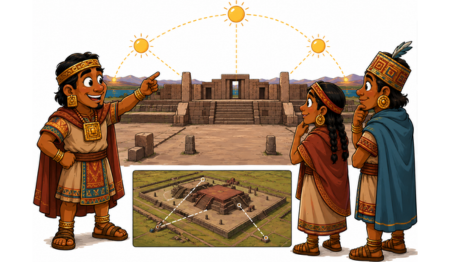
Certain structures, such as the Kalasasaya platform, align with the position of the sun at specific moments of the year, particularly during solstices. This was not incidental. It rarely is.
From particular points, it became possible to observe how the sun rose or set in relation to architectural markers, turning the horizon into something that could be read. Almost like a text, just without the convenience.
These were not only spaces for ceremony. They made observation possible.
The relationship between space and sky was built, not assumed.
And this is where things stop being easy to explain.
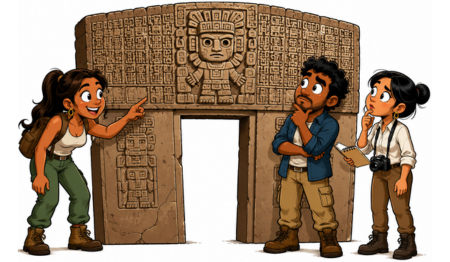
The Gate of the Sun and the Problem of Interpretation
One of the most well-known monuments of Tiwanaku, the Gate of the Sun, is often described as a kind of calendar carved in stone.
You can see why.
Its central figure, surrounded by repeated motifs, suggests a pattern that feels too deliberate to ignore.
And yet, something does not fully resolve.
Unlike the Maya, Tiwanaku did not leave behind a system we can read with confidence. There is no clear sequence of numbered days. No structure that can be reconstructed without doubt.
What remains is the pattern.
But not the key.
Time Without a Written Calendar
This does not mean time was not measured. It means the logic was different.
Instead of being written down, time was embedded in space. In repeated observations. In shared practices.
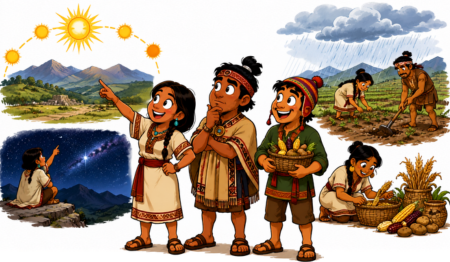
The position of the sun. The arrival of the rains. The cycles of planting and harvest.
All of it formed a system that worked without needing to be recorded.
Time was not stored.
It was lived.
The Wari: When Time Also Builds an Empire
The Wari introduce another dimension of Andean time: time as organization.
Because creating an empire requires more than conquering territory.
It requires coordination.
Thousands of people need to work together. Food needs to move. Labor needs to be organized. Resources need to be collected and redistributed.
Someone had to know when to plant crops, when to transport goods, when communities needed to contribute, and when resources needed to arrive.
In other words, even an ancient empire faced a problem that sounds surprisingly familiar:
too many things happening at once and never enough time to manage everything.
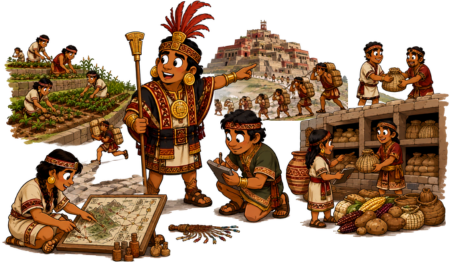
When Time Becomes a System
The Wari did not leave behind calendar systems as extensively documented as the Maya.
But their empire reveals another way time could function.
Time was not only something people observed.
It was something they managed.
An empire is not maintained only through power. It depends on coordination. Roads, administrative centers, storage systems, agriculture, and exchange networks all require timing.
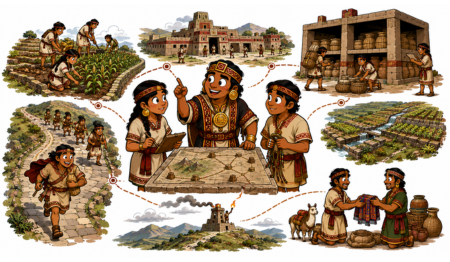
No Need for a Carved Calendar
The Wari did not need a calendar carved in stone to understand time’s importance. Their entire political system depended on knowing when things needed to happen.
Time became part of how the empire worked.
Because controlling territory is not only about knowing where everything is.
It is also about knowing when everything happens.
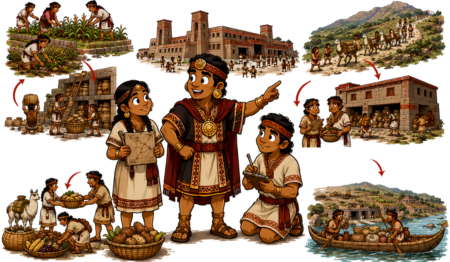
The Inca: Time as Imperial Coordination
If the Wari show us how time could organize an empire, the Inca take that idea further.
They did not just coordinate activities.
They synchronized them.
At its height, the Inca Empire stretched across vast and diverse territories, from coastal deserts to high mountains and dense forests. Managing that space required more than roads and administrators.
It required shared timing.
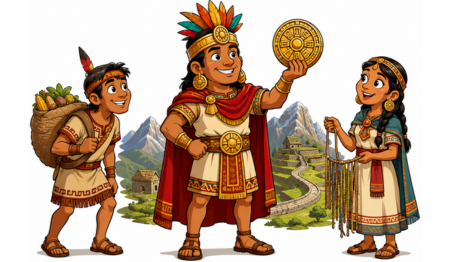
A Need for a Common Time
Agriculture, labor obligations, religious ceremonies, and state activities all depended on knowing when things needed to happen—not only locally, but across regions with very different conditions.
Labor systems such as the mita depended on this. Communities contributed work at specific times, aligned with both local cycles and state needs.
Festivals followed the solar year. Agricultural production had to align with storage and redistribution. Movement along the road system also depended on timing.
Time, in this context, was no longer only observed or managed.
It was synchronized.
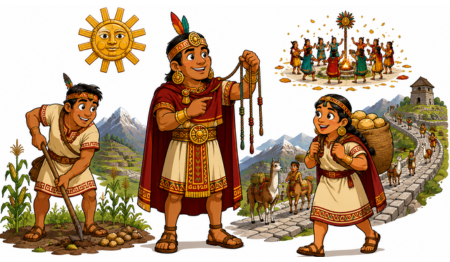
Cusco & the Ceque System: Time in Space
This synchronization was not only administrative. It was also part of how the Inca understood space.
Cusco, the imperial capital, was more than a political center. It was where things were organized.
From the city extended a network of lines known as ceques, connecting hundreds of sacred sites, or huacas, across the surrounding landscape.
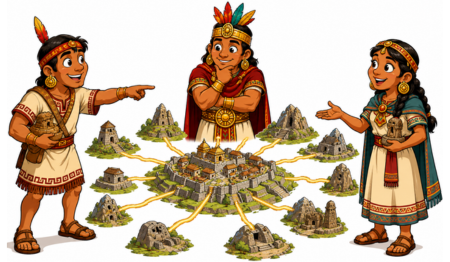
These Lines Were Not Random
They structured movement, ritual, and relationships between communities and the state. They may also have structured time.
Some points along the ceque system have been linked to astronomical observations, seasonal markers, and ritual cycles. This suggests that the landscape itself worked as a temporal framework.
Time was not kept in a single place or written in a single system.
It was distributed.
To move through the landscape was, in a sense, to move through time.
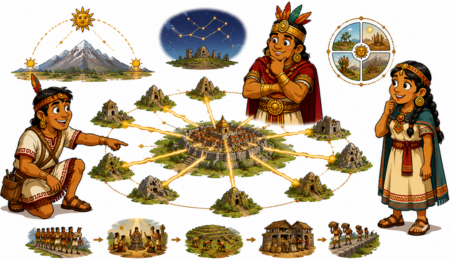
Cusco, the Sun, and the Order of Time
In the Inca world, the relationship between time and power became visible in Cusco, the center of the empire.
The movement of the sun was not only an astronomical phenomenon. It was tied to the ritual calendar and to imperial authority.
Ceremonies such as Inti Raymi marked specific moments in the solar cycle. But they did more than mark time. They reinforced the relationship between the ruler, the community, and the forces that sustained the world.
Time was not separate from political order.
The calendar also reflected how society was expected to function.
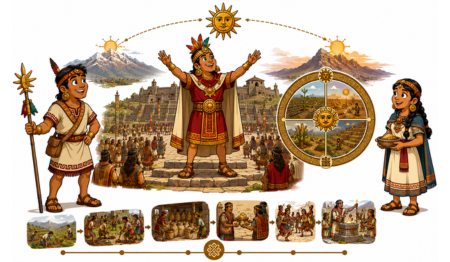
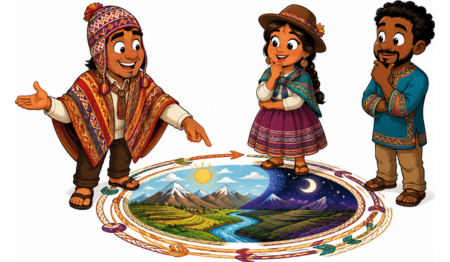
Pacha: When Time and Space Are One
One of the most important concepts in Andean thought is pacha.
It is often translated as “time” or “world,” but the idea is more complex. It does not separate time and space the way we usually do.
In modern thinking, time and space are treated as different things. We use clocks for one and maps for the other. It keeps things simple.
In the Andean worldview, both are part of the same reality.
A moment exists in a place, and a place has meaning within a moment.
The universe is not divided into separate parts.
It is connected.
Time as Responsibility
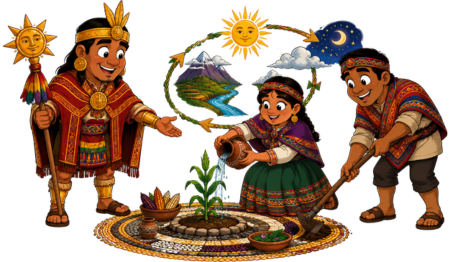
Perhaps the most striking difference between the Inca understanding of time and our own appears here. We tend to think of time as something that simply moves forward.
The calendar changes because a new date arrives.
For the Incas, time required participation.
The relationship between humans, nature, agricultural cycles, and the wider order had to be maintained.
Time was not a machine that ran on its own.
It depended on balance.
And balance does not maintain itself.
Quipus: When Time Could Be Touched
When we think about recording information, we usually imagine writing.
Words carved into stone. Dates marked on calendars. Numbers arranged in tables.
But in the Andes, information was not always written.
Sometimes, it was tied.
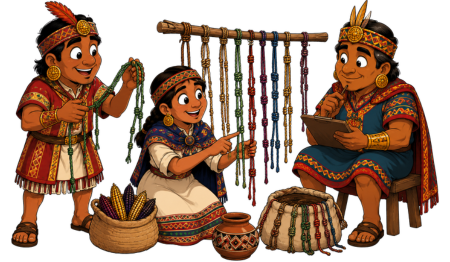
Quipus used cords, colors, and carefully placed knots to store information. Instead of ink on a page, knowledge was held in a physical object that could be touched, carried, and interpreted.
During the Inca Empire, quipus became one of the most important tools for managing the Tawantinsuyu. They allowed officials to record quantities, resources, production, obligations, and many other details needed to organize a vast territory.
An empire had found a way to make information visible without using traditional writing.
Organizing an Empire One Knot at a Time
Because governing an empire is not only about conquering land.
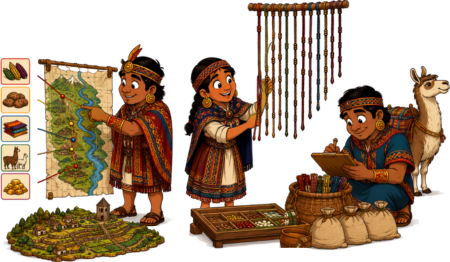
It is also about knowing what each region produces, what resources are available, what communities owe, and when those responsibilities must be fulfilled.
In other words, even the Inca faced a problem that sounds surprisingly modern:
Too much information.
And someone had to keep track of it.
Quipus were the solution.
They transformed numbers, responsibilities, and resources into something that could be stored, transported, and understood.
Long before spreadsheets and databases, the Andes had their own system for managing information.
A Memory That Comes From Far Away
For a long time, quipus were seen as something uniquely Inca.
A tool created by the empire to manage its complexity.
But archaeology tells a different story.
The use of cords and knots to record information did not begin with the Incas. It belongs to a much older Andean tradition, one that developed slowly over thousands of years.
Quipus were not an invention.
They were part of a memory that had been building long before the Inca Empire existed.
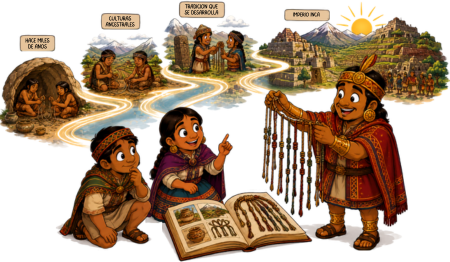
Quipus Come from Caral
Even in Caral, one of the oldest civilizations in the Americas, researchers have found fiber objects and knot-based structures that suggest early forms of information organization were already taking shape.
Which changes the way we see the Incas.
They did not invent a system from scratch.
They inherited it.
Refined it.
And turned it into something powerful enough to manage an empire.