The Time We Never Question
We usually think we understand time.
After all, we have become extremely good at measuring it.
We have clocks on our phones, calendars on our computers, watches on our wrists, and reminders that appear every few minutes to tell us where we are supposed to be and what we are supposed to do.
It would seem that no civilization in history has been more obsessed with organizing time than ours.
And yet, there is something a little strange about our relationship with it.

The Time That Feels Normal
We created incredibly precise ways to measure time, but we still constantly feel that we do not have enough of it.
We save time.
We waste time.
We lose time.
We try to manage time.
Sometimes it feels like time is the one thing in life that everyone is chasing but nobody can actually catch.
But before we assume that our way of understanding time is simply the natural way, it is worth remembering something important:
Time has not always been understood the same way.
The idea that time is a straight line, divided into equal units that move forward at a constant speed, is only one way of looking at it.
It is the system that shapes our modern lives, but it is not the only possibility.

Time Was More Than a Measurement
For many ancient cultures of the Americas, time was not simply a tool for organizing activities.
It was not just a system created to answer practical questions like when to plant crops, when to hold ceremonies, or when to mark important events.
Those things mattered, of course.
Calendars were practical. Knowing the seasons, tracking the sun, and recognizing natural patterns were essential for societies that depended on agriculture and the environment.
But reducing these systems to simple organization would miss the bigger picture.
Living Inside It Instead of Just Measuring It
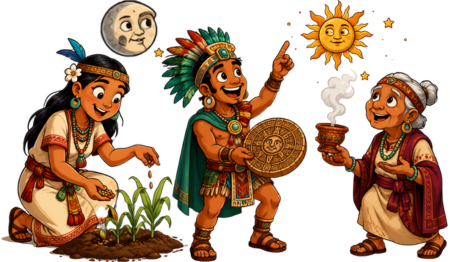
Time was not just something humans measured.
It was something they lived inside.
The difference may seem small, but it changes everything.
Today, we usually think of a calendar as a tool. It helps us arrange our lives, schedule appointments, and avoid forgetting what we are supposed to do.
Basically, it is the ancient version of a notification app — except with fewer reminders telling us to drink water.
For many ancient American cultures, however, time was not separate from the world around them.
The cycles of the sun, the seasons, agriculture, ceremonies, and social life were connected.
The calendar was not simply a way to count days.
It was a way to understand relationships.
When a Moment Had Meaning
This is where the difference becomes even more interesting.
Today, if someone asks us what day it is, we usually answer with a date.
July 20th.
Monday.
A specific point inside a calendar.
That answer is enough for us because our calendar mainly tells us where we are in time.
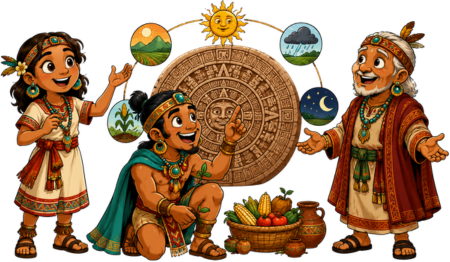
For many ancient American cultures, that answer would have been incomplete.
Knowing the date was only part of the information.
The Bigger Question Was Not “When?”
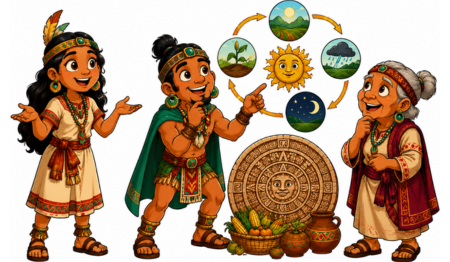
What kind of moment is this?
Was it connected to an important cycle?
Was it the right time for a certain activity?
Did it have a relationship with the movement of the sun, agricultural seasons, or the larger order of the universe?
A date was not only a location in time.
It was part of a much bigger pattern.
The question was not only:
“When is it?”
It was also:
“What does this moment mean?”
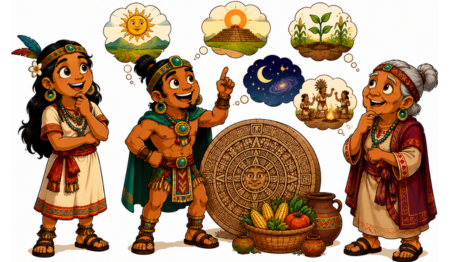
Time Was Never One Universal System
When we talk about ancient America, it is easy to make a common mistake.
We sometimes imagine that a continent this large somehow had one single way of understanding the world.
It did not.
The Americas were enormous, and the civilizations that developed across them created their own relationships with time.
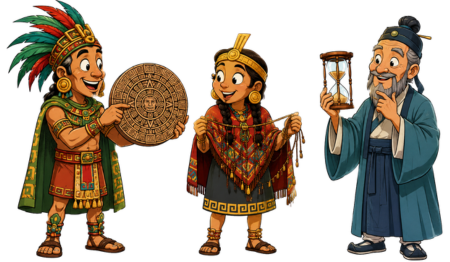
Time Meant Different Things in Different Times
The Maya did not understand time exactly like the Mexica.
The civilizations of the Andes did not organize time in the same way as Mesoamerican societies.
And many Indigenous cultures of North America developed their own systems based on observing animals, seasons, plants, and the changing environment around them.
There was no single “ancient American calendar.”
There were many different answers to the same human question. But, why?
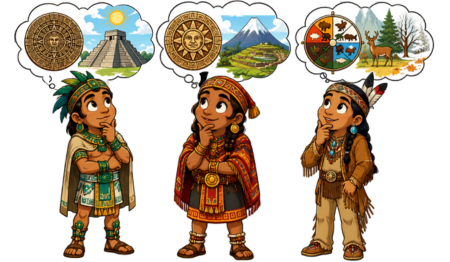
The Question Was Never Just “What Time Is It?”
It was:
How do we understand our place within time?
Or even better, how do we understand our place within time?
Some cultures turned time into incredibly complex mathematical systems.
Others connected it more directly with landscapes, agriculture, and natural cycles.
Some recorded history through writing.
Others preserved knowledge through memory, objects, and traditions.
But despite these differences, something appears again and again:
Time was never just something that happened while humans existed.
It was part of the world humans lived inside.
And nowhere does this become more fascinating than in one of the most famous regions of ancient America: Mesoamerica.
MESOAMERICA
Before the Great Calendars: A Tradition Built Over Centuries
Whenever ancient American calendars are mentioned, the Maya usually appear first.
It makes sense.
The Maya became famous for their astronomical observations and sophisticated calendar systems. Their understanding of cycles was so advanced that even today people are fascinated by how they tracked enormous periods of time.
Sometimes, however, this creates the impression that the Maya simply appeared one day and invented everything from the beginning.
Almost as if someone woke up and said:
“Today seems like a good day to create one of the most complex calendar systems in human history.”
That is not how it happened.
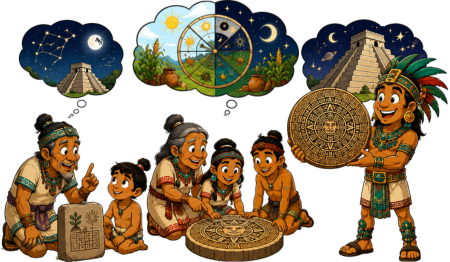
History Rarely Works That Way.
Great ideas almost never appear out of nowhere.
They develop slowly through generations of observation, experimentation, and accumulated knowledge.
Long before the Maya created their famous calendars, other cultures in Mesoamerica were already paying close attention to the relationship between the sky, the earth, and human activities.
The story of Mesoamerican time does not begin with the Maya.
It begins much earlier.
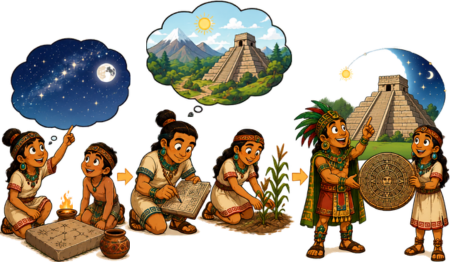
From the Olmecs to the Maya
The Olmecs are often considered one of the earliest major civilizations of Mesoamerica, and although we do not have a complete record of how they understood time, their legacy shows something important.
They were already observing patterns.
The movement of celestial bodies, the cycles of nature, and the relationship between human life and the environment were becoming central questions.
Later cultures continued developing these ideas.
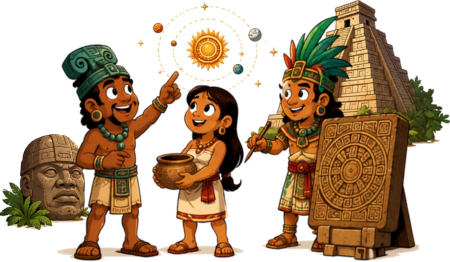
Zapotec Writing System
The Zapotecs created early writing systems and recorded dates, showing an increasing interest in organizing historical events and marking important moments.
The question was not simply how to count time.
Counting was the easy part.
The more difficult question was understanding what those measurements meant.
A calendar could tell you when something happened.
But could it explain why that moment mattered?
That question would continue shaping Mesoamerican civilizations for centuries.
When the Maya developed their own systems, they were not starting from zero.
They were inheriting a much older tradition and expanding it into one of the most sophisticated ways of understanding time ever created.
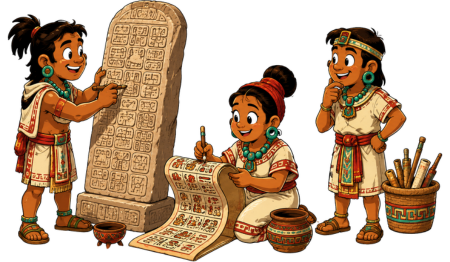
The Maya: When Time Became a System
When people talk about the Maya and time, the first thing that usually comes to mind is their calendar.
That makes sense.
The Maya developed some of the most sophisticated systems for tracking cycles in the ancient world. Their astronomical observations were incredibly detailed, and their ability to record long periods of time continues to surprise researchers today.
But focusing only on their accuracy misses the most interesting part.
The Maya were not simply trying to create a better calendar.
They were not looking for an ancient version of a planner where someone could check what happened on a certain day or what needed to be done next week.
Time Meant More Than Just “When”
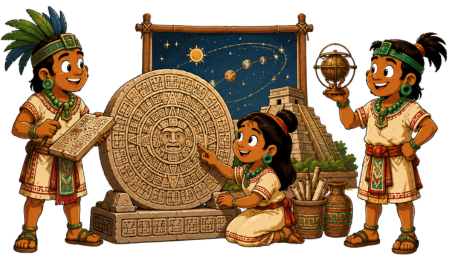
Their calendars reflected a much deeper idea: time itself had meaning.
A moment was not just a location on a timeline.
It had a place within larger cycles, and understanding those cycles helped explain the relationship between humans, nature, and the universe.
This is where the Maya approach becomes very different from our modern one.
Today, a date is mostly information.
If someone tells us that something happened on March 15th, we know when it happened. The date gives us a position in time, but usually it does not tell us much more.
A Date Was More Than Just a Date
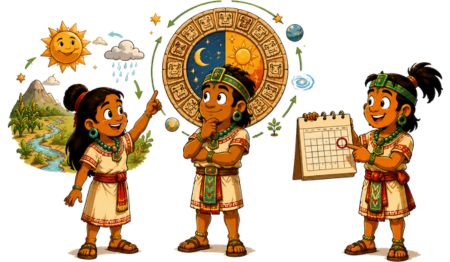
For the Maya, a date could carry additional layers of meaning.
The day was connected to different cycles that were constantly interacting with one another. A specific moment existed within a larger pattern, and that pattern influenced how the moment was understood.
This does not mean that every day was automatically good or bad.
It was not a simple system where people opened a calendar and found a label saying “today is lucky” or “today avoid everything.”
The idea was more complex.
Time had qualities that needed to be interpreted.
The Tzolk’in: When a Day Had Meaning
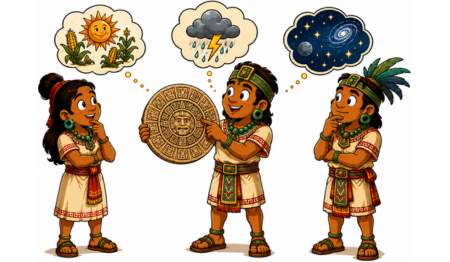
One of the best examples of this is the Tzolk’in, the 260-day calendar used by the Maya.
Compared with our modern calendar, it looks unusual.
There are no months like January or February.
There are no weeks like the ones we use today.
Instead, the cycle combined numbers and day names to create different combinations that repeated over time.
From a modern perspective, this can seem strange.
We are used to thinking of a day as a simple unit.
A square on a calendar.
A space where we place appointments, meetings, or reminders.
The Tzolk’in followed a different logic.
A day was not just a place to put an event.
It was part of a larger system of relationships.
The combination of numbers and names gave each day a particular identity within the cycle. Understanding the day meant understanding its position inside that system.
This tells us something important about Maya thinking.
The purpose of the calendar was not only to measure time.
It was also to interpret it.
The Haab: Following the Rhythm of the Sun
The Haab worked differently.
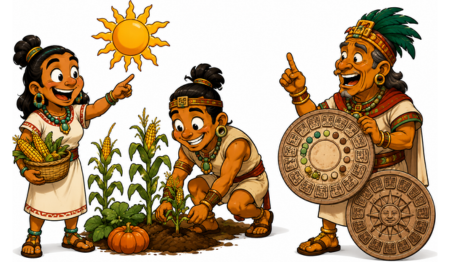
With 365 days, it was much closer to the solar year and was connected to the practical rhythms of life, especially agriculture.
This makes it easier for us to understand because we still depend on seasonal patterns today.
Farmers need to know when conditions are right for planting and harvesting.
Communities need to organize activities around the environment.
The difference is that the Maya did not separate these practical concerns from their broader understanding of time.
The solar cycle was not just a scientific measurement.
It was part of a larger relationship between human beings and the world around them.
The most interesting part, however, was not either calendar by itself.
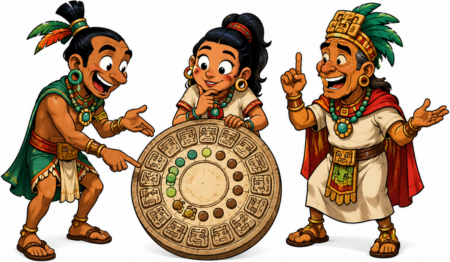
It was the way different cycles worked together.
A moment could be understood from several perspectives at the same time.
The Tzolk’in provided one layer.
The Haab provided another.
Together, they created a much more complex picture of where a particular moment existed within the larger structure of time.
The Long Count: When Time Became Memory
The Maya also developed the Long Count, a system designed to record much larger periods of time.
This is where their understanding of time becomes especially impressive.
Many societies create calendars because they need to organize the present.
The Long Count shows that the Maya were also thinking about the distant past and the long future.
They were comfortable working with periods that extended far beyond a single human lifetime.
This is a very different relationship with time.
Most of us today struggle to remember what we scheduled for next Tuesday.
The Maya were recording events within cycles that stretched across centuries.
The Long Count transformed time into a form of historical memory.
It allowed events to be placed within a much larger story, connecting the actions of rulers and communities with broader cycles that extended across generations.
Time was not disappearing behind them.
It was being preserved.
For the Maya, understanding time meant understanding where a moment belonged and how it connected with everything that came before it.