
Wait… Aren’t We Speaking American Already?
— Yeah… but not really!
— I no comprendo, hombre!
— I’m telling you, it’s about the new American language.
— Whaat!?
— Never mind. It was just another KDF Blog Troll.
— Well, I had no idea.
— Exactly. And before we go any further, let’s talk before you snooze and lose again.
— Whatcha talkin’ ‘bout, Willis?
— Fake it until you make it! Let’s get into the alternative facts now! Kelly Conway: All the way!

The Fake News That Started It All
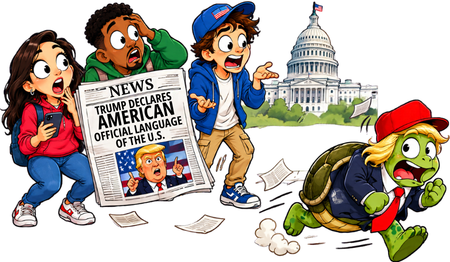
Our story began with fake news.
A completely fictional story about Donald Trump declaring American the official language of the United States.
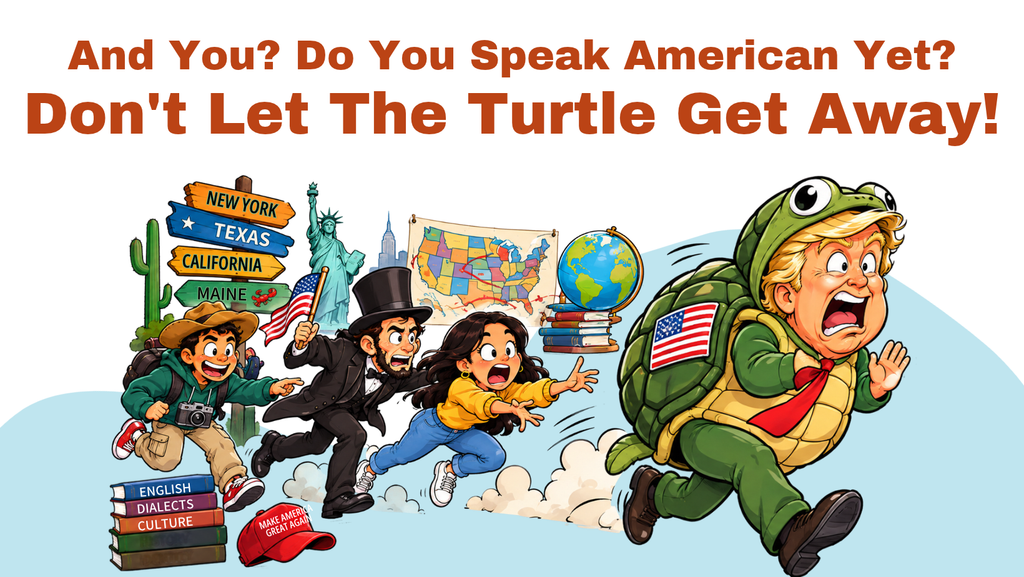
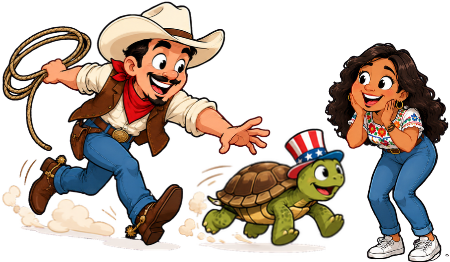
The story was fake. As fake as that turtle dressed as POTUS running away!
The linguistic questions it raised, however, were not.
Because before we can decide what an “American language” might mean, we have to deal with a much more uncomfortable question:
What the Hell Does “American” Mean?
And this is where things start getting complicated.
Because if someone says American language, most of us immediately think of English.
Makes sense. The United States speaks English. Well… mucho bien.
But not everybody speaks it the same way. Not even close.
Which, as it turns out, is kind of the whole point.
And apparently, we weren’t the first ones to wonder about this. Back in 2005, PBS asked a very similar question: Do You Speak American?
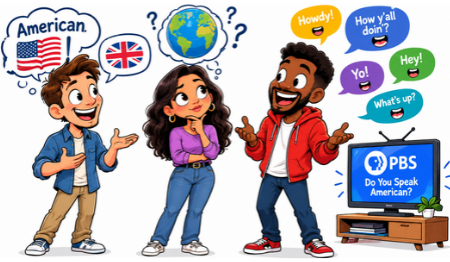
Do You Tho? For Real?
Let’s take a look at the program that started it all.
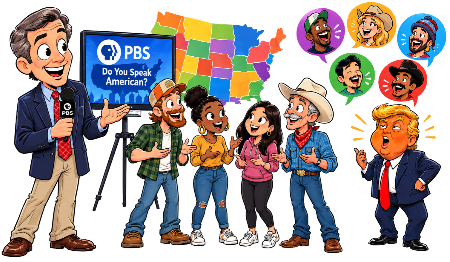
In 2005, PBS premiered Do You Speak American?, a three-part documentary series hosted by Robert MacNeil.
MacNeil traveled across the United States exploring how Americans speak and, more importantly, what it might actually mean to “speak American.”
And it turned out that American English was a lot more complicated than just having funny or different accents.
It wasn’t simply una colección de acentos pintorescos—como el hombre naranja.
Well… There Were Accents
But there was a lot more going on.
MacNeil spoke with people from different regions and communities and looked at how American English changes according to place, age, social group, identity, and community.
The series also got into linguistic prejudice, the whole idea of “standard” English, Spanish, language contact, and the fact that people don’t necessarily speak the same way all the time.
You might sound one way with your friends, another way at work, and yet another way when you go back home to visit your family.
And that brings us to the central question:
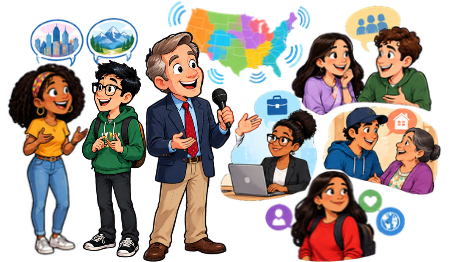
What Does It Mean to Speak American?
The answer turned out to be considerably more complicated than:
“You speak English.”
Because apparently, speaking the same language doesn’t necessarily mean sounding the same.
And to find out just how different American English can be, MacNeil did something fairly simple:
he went traveling.
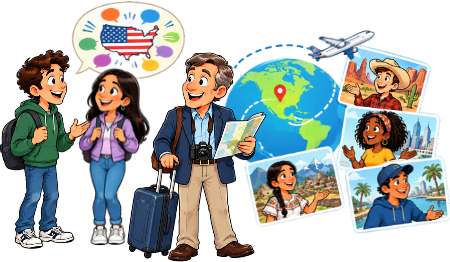
A Trip Through American English
The documentary turns the question into something of a linguistic road trip across the United States. Each place reveals a different relationship between language, geography, history, and community.
PBS asks some pretty specific questions.
Why do lobster fishermen in Maine sound so different from cowboys in Texas?
What happens to English in different regions?
And how are language, identity, race, and social class connected?
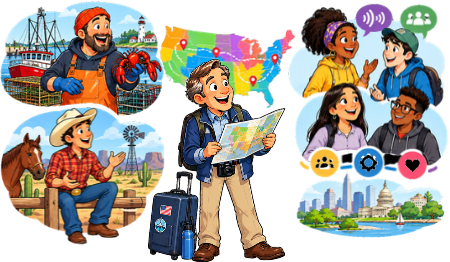
So What Was He Looking For?
And this is where things get fun.
Because the way you pronounce something can reveal where you’re from.
A single word can tell a story about contact between languages.
And the way you speak can become a signal that tells other people:
You’re one of us.
Let’s take it one step at a time.
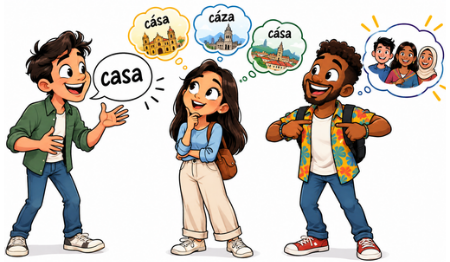
Maine: When One Word Gives You Away
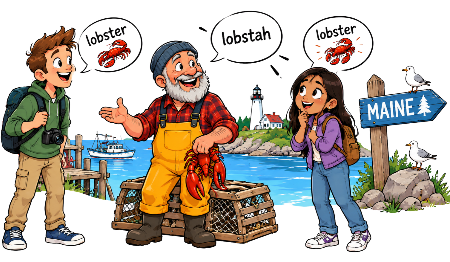
One of the first places featured in the documentary is Maine.
And that’s where you start discovering that American English isn’t some giant linguistic block with a bunch of different accents sprinkled on top.
There are local varieties, regional pronunciations, and expressions that can sound completely normal to one person and strangely unfamiliar to another.
You’re How You Speak
PBS uses Maine lobster fishermen as one of its examples of just how much speech can vary within the United States.
And that’s what’s interesting.
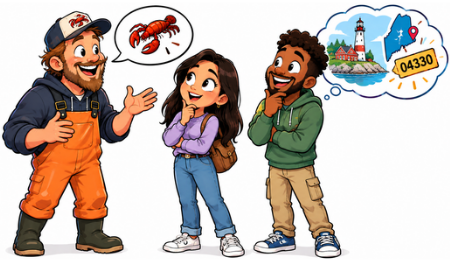
Someone can hear a perfectly ordinary word and, without the speaker ever telling them where they were born, start making a pretty good guess about where they’re from.
It’s almost as if language came with a ZIP code.
New York: Is the Language Getting Worse?
Then we get to New York.
And here we encounter another very human phenomenon:
people who believe previous generations spoke correctly and that younger generations are destroying the language.
And that leads to one of the questions raised by the documentary:
Is American English getting worse?
Yes.
Some people are convinced it is.

The Same Old Complaint
In the documentary, that debate appears pretty directly.
John Simon, a Yugoslav-born theater critic and defender of what he considered standards of English, argued that the language had deteriorated and that younger generations were contributing to that decline.
Linguist Jesse Sheidlower, on the other hand, challenged precisely that idea: the assumption that linguistic change means the language is falling apart.
In other words, the old argument:
—People don’t speak correctly anymore!
—Compared with when?
—Back when people knew how to speak!
—And when was that?
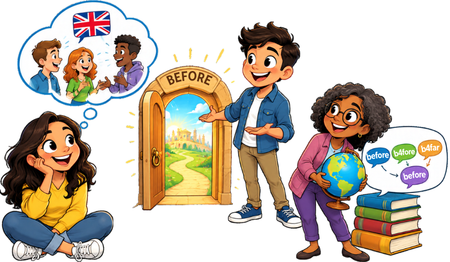
—Well… before.

Before When?
That “before” is a wonderful linguistic place.
Nobody knows exactly where it is, but apparently everybody spoke perfect English there.
The problem is that languages never sit still.
They change because people change.
Pronunciations Shift
New words appear. Others disappear. Expressions move from one generation to another.
That doesn’t mean every change is automatically good or bad.
It means that change and decline are not synonyms.
And that distinction becomes pretty important when we’re talking about American English.
The South: One Label Isn’t Enough
Then the trip moves south.
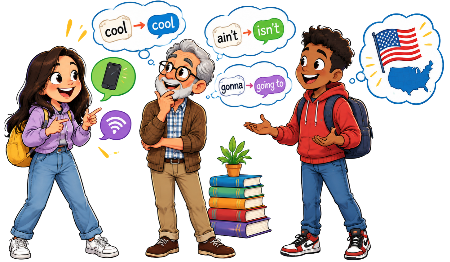
Here we encounter different varieties of Southern English, including Appalachian English.
And suddenly the word “Southern” starts looking a little too small.
Because even within one enormous region, there are differences. There is no button labeled:
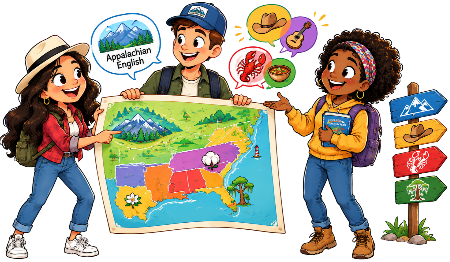
SPEAK SOUTHERN
that everybody simply presses.
History leaves fingerprints, too.
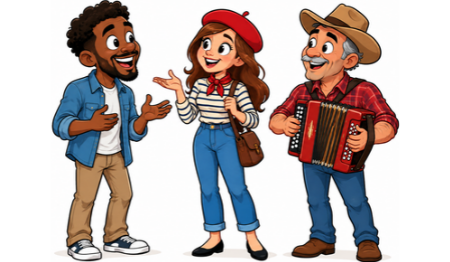
In some communities in southern Louisiana, for example, French language contact helped shape varieties of English that can’t simply be explained as “English with a Southern accent.”
And That’s the Thing
There is history behind the way people speak.
Migration.
Contact between communities.
Languages meeting, mixing, influencing one another, and leaving traces behind.
That’s why a linguistic variety can’t always be explained by looking only at the map as it exists today.
Sometimes you have to look backward.
Texas: Even Cowboys Speak History
And then Texas adds another layer.
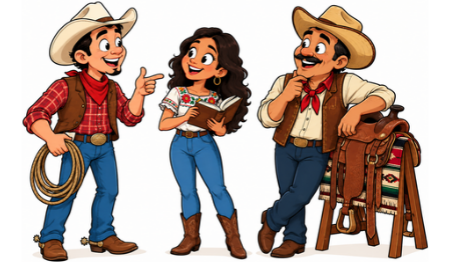
Cowboy culture is full of words that came from Spanish.
And that’s without even getting into the broader influence of Spanish on American English.
We’ll save that one for later.
No need to get ourselves into a linguistic mess just yet.
The Cowboys and The Turtle
The interesting thing is that something so strongly associated with a supposedly quintessentially American image—the cowboy—can carry a little collection of linguistic fingerprints from Spanish.
And that’s before we even mention that the cowboy itself has roots in the Spanish vaquero tradition, which later developed in territories that were once Spanish and Mexican and are now part of the United States.
And don’t worry. This time, we’re not letting the turtle get away. Huh! You’re still wondering about the Turtle POTUS, right? No worries: You’ll find out!
Languages Don’t Need Passports
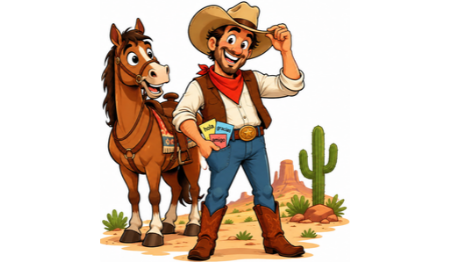
And that’s pretty funny when you think about the traditional image of the American cowboy:
horse, hat, boots, desert…
and a few Spanish words hiding in his pocket.
But it also reminds us of something important.
No Need to Respect Cultures
Languages don’t respect cultural borders nearly as carefully as we do.
Words travel.
Speakers travel.
Cultures meet.
And languages keep the evidence.

Oklahoma vs. Texas: One Cahh Can Start an Argument
And here we get one of those examples that makes linguistics stop feeling like a class and start feeling like a conversation between neighbors.
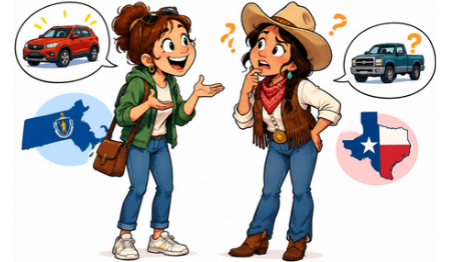
Imagine a woman from Massachusetts who had lived in Oklahoma talking to a woman from Texas.
Pam, the woman from Massachusetts, says:
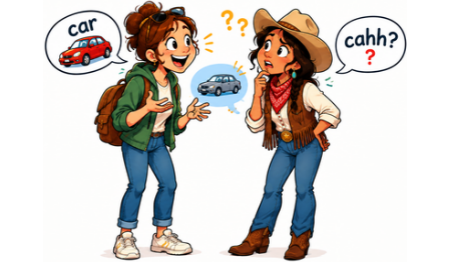
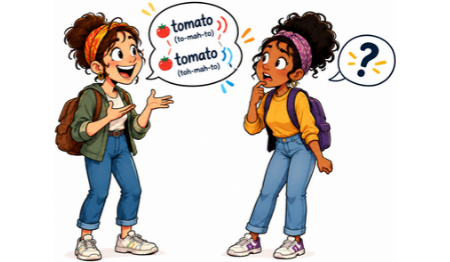
I wanna buy a cahh.
The Texan stares at her.
—A what?
—A cahh.
—What’s a cahh?
—You know, automobile, vehicle, thing you get in and drive.
—Oh! You mean a car.
—No, a cahh!
And There We Have the Problem
It’s not that one of them doesn’t know English.
It’s not that one of them is speaking “badly.”
They don’t even need radically different vocabularies.
A difference in pronunciation can be enough to make a perfectly familiar word suddenly stop sounding familiar.
When Pronunciation Matters
And that’s exactly what makes linguistic varieties so interesting.
Sometimes you don’t need a new word.
You just need to pronounce an old word a little differently.
And suddenly someone asks:
“What did you say?”
Californication: What Makes America Sound American
And then we arrive in California.
Oh, California.
If there is one state that has helped America export the way it sounds to the rest of the world, this is probably it.
Hollywood. Television. Music. Silicon Valley. Surf culture. Teenagers saying things that eventually make their way into everybody else’s vocabulary.

California Sounds American, Doesn’t It?
California has spent decades helping the rest of America—and the rest of the planet—figure out what “American” is supposed to sound like.
And yet California itself doesn’t even speak with one voice.
Not even close.
But Which California?
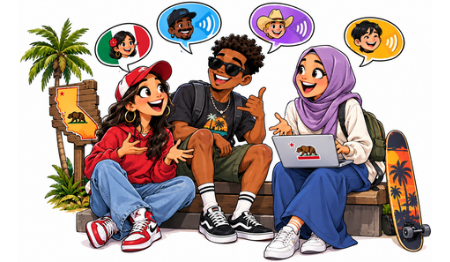
California is enormous, and its linguistic map is anything but simple.
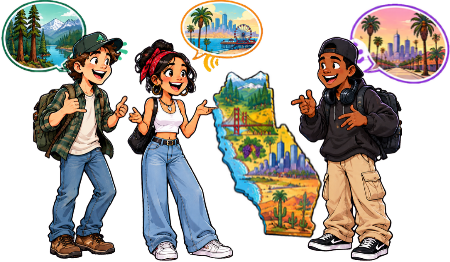
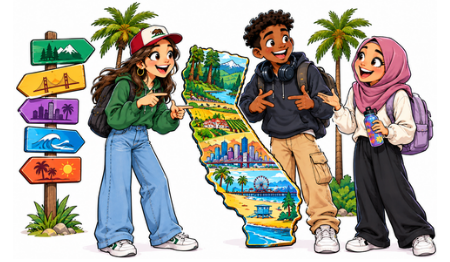
You can find different accents, different vocabulary, different communities, different histories, and different ideas about what sounds “normal” depending on where in California you are. Northern California doesn’t necessarily sound like Southern California.
From South or North? ¿Cuál es mejor?
And even within those broad regions, people can sound very different depending on their community, family, ethnicity, social circles, and the languages around them.
Which brings us to a very California question:
Where in California are you from?
Because apparently, even California needs to know which California you’re talking about.
Hella California
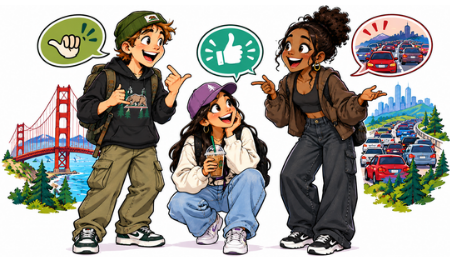
Take the word hella.
You don’t need a linguistics degree to notice that something is going on.
Sometimes all you need is one little word.
Hella.
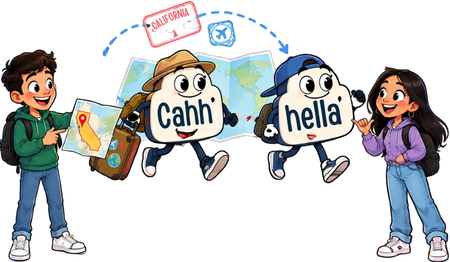
That’s hella expensive.
That was hella good.
There’s hella traffic.
Congratulations.
You may have just walked into Northern California.
Welcome to Northern California
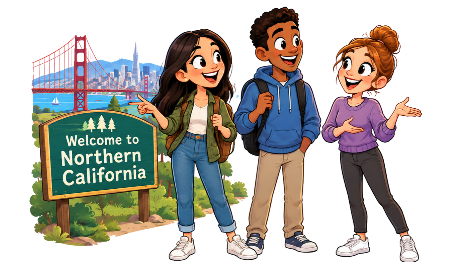
The word became strongly associated with Northern California, especially the Bay Area, even though it eventually escaped California and started showing up elsewhere.
And that’s what makes words like this so interesting.
From Cahh to Hella
A word can start in one place, travel somewhere else, and eventually lose the little linguistic passport stamp that told you where it came from.
So one tiny word can give you a clue about where somebody is from.
Just like cahh did.
Except this time, we’re still in California.
And Then California Gets Complicated
And hella is just one little example.
California is also home to Chicano English, African American English, Spanglish, and many other ways of speaking shaped by migration, history, ethnicity, community, and contact between languages.
One Language, Many Voices
So California can help define what American English sounds like to the rest of the country…
while Californians themselves keep proving that there isn’t just one way to sound Californian.
Apparently, even the state that helps America find its voice doesn’t have just one of its own.
No! We Don’t Talk the Same Way to Everyone
But here we encounter an even more important idea:
a person doesn’t necessarily speak exactly the same way all the time.
You can talk one way with your friends and another way in a job interview.
You can use certain words with your family and different ones with someone you just met.
No Necessarily Faking it!
You can change your pronunciation, vocabulary, or even your level of formality depending on the situation.
That doesn’t necessarily mean you’re “faking it.”
It means you have more than one linguistic resource available to you.
Human beings do this all the time.
This Land Is Your Land!
Now let’s look back at the whole trip.
Maine, New York, the South, Texas, and California are all part of the same country.
They all have English speakers.
There’s No Single Way to Speak American
But the way people speak can vary enormously from one place to another and from one community to another.
So it’s pretty difficult to maintain that there is one single way of speaking American English.
Because clearly, there isn’t.
And that’s where things start getting interesting.
So… What Does American English Actually Mean?
If someone says American English, most of us think we know exactly what they mean:
English as it is spoken in the United States.
Perfect, right?
Until you start listening to Americans.
Then Everybody Starts Sounding Different
And suddenly the definition gets a little more complicated.
A lobster fisherman from Maine, a teenager from Los Angeles, a cowboy from Texas, and someone from New York may all be speaking English.
But they don’t necessarily sound like they belong to the same linguistic neighborhood.
Geography Is Only Part of the Story
Differences can also relate to age, community, social class, ethnicity, identity, and the situation in which someone is speaking.
A person can even shift between varieties depending on whom they’re talking to.
So maybe American English isn’t one single thing.
So What Is It? Do We Know?
Interestingly enough, maybe what we know is what isn’t American English.
Canada’s English, for example, isn’t American, even though Canada speaks English and is in América—the continent, of course.
And don’t even start mentioning other countries in América.
What Is It Then?
Maybe it’s a collection of varieties that share a country, a history, and a broad linguistic tradition.
That sounds reasonable enough.
Until we remember the question that started all of this.
Because our original story wasn’t about American English.
It was about American.
And those two things aren’t necessarily the same.
When American Doesn’t Mean Exactly the Same Thing
Now we need to put English aside for a moment.
Because the problem gets even bigger when we look at the word American itself.
America didn’t begin as the name of the United States.
That sounds obvious once you say it.
But linguistically, it creates a little headache.
In American English, American is the standard demonym for a person from the United States.
And What Happens in Spanish?
In Spanish, however, americano can refer to the Americas as a whole or, depending on the context, to something associated with the United States.
But it is not normally the preferred way to identify a person specifically from the United States when precision matters.
For that, Spanish has another word:
estadounidense.
And now we have two languages using similar-looking words in ways that aren’t exactly the same.
¿Por qué norteamericano entonces?
And while we’re at it, Spanish has its own complications when it comes to demonyms.
For example, alongside estadounidense we also have norteamericano, which, although accepted by the RAE, is technically imprecise because North America includes more than just the United States.
The RAE has never been perfect.
And it never will be.
As we’ve said before, the RAE can recommend linguistic usage, but it can’t necessarily dictate what millions of speakers actually do with their language.
… It Doesn’t Stay in Spanish!
And Spanish isn’t alone.
French has états-unien.
Italian has statunitense.
Portuguese uses estadunidense in Brazil and estado-unidense in other Portuguese-speaking countries.
That doesn’t mean their equivalents of American have disappeared.
When We Need to Be Precise
They still exist and are still used. The other forms simply do something very useful:
they specify the United States.
It’s a perfectly logical linguistic solution. But the existence of a more specific alternative doesn’t mean the conventional word is going to disappear.
And that brings us to another little problem:
what happens when we try to invent a completely new demonym?
What If We Invent Another Demonym?
English has produced alternatives too.
There’s Usonian, a term especially associated with architect Frank Lloyd Wright.
You’ll also occasionally encounter forms such as United-Statesian and USian.
But none of them managed to replace American in everyday English.
And honestly, United-Statesian sounds like it was invented by a committee.
When a Committee Is Not Really Committed
—Ladies and gentlemen, we need a new demonym.
—How about United-Statesian?
—Brilliant!
—Do you think people will actually use it?
—Absolutely not.
—Excellent. Meeting adjourned.
Inventing a word is easy. Getting millions of people to actually use it is another story.
So… Who Gets to Be American?
Now we have to separate two things.
One thing is what a word can mean.
Another is how a community actually uses that word.
In American English, American became the conventional demonym for people from the United States. That convention has been around for generations.
América Is More Than America
At the same time, America can refer to a much broader geographic space than the United States, especially in languages and traditions that understand North and South America as parts of a larger whole.
So someone outside the United States can hear:
“I’m American.”
and think:
“Well… so am I.”
When Two People Say “American”
Imagine this conversation:
—I’m American.
—Me too.
—Where are you from?
—Peru.
—Oh… I meant the United States.
—Then why didn’t you say that?
And there we have the difference between a word having a possible meaning and a word having a conventional use within a particular community.
We don’t need an international language commission approving every one of these conventions.
Languages simply develop their own habits.
When Habit Beats the Rulebook
And when millions of people have been using a word in a particular way for generations, changing it is considerably harder than inventing a theoretically more precise alternative.
But that doesn’t make the cultural or geographic question disappear.
It simply helps us understand that we’re dealing with two different problems.
Same Shit, Different Smell
One is:
What does the word mean?
The other is:
How does a community use it?
And that leads us to an even more interesting question:
Who was using their own words to name this continent before all these discussions ever began?
Maybe Turtle Island?
We’re Back to the Turtle and, yeah!
Turtle Island is one name used in several Indigenous traditions for these lands, and it has become a widely used Indigenous term for North America.
So suddenly, our ridiculous little turtle has taken us somewhere a lot older than Donald Trump.
But before we go there, let’s finally understand why Mr. Trump was dressed as a turtle in the first place if it wasn’t Halloween yet.
Or was it a turtle dressed as POTUS? Doesn’t matter anymore. The turtle has already done its job.
And that brings us to a little language lesson.
The Snoozy Turtle
All right! The Spanish teaching moment has arrived.
You’ve probably heard the common American saying:
If you snooze, you lose!
So how would you say that in Spanish?
Let’s See the Spanish Version
Well, apparently, the Spanish-speaking world has decided that you should not let a turtle escape:
No dejes que se te escape la tortuga. Literally, don’t let the turtle get away. And there you have it. Now all those turtle references we’ve been making should finally make sense.
Wait… What Does “Get Away” Mean?
There’s actually a little language lesson hiding inside that sentence.
Get away is a very common English phrasal verb meaning to escape.
So when we say:
The turtle got away.
we mean:
The turtle escaped.
This is one of those moments when translating individual words doesn’t quite get you there. Get means one thing, and away means another. Put them together, and get away takes on a meaning of its own.
And That’s the Point
This is one of the reasons learning a language isn’t simply about translating words. You also have to learn how speakers actually put those words together and what those combinations mean in real life.
And that brings us right back to the bigger question we’ve been asking throughout this article:
What does a word mean, and how does a community actually use it?
American, americano, and estadounidense give us one example.
Get away gives us another. And apparently, the turtle has been teaching us English this whole time.
And About That Turtle…
We started this article with a fake story about Donald Trump declaring American the official language of the United States.
Then our fictional turtle ran away.
Then we learned how to say get away.
Not Bad for a Turtle
And now that same turtle has taken us all the way back to Indigenous names and the question of what these lands were called before America.
No bad, huh? But we’re not going to answer all of those questions today. The turtle has already escaped once. Let’s not give it another opportunity.
Yes! And There Are Still Questions
After this whole journey, we can finally return to the question that started it all.
Does speaking American simply mean speaking English?
Not really.
There is such a thing as American English, but it isn’t one single way of speaking.
It contains regions, communities, histories, identities, accents, dialects, vocabulary, and different ways of using the same language.
American or American English?
And once we move from American English to simply American, things get even more interesting.
Because a word can mean one thing inside a particular community and something else when we look at it from a broader geographic or linguistic perspective.
Languages change.
They mix.
They travel.
They borrow. They develop habits.
When Habits Get Established
And sometimes those habits become so deeply established that we stop noticing how strange they might look from the outside.
So maybe the better question isn’t simply:
Do you speak American?
Maybe the question is:
What exactly do we mean by American?
And that is where things get really interesting.
But Some Questions Will Have to Wait
Because once you start pulling on this linguistic thread, you discover that there are quite a few more questions hiding underneath it.
What were these lands called before America?
Where did the name America actually come from?
What happened to the languages that were already here?
When does a dialect become a language? Who gets to decide?
Not Today, Turtle
We aren’t going to solve all of that here.
Not today.
The turtle has already escaped once.
Let’s not make things worse.
Those questions can wait for future classes, future meetups, future conversations…
To be continued…
