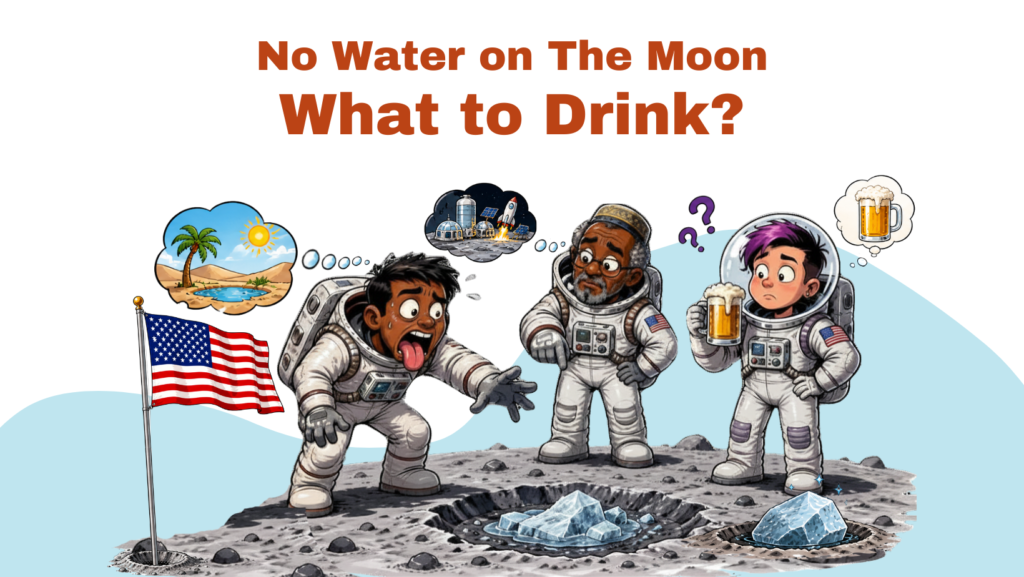
When There’s No Water… Beer Will Do
Sounds reasonable, right? No water? No problem—just grab a beer. After all, half a beer is better than no water.
Exactly! Who needs water when there’s beer? Beer is 90% water anyway!
Simple solution, problem solved. That’s usually how we think: if one thing is missing, something else can replace it.
That logic works… until it doesn’t.
And that’s where things get interesting.

Everything Was Fine… Until You Got Thirsty
Picture it for a moment. You’re on the Moon.
Everything feels extraordinary: the landscape, the silence, the strange awareness of being somewhere almost no one has ever been. For a brief moment, it all feels perfect.
And then something simple happens. Something deeply human.
You get thirsty.
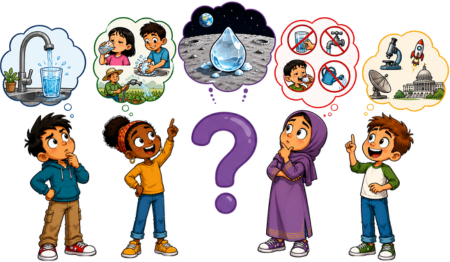
At first, your mind reacts automatically. You start thinking about water, about something to drink, about any quick solution—just like you would on Earth. It’s almost instinctive.
But what if I told you something changes everything?

Not Water on The Moon
Wait—what?
But I was told there is water on the Moon.
And that’s true. There is water. But there’s one thing that changes everything: there’s nothing to drink.
Really? Yeah.
No bottles, no liquids—nothing at all that could quench your thirst.
And yet… we know there is water on the Moon.
That’s the contradiction—and that’s exactly where the problem begins.
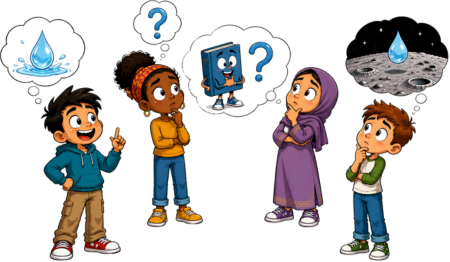
So… is there actually water on the Moon, or not?
A Ridiculous Question… Until It Isn’t
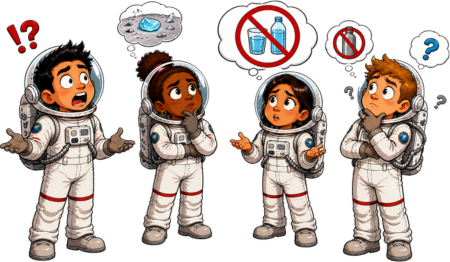
The scene itself isn’t the interesting part. That’s already clear: you’re on the Moon, you’re thirsty, and there’s nothing to drink.
The problem starts when you try to explain it.
On Earth, things are simple. If you’re thirsty, you drink water. No questions, no analysis, no confusion. It just works.
But here, something breaks.
We know there is water on the Moon—not in rivers or lakes, but it exists. So the question stops being absurd and starts becoming uncomfortable:
How is it possible that there is water… but nothing to drink?
What Do We Mean by “Water”?
And more importantly, what do we actually mean when we say “water”?
Let me ask you something—without overthinking it:
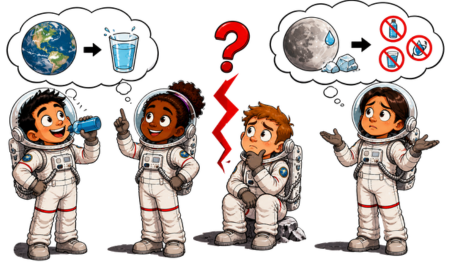
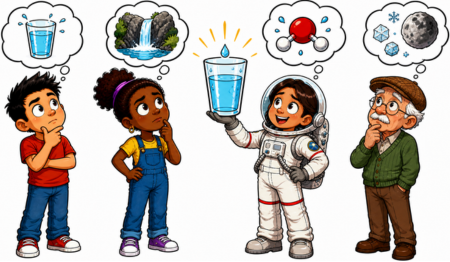
What is water, to you? When you say the word “water”… what exactly are you picturing?
Now you’re thinking about it. You’re trying to figure out what “water” actually means. And it’s not as simple as it seems—at least not if you’re only looking at it from human experience on Earth.
So where’s the trick? There isn’t one. Just a mental trap.
The Mental Trap (And Why We All Fall Into It)
The problem isn’t the Moon. It’s us.
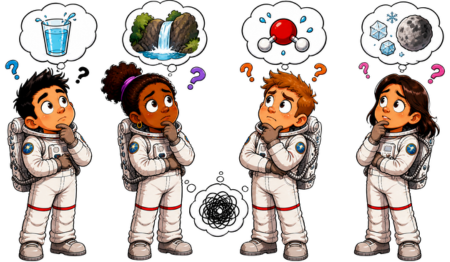
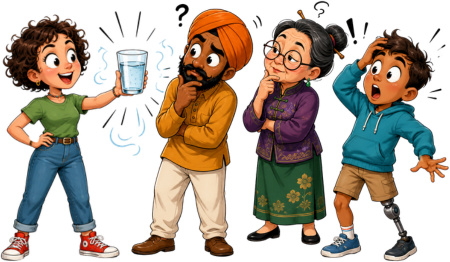
When we hear the word “water”, we don’t think of H₂O as a chemical concept or its different physical states. We think of something very specific: a clear, drinkable liquid that refreshes us and quenches our thirst.
That image isn’t universal.
It’s local.
It’s terrestrial.
And the interesting part is that we’re almost never aware of it.
We think we understand what water is… when in reality, we only understand a very specific version of it—one that depends entirely on the conditions of our planet.
The Uncomfortable Fact
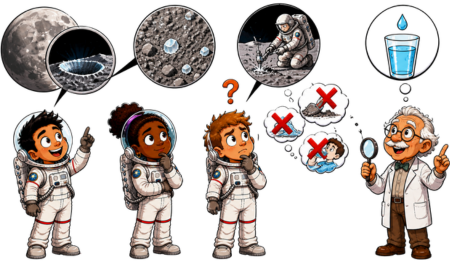
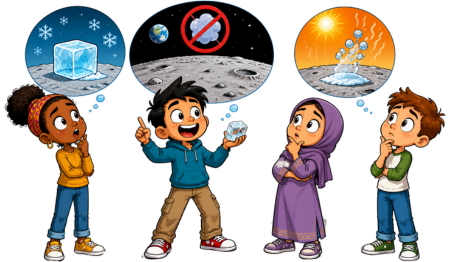
Yes, there is water on the Moon. This isn’t speculation or science fiction. Ice has been detected in permanently shadowed craters—places where sunlight never reaches and temperatures are so low that water can remain frozen for millions of years.
There are also traces of water in the lunar regolith, the fine dust that covers the surface.
But here’s the key point:
That water is not available in any way that makes sense to us.
You can’t easily collect it.
You can’t see it flow.
You can’t drink it.
It is water in scientific terms.
But not in human terms.
So… Is It Useful or Not?
Think about it for a second:
If you can’t drink it, use it, or access it… is it still water—for you?
This is where things get interesting, because the answer depends entirely on context.
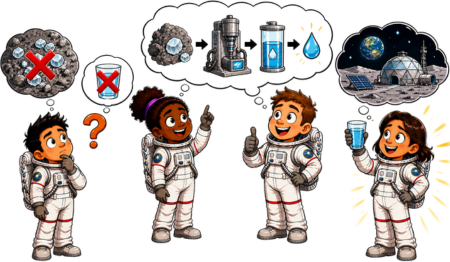
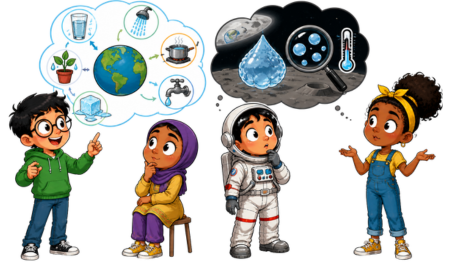
For an astronaut with advanced technology, that water could be incredibly valuable. It could be extracted, heated, processed, and turned into something usable.
In that sense, yes—it works.
It’s Water, But It’s Not Really Water
Wait! What? Wait… that doesn’t even make sense. Whacha takin’ ‘bout Willis?
But if we remove technology and stay with a basic human experience—one person, thirsty, standing on the Moon—then that water is useless.
It doesn’t fulfill the function we expect from it.
And that leads to a key idea:
Something can exist without being functional for us.
And when that happens, we start questioning whether it really is what we thought it was.
It’s Not Just the Moon
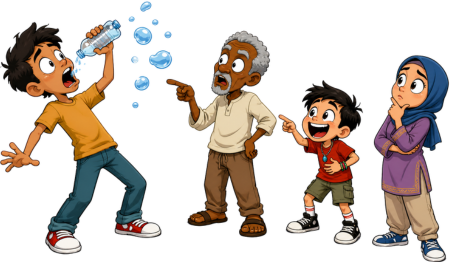
It is you! This isn’t as strange as it sounds.
Something similar happens here on Earth—we just don’t always notice it.
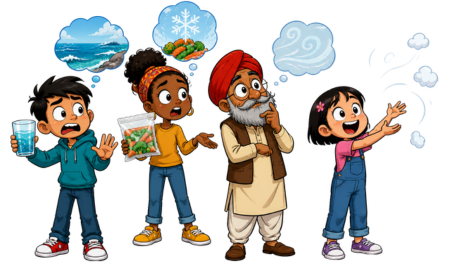
Seawater, for example, is everywhere… but you can’t drink it.
Frozen food works the same way. You know it’s food, you know it exists—but in that moment, it doesn’t serve you.
Even air behaves like this. It’s everywhere, yet you can’t grab it, store it easily, or use it the way you use other resources.
It’s not that things don’t exist.
It’s that they don’t always exist in a way that is useful to us.
The Real Problem Isn’t the Water
There’s nothing wrong with water on the Moon.
The problem is the environment in which it exists.
The Moon lacks a significant atmosphere, which means there’s no stable pressure like on Earth. Temperatures also fluctuate dramatically between day and night.
Under those conditions, water cannot naturally remain in liquid form. It either freezes or sublimates—going directly from solid to gas.
In other words, the behavior we take for granted on Earth simply doesn’t happen there.
So it’s not that water stops being water.
It’s that our expectations stop working.
This Is Where the Word Breaks
And then a more uncomfortable question appears:
Do words describe reality… or just help us understand it?
In everyday life, words work because they simplify reality. We say “water” and everyone understands the same thing—no explanation needed.
But that simplicity comes at a cost:
It depends entirely on context.
When the context changes—when we leave Earth, for example—those words start to fail.
They are still technically correct, but they no longer match our experience.
So the real question is not just whether there is water on the Moon, but what that word actually means in a completely different environment.
What We Think “Water” Means
There’s something deeper going on here.
The meaning of a word is never pure or isolated. It depends on everything around it: how we use it, what we expect from it, the context in which it appears.
“Water”, for example.
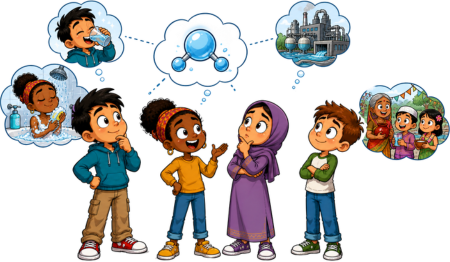
On Earth, when you say “water”, you’re not thinking about H₂O as a formula. You’re thinking about something you drink, something that sustains you, something you use every day.
There’s an entire network behind it: survival, hygiene, industry—even culture and ownership.
And that leads to something we rarely question:
We tend to believe that words have fixed, stable, universal meanings.
As if “water” meant the same thing everywhere.
When That Idea Stops Working
That assumption works… until the context changes.
Because on the Moon, that entire network disappears.
There is no access, no immediate use, nothing you can do with it to quench your thirst.
So it’s not that water stops existing.
It’s that it stops meaning the same thing.
The word is still the same.
But everything that supported it changes.
And with that, something new appears: new implications, new questions—scientific, practical, even political.
In the end, it’s not that lunar water doesn’t physically exist.
It’s that its meaning is not “just there”.
It only appears within a context—within use, possibility, and interpretation.
When Words Start to Slip
What’s interesting is that this isn’t a new problem.
This is the kind of thing philosophers have been pointing at for a long time.
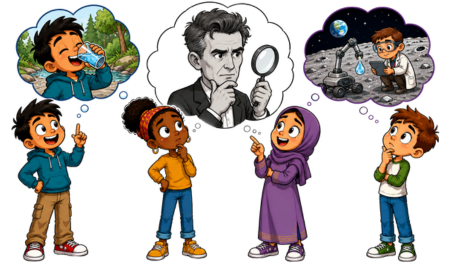
Ludwig Wittgenstein, for example, argued that the meaning of a word isn’t something fixed—it comes from how we use it, from the context, from the situation we’re in.
And if that’s true, then “water” doesn’t mean the same thing everywhere.
On Earth, it’s something you drink. On the Moon, it’s something you detect, measure… maybe extract—but not something you can simply use.
Same Word: Different Reality!
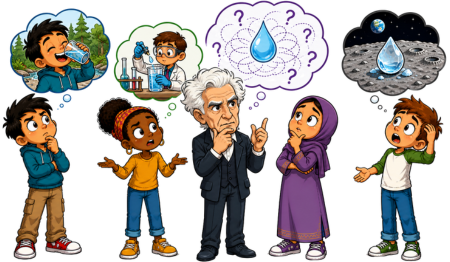
And then Jacques Derrida comes in and makes things even more uncomfortable.
Because if meaning always depends on context… then it’s never completely stable to begin with.
It shifts. It depends. It slips.
So now the problem isn’t just that water behaves differently on the Moon.
It’s that the word itself was never as solid as we thought.
A Small Hit to Human Ego
We like to think that language describes the world as it is.
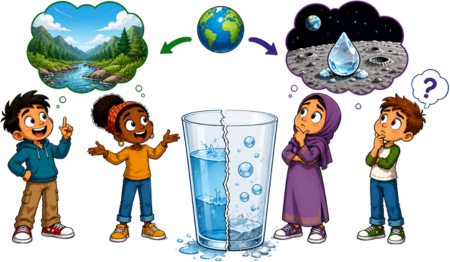
But in reality, language describes the world as we experience it.
And that difference is huge.
What we call “water” works perfectly on Earth because it aligns with our needs, our perceptions, and our physical conditions.
But outside that environment, that definition begins to fall apart.
It’s not that the universe is confusing.
It’s that our categories are limited.
When Language Draws the Line
“The limits of my language mean the limits of my world.”
— Ludwig Wittgenstein
It sounds abstract at first. Almost like one of those phrases you read twice and move on.
But look at what just happened.
A moment ago, “water” felt obvious. Simple. Universal.
And now?
Now you’re not so sure anymore.
That’s exactly the point.
What That Actually Means
Wittgenstein’s idea wasn’t just about language as a tool—it was about its limits. The idea that what we can understand is deeply tied to what we can express, to the words and concepts we have available.
Not because reality stops there—but because our way of making sense of it does.
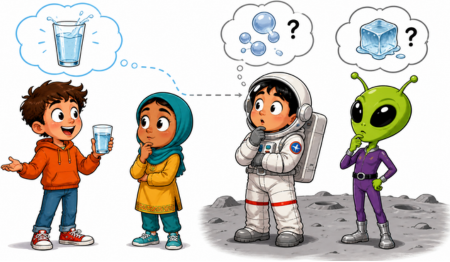
So when you say “water”, you’re not just naming something that exists out there.
You’re describing what you’re able to recognize, to use, to experience within your world.
On Earth, that works perfectly.
But on the Moon?
That’s where those limits start to show.
Nothing Outside the Text?
And if that idea already feels a bit unsettling, it doesn’t stop there.
Jacques Derrida pushes it even further with a phrase that sounds almost impossible at first: “There is nothing outside the text.”
At first glance, it feels exaggerated. Almost like it’s denying reality itself. But that’s not really what’s going on.
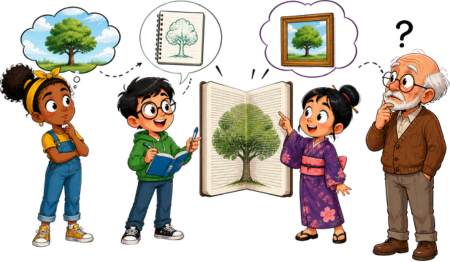
The point isn’t that the world disappears or that things only exist when we describe them. The point is that we never encounter reality in a completely raw or unfiltered way.
Meaning Doesn’t Stand Alone
Everything we understand passes through some kind of framework—language, context, experience, expectations. These are not optional; they are the conditions that make understanding possible in the first place.
So when we say “water”, we are not pointing to something neutral or universal. We are relying on a system that tells us what that word means, how it behaves, and what it is for.
That system works as long as the context holds. But on the Moon, it doesn’t. The word is still there, and the substance is still there, yet the meaning no longer aligns in the same way.
It’s not just that water behaves differently. It’s that what we take “water” to be was never independent of the way we interpret and use it.
Language Checkpoint (Before Things Get Abstract)
Before we go any further, it helps to pause for a second.
We’ve been using words like “water,” “meaning,” and “context” as if they were stable—but that’s exactly what’s starting to shift. So instead of assuming we all mean the same thing, here are a few key terms worth holding onto as the ground begins to move:
| English | Spanish | Why It Matters |
|---|---|---|
| Water | Agua | Central example — shows how meaning shifts with context |
| Meaning | Significado | Core idea of the article |
| Language | Lenguaje | The system through which we interpret everything |
| Context | Contexto | What gives meaning its shape |
| Use | Uso | Words only make sense when used |
| Reality | Realidad | What we think we describe—but actually interpret |
| Interpretation | Interpretación | How we understand what we experience |
| Environment | Entorno | Changes everything (Earth vs Moon) |
| Experience | Experiencia | Shapes how we assign meaning |
| Understanding | Comprensión | The result of language + context |
Back To the Title (Yes, the Beer Matters)
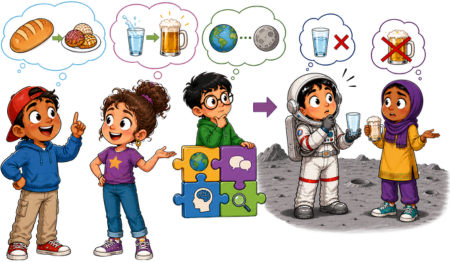
“When there’s no water… beer will do” sounds like a joke.
But in this context, it says something more serious.
Even that phrase depends on assumptions we take for granted: that there is liquid water, that we can produce beer, that we have access to it.
On the Moon, none of that is guaranteed.
There is no accessible water—but there is no beer either.
What sounds like a clever solution on Earth simply stops working.
And once again, language loses its footing.
No water. No beer.
And suddenly, even simple words stop working.

Where That Beer Line Comes From
The line “When there’s no water… beer will do” didn’t come out of nowhere.
It’s loosely inspired by a common expression in Spanish: “si no hay pan, buenas son las tortas.” The idea is simple—if you don’t have what you need, something else can take its place.
It’s a very practical way of thinking. Flexible. Grounded. It works most of the time.
In many ways, this whole article is just a different version of that same idea—translated, adapted, and pushed a little further.
Because what feels obvious in one context doesn’t always survive in another.
And sometimes, when you change the setting enough…
there’s no water—
and there’s no beer either.
We’re Not Done Yet
Imagine the scene again: you’re on the Moon, you’re thirsty, and you know there is water somewhere—but you can’t use it.
That contradiction isn’t a mistake.
It’s a signal.
A signal that our words, our ideas, and our certainties depend far more on context than we usually admit.
And maybe the most interesting question is no longer what you would drink on the Moon…
but what “water” really means when we stop thinking like inhabitants of Earth.
Water on the Moon: what it is… and what it could become
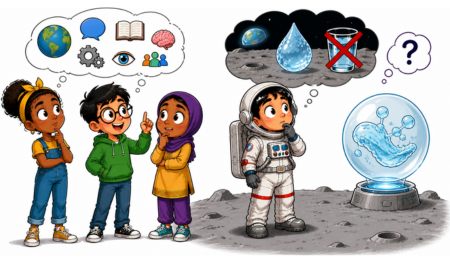
There is no drinkable water on the Moon—not in the sense we understand on Earth. There are no rivers, no rain, no cold glass to quench your thirst.
What exists is ice, hidden in darkness, trapped in craters where sunlight never reaches.
And yet… that “non-water” could be everything.
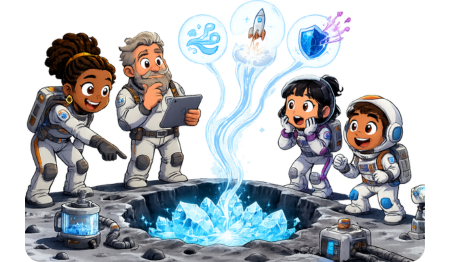
It could become breathable air, fuel for deeper space travel, protection against radiation—the foundation of a human presence beyond Earth.
So the question shifts again. It’s no longer just what “water” means. It’s what it could become.
Because on the Moon, water isn’t something you drink. It’s something you transform.
And maybe that’s the key: Not what things are—but what language, and we through it, allow them to become.
What Language Would You Take to the Moon?
If the meaning of something as simple as “water” can change depending on where you are… what about language?
On Earth, we rarely question it. We speak what’s around us—what works, what connects us to others.
But step outside that environment, and even that becomes uncertain.
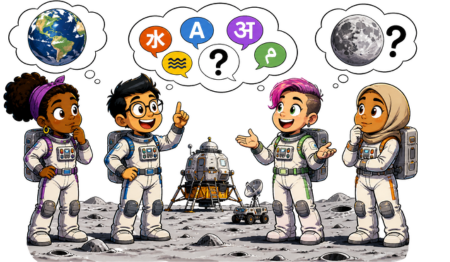
What language would you take to the Moon?
English might seem like the obvious choice. It dominates science, technology, and international communication. But that’s only true within a specific context.
Change the setting, and that certainty starts to loosen.
When Language Stops Being Obvious
Spanish, for example, connects millions of people across different continents and cultures. In another context—another kind of human presence beyond Earth—it could be just as relevant.
Or maybe several languages would coexist. Maybe none would dominate at all.
And if context really defines meaning…
who knows?
Maybe one day Spanish ends up being one of the most useful languages on the Moon.
Not because it “belongs” there—
but because, like everything else, its meaning depends on where—and how—we use it.
Taking More Than Just Ourselves
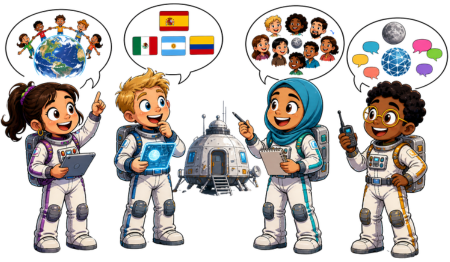
As we start thinking about living beyond Earth—on the Moon, maybe even on Mars—language won’t stay behind.
That’s already happening here on Earth. Communities form around shared ways of understanding and communicating—whether in classrooms, online spaces, or places like KiDeeF Spanish and Kasa de Franko, where language is less about rules and more about use, context, and interaction.
And that matters, because it shows that language is not something fixed—it evolves with the people who use it.

From the North of Peru… to the Moon
Even the idea of traveling beyond Earth is starting to take shape. Projects like Koslachek—a sister initiative to KiDeeF Spanish and Kasa de Franko—already explore places like the north of Peru, offering a different way of experiencing language, culture, and environment.
And who knows? Maybe one day, that same spirit of exploration extends even further—beyond Earth itself.
Because if we ever get there, we won’t just bring technology—we’ll bring our ways of speaking, understanding, and making sense of everything around us.

If You’re Still Thinking
If this made you pause—even for a moment—there’s more to explore.
Each of these looks at the same ideas from a different angle:
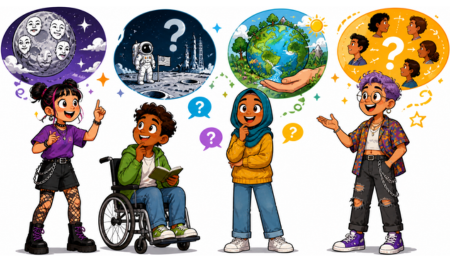
- The Thousand and One Faces of the Moon — the Moon is never just one thing
- What If We Never Went to the Moon? — history depends on how we frame it
- Earth Day Must Be Everyday — meaning shapes how we treat what we have
Different perspectives. Same question underneath.
Why Kasa de Franko
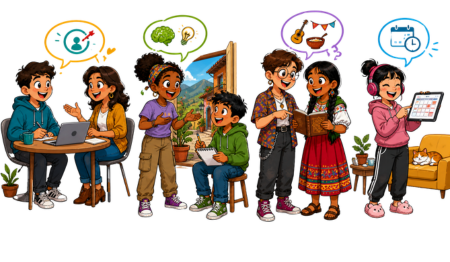
At Kasa de Franko, Spanish is not about memorizing rules—it’s about learning how meaning works in real situations.
- Personalized Lessons — one-on-one sessions built around you
- Immersive Approach — learn to think in Spanish, not translate
- Native Insight — language shaped by real culture and use
Flexible Scheduling — learning that fits your rhythm
Explore More
If you’re curious about how language connects with culture, expression, and even humor, you can explore:
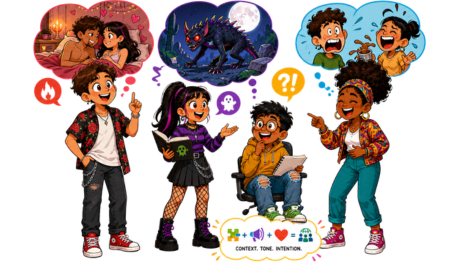
- 🔥Romance — Things Spanish People Say in Bed
- 👻Legends — El Sexi Chupacabras
- 😂 Mistakes — common phrases that go very wrong
Language isn’t just structure—it’s context, tone, and intention.
Take It Further with Free Spanish
You can read about Spanish.
Or you can actually start using it. Free Spanish Lessons for all
Kasa de Franko offers one-on-one lessons designed to help you speak naturally and understand how the language really works.
Tupananchiskama: And may not too many moons pass before we meet again.