

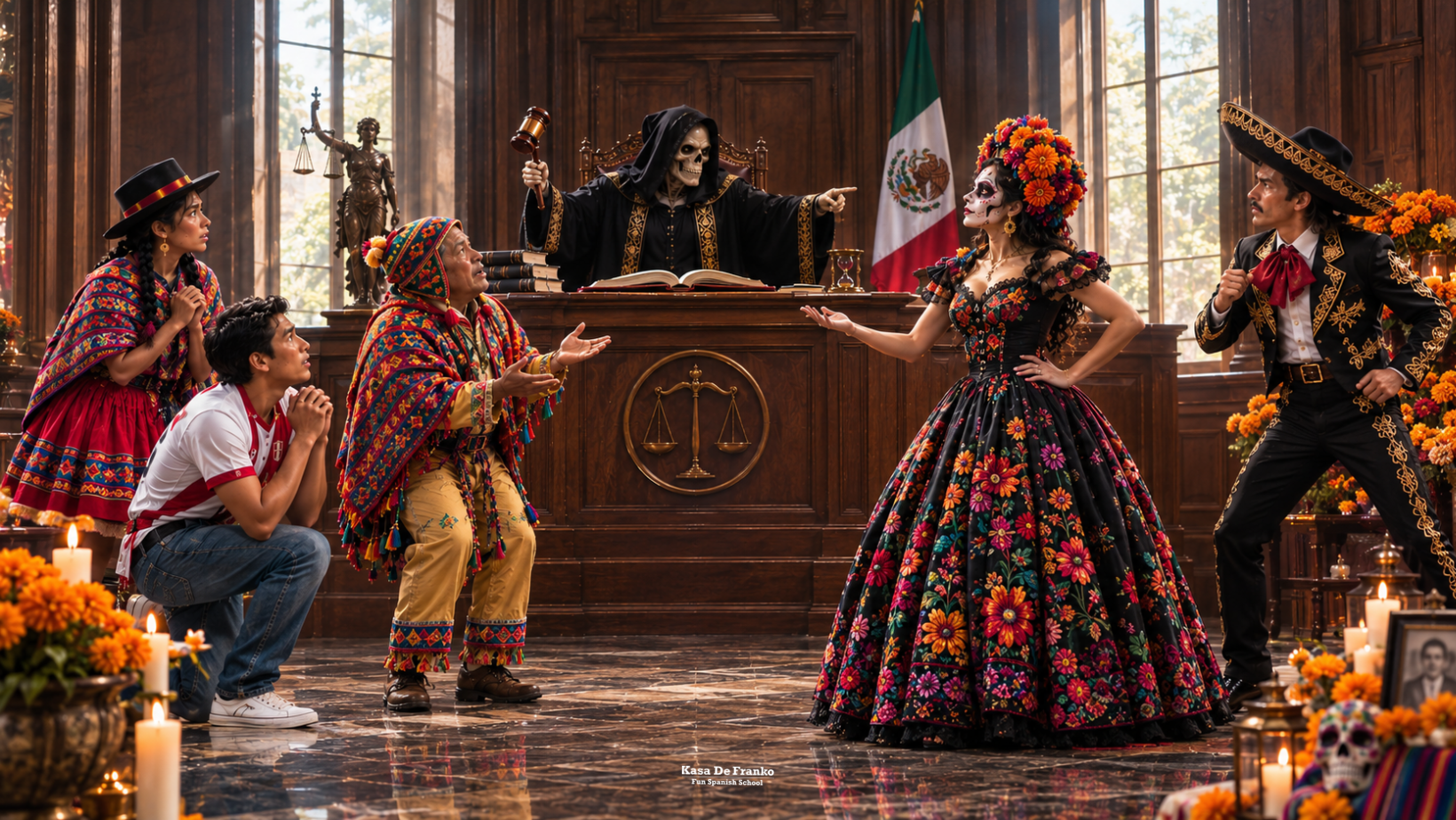
Did Mexico Steal the Day of the Dead from Peru?
Online Spanish Socials$35.00
Conversational Spanish
Tuesday, 11-03-2026 (PT)
07:00 pm to 08:30 pm (PT)
Level: Int. – Adv.
Who Really Owns the Day of the Dead: Mexico or Peru?
Wait… Can You Steal a Tradition About the Dead?
Imagine discovering that another country has allegedly stolen your ancestors’ traditions. Not your phone or your wallet. Your dead.
A recent controversy raises a provocative question: Did Mexico borrow the Day of the Dead from Peru, or are people confusing ancient traditions with the modern celebration?
Before we start issuing international arrest warrants for cultural theft, let’s examine the evidence.
Wait… Didn’t Peru Honor the Dead First?
The Indigenous chronicler Felipe Guamán Poma de Ayala documented an Inca observance called Aya Marcay Quilla, associated with bringing the dead out, offering them food and drink, dressing them, and carrying them in processions.
Does this mean Peru owns the Day of the Dead? Not so fast. Documenting an ancient tradition doesn’t prove another culture stole its modern celebration.
Didn’t Mexico Have Its Own Traditions?
Absolutely. Indigenous peoples across Mesoamerica, including the Mexica, Maya, Mixtec, and Zapotec, had their own beliefs and practices surrounding death and the afterlife.
The history of today’s Día de Muertos also involves Catholic observances, Spanish colonialism, and centuries of cultural transformation.
So, where does cultural exchange end and cultural appropriation begin?
Who Owns the Dead?
Traditions evolve, merge, and sometimes develop independently. Finding ancient practices in Peru doesn’t prove Mexico copied them, just as Mexico’s Indigenous history doesn’t explain every element of today’s celebration.
Can a country claim exclusive ownership of a tradition that has evolved across centuries? And why do historical debates so quickly become competitions between national identities?
Practice Spanish & Discover Something New
Join us to explore ancient Andean and Mesoamerican traditions, examine historical evidence, and discuss cultural appropriation, national pride, and the difference between historical facts and viral claims.
Bring your Spanish, your curiosity, and your opinions. You don’t need to be a historian or a lawyer specializing in disputes involving the deceased.
And don’t worry: nobody will ask you to return your ancestors to their country of origin.
¡Hablemos!
👥 Group Size Policy
🕗 1 attendee: 07:00 p.m. – 07:45 p.m.
🕗 2 attendees: 07:00 p.m. – 08:00 p.m.
🕗 3+ attendees: 07:00 p.m. – 08:30 p.m.