

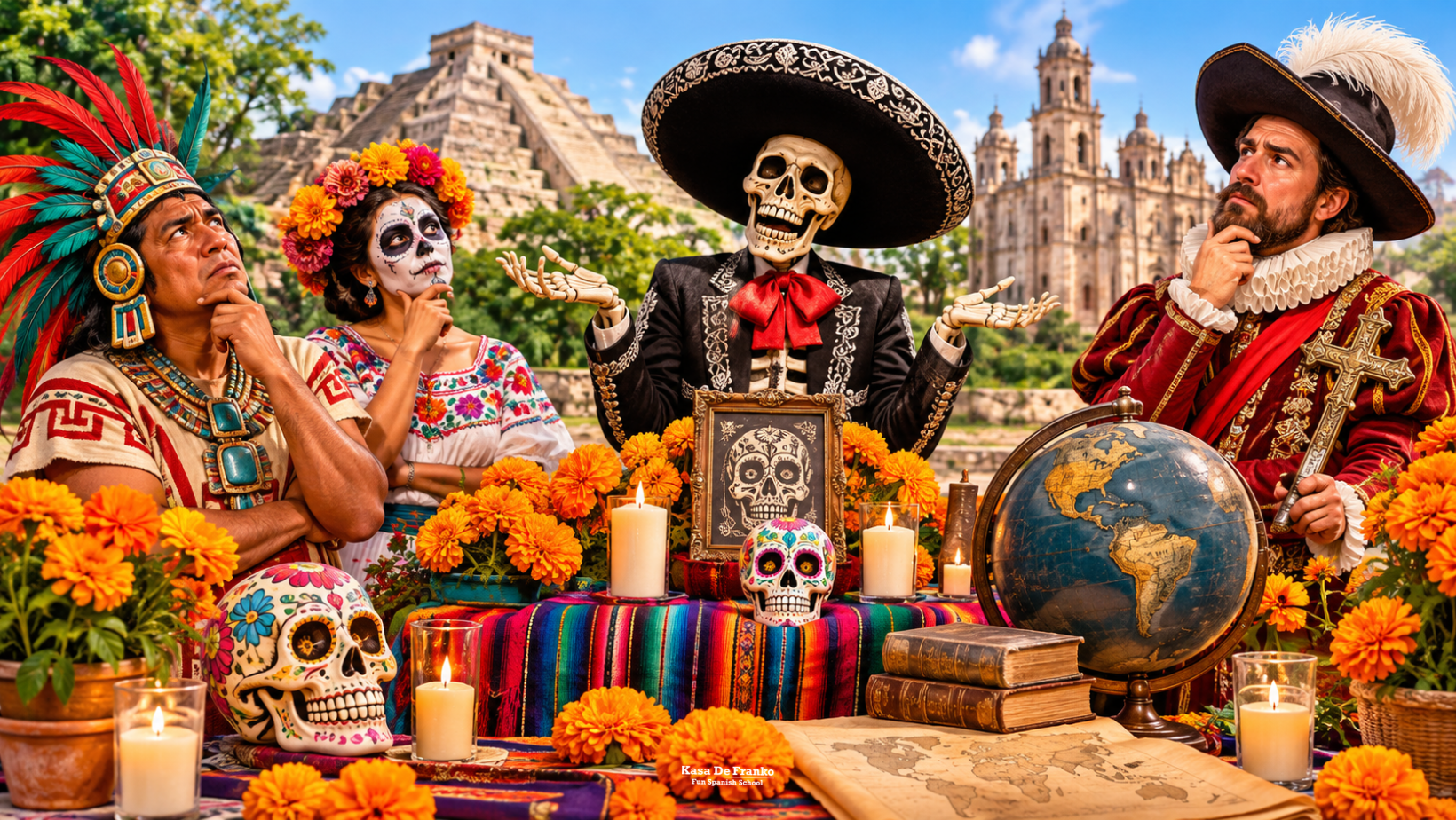
The Dead that Mexico & Peru Stole from Spain
Online Spanish Socials$35.00
Conversational Spanish
Tuesday, 11-17-2026 (PT)
07:00 pm to 08:30 pm (PT)
Level: Int. – Adv.
The Dead Mexico and Peru Stole from Spain: Who Really Owns Día de Muertos?
Wait… Is Spain the Original Owner Now?
Just when we thought we had settled the dispute over who owns Día de Muertos, another country walks into the courtroom. This time, it’s Spain.
Apparently, Peru and Mexico aren’t the only suspects anymore. If we’re going to start returning traditions to their rightful owners, perhaps we should put the ancestors in lost-and-found and ask everyone to bring proof of purchase.
But seriously, what exactly did Spain bring to the Americas, and what was already there before the Spanish arrived?
Did Spain Bring the Day of the Dead?
Well, not exactly. Spain brought Catholic observances to the Americas, including All Saints’ Day (November 1) and All Souls’ Day (November 2), both with medieval European roots.
But Indigenous peoples already had their own beliefs, ceremonies, and ways of honoring the dead long before the arrival of Europeans.
So, did Catholic traditions replace Indigenous practices, or did centuries of conquest, religious imposition, adaptation, and resistance shape something entirely different?
When Historians Disagree!
Here’s where things get interesting. Even Mexico’s own National Institute of Anthropology and History (INAH) has published different interpretations of the origins of Día de Muertos.
Some historians distinguish the modern celebration from ancient Indigenous practices, while other accounts emphasize the interaction between Catholic observances and pre-Hispanic traditions.
So, if the experts don’t tell exactly the same story, how can we expect a simple answer?
Who Gets to Own Remembrance?
And what about the rest of the world? China has Qingming, India has Pitru Paksha, and Europe has its own traditions for remembering the dead.
Does sharing similar customs mean cultural appropriation? Or can different civilizations develop their own ways of honoring ancestors without copying one another?
Perhaps remembrance isn’t something that needs a single inventor—or a country claiming exclusive ownership.
Practice Spanish & Put History on Trial!
Join us for an engaging discussion about Indigenous traditions, Spanish colonialism, Catholic observances, and the complicated history behind Día de Muertos.
We’ll examine historical interpretations, question popular assumptions, and debate cultural appropriation, national identity, and who gets to claim ownership of a tradition.
Bring your Spanish, your curiosity, and your arguments. You don’t need to be a historian, an archaeologist, or an international lawyer specializing in disputes involving the deceased.
And remember: before accusing anyone of stealing the dead, we’d better establish who owned them in the first place.
¡Hablemos!
👥 Group Size Policy
🕗 1 attendee: 07:00 p.m. – 07:45 p.m.
🕗 2 attendees: 07:00 p.m. – 08:00 p.m.
🕗 3+ attendees: 07:00 p.m. – 08:30 p.m.