
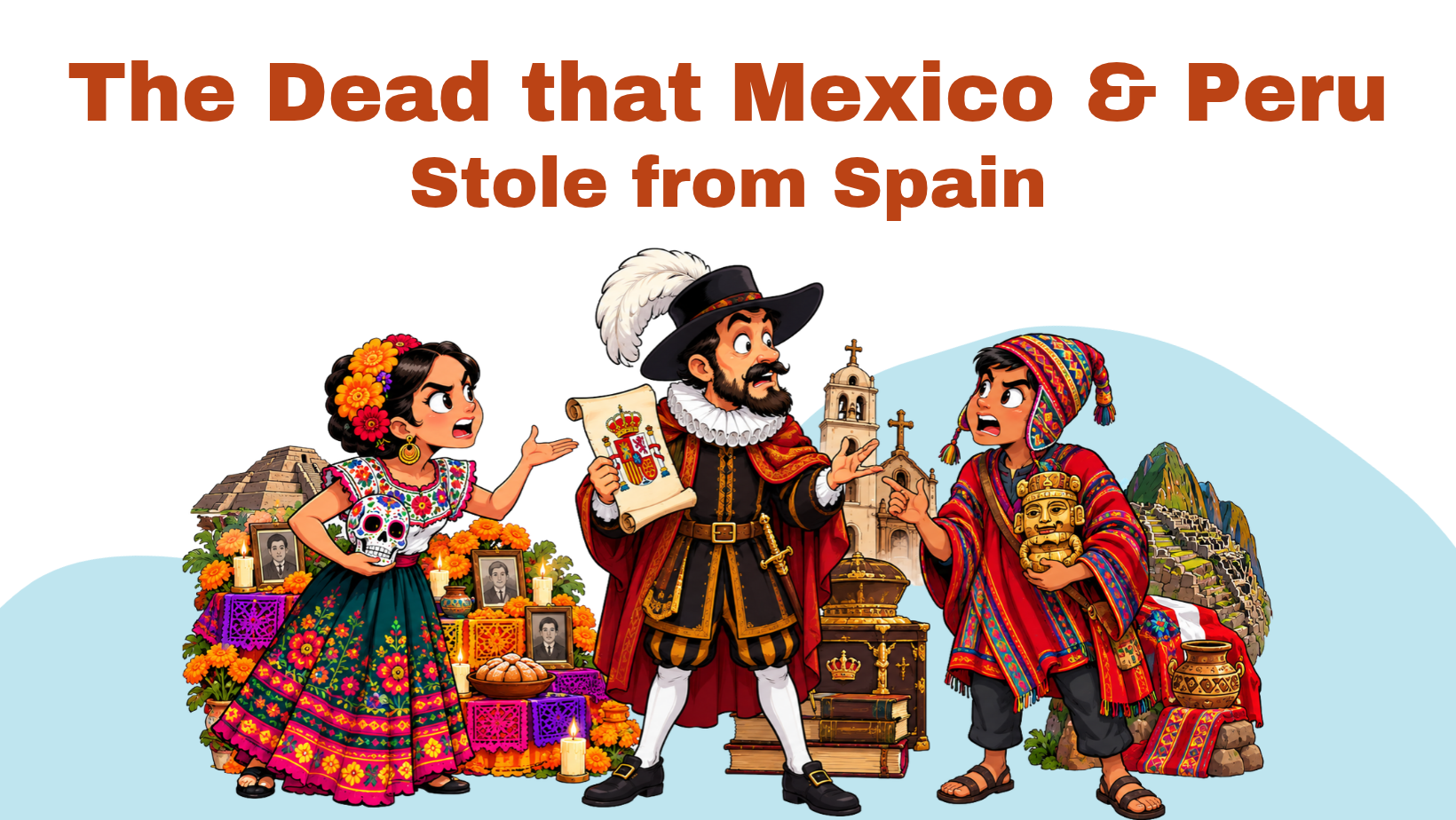
When Three’s a Crowd!
Just when we thought we had enough trouble deciding whether Mexico stole Día de Muertos from Peru, along comes another suspect to complicate the family reunion— or shall we call it the Cultural Appropriation Trial?
Because apparently, when it comes to the dead, nobody can simply let the dead be dead.
¿Pero, por qué? Well…
“Dos son compañía, tres son multitud”, meaning “Two’s company, three’s a crowd”.
Who is it now?
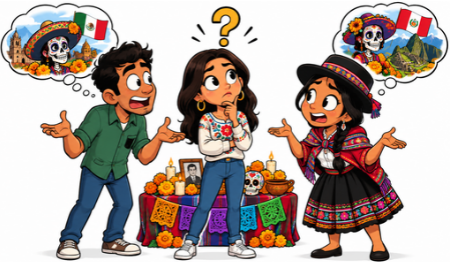
The Unwanted Guest!
Or better yet, call them invaders! Mmm… what? Things, now, are getting uglier—not even color de hormiga, sino de cucaracha: sí, la que no puede caminar.
Well, well, well! Let´s get down to business.
Apparently, the dead have been caught up in a much bigger dispute than we first imagined. First, Peru supposedly wants its tradition back from Mexico.
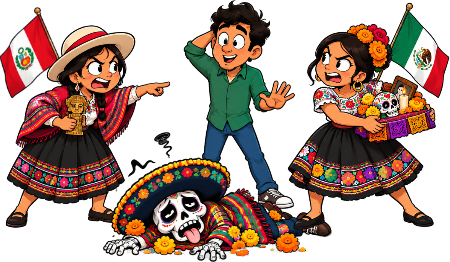
¡Cuando la madre patria quiere su tajada!
Now Spain enters the picture, and suddenly we’re looking at a different kind of family reunion. If we’re going to start demanding that countries return what supposedly belongs to somebody else, perhaps we should put the ancestors in lost-and-found and ask everyone to bring proof of purchase.
Something tells me this little dispute isn’t going to be settled quite so easily.
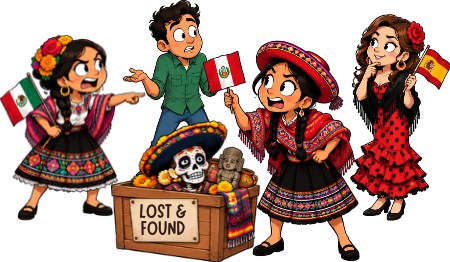
The Day that Death Passed Away
The title sounds ridiculous, doesn’t it? Good. Because the idea that an entire tradition belongs neatly to one modern country—and that another country must therefore have stolen it—is worth questioning.
But seriously, who gets to decide who owns a tradition? Spain brought Catholic observances to the Americas, but Indigenous peoples weren’t sitting around waiting for Europeans to teach them what to do with their dead.
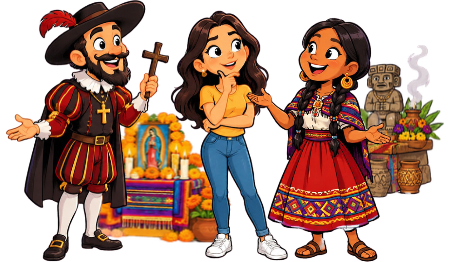
But Hold on to Your Minutes
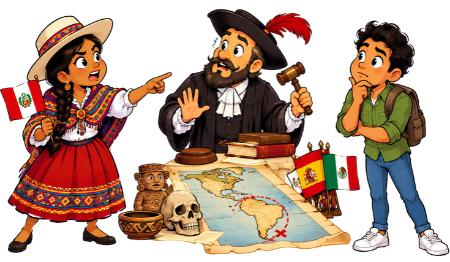
The judge just repealed!
If Peru accuses Mexico of stealing its dead, and Spain enters the picture, are we about to discover that the original crime scene was somewhere else entirely?
Watcha talkin’ ‘bout Willis? Perhaps we were looking at the wrong suspects all along.
Before anybody starts returning the dead to their rightful owner, we’d better figure out what we’re actually talking about.
The Church that Brought Us Death
And much more! Yeah, yeah, we knew it!
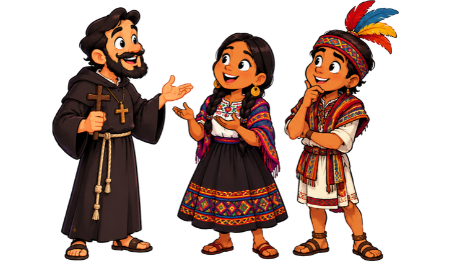
Spain brought Catholic observances to the Americas, but Indigenous peoples already had their own beliefs and practices concerning the dead.
So what happened when those histories met? Did one tradition simply replace another? Did everything merge into one celebration? Or did centuries of conquest, religious imposition, adaptation, and resistance produce something that can’t be reduced to a single origin story?
When History Refuses to Cooperate!
Traditions don’t come with receipts, and history doesn’t always leave us a neat paper trail.
What people celebrate today may carry traces of different beliefs and practices, shaped over generations in different parts of the world—and under circumstances that were anything but equal.
Of course, we all die! Neither Peru, Mexico, nor Spain invented death.
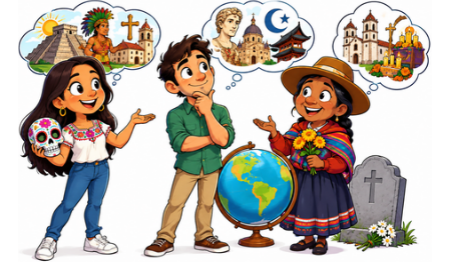
That Matters Especially Here, Your Honor
Spanish colonial rule wasn’t a lovely family picnic, and Indigenous traditions didn’t simply vanish because a new religious calendar arrived.
But just because ancient practices existed doesn’t mean they automatically explain everything about today’s celebration.
To understand how Día de Muertos took shape, we need to look at the history behind the dates, the beliefs, and the traditions—and begin with the Church.
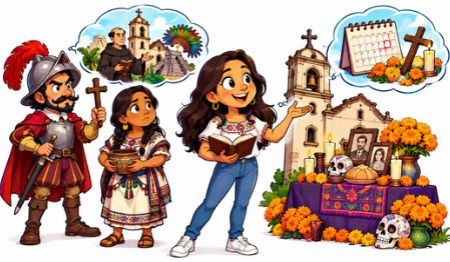
Enter the Church—and Her Historical Complications
So, what about November 1 and 2?
Before anybody starts waving ancient calendars around as evidence, let’s look at the other calendar that entered the picture.
And that calendar didn’t exactly originate in the Americas either.
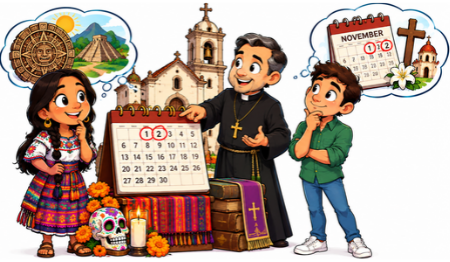
Dia de los Santos, no es de los Muertos
The Catholic Church distinguishes between All Saints’ Day, on November 1, and All Souls’ Day, on November 2. Both observances have medieval European roots and arrived in the Americas during Spanish colonial rule.
As Spain conquered territories across the continent, Catholic institutions established churches, rituals, and calendars among peoples who already had their own beliefs and practices concerning the dead.
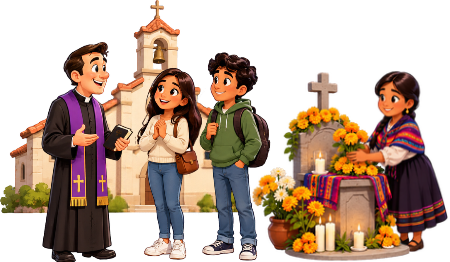
When Two Calendars Collide
That matters, of course. But finding ancient traditions involving the dead doesn’t automatically mean that today’s Mexican celebration has survived unchanged since pre-Hispanic times. Still, let’s not jump to the opposite conclusion, either.
The European origin of the Catholic dates doesn’t mean everything associated with Día de Muertos arrived from Europe, ready-made, in a colonial shipping crate.
A calendar can cross an ocean without every practice attached to it remaining the same.
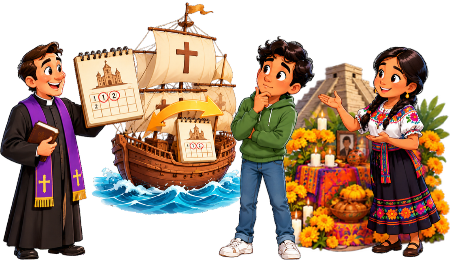
When Similar Doesn’t Mean Equals!
When Catholic observances arrived, Indigenous communities already had their own beliefs and customs—and colonial rule meant the two didn’t meet on equal terms.
What happened next wasn’t simply a matter of replacing one calendar with another. Communities preserved, adapted, and reshaped traditions in ways that varied across time and place.
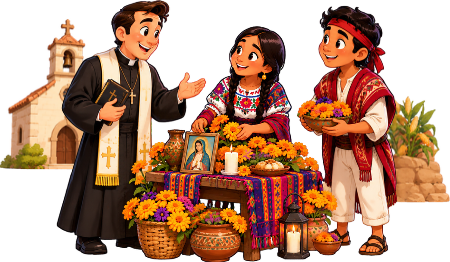
History Doesn’t Fit in a Shipping Crate
And that’s where the story gets even more colorful. Yeah! Color cucaracha. No nice, huh?
The modern celebration cannot be explained by pointing exclusively to either pre-Hispanic traditions or Catholic observances.
Its history involves Indigenous practices, European religious calendars, colonial power, and generations of communities living through the consequences.
These weren’t two finished traditions politely introducing themselves and agreeing to share the same date.
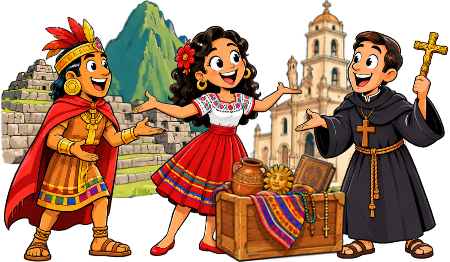
Imposition Doesn’t Always Work
This wasn’t a meeting of equals. Spain had the power to impose its religious calendar; Indigenous communities had to navigate what that meant for their own traditions.
So, if we’re looking for the origins of modern Día de Muertos, we’ll need more than a calendar and a national flag. We’ll need to examine what actually changed, what survived, and how the celebration took shape over time.
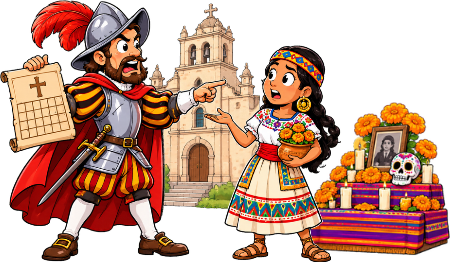
A Living Tradition, Not a Museum Exhibit
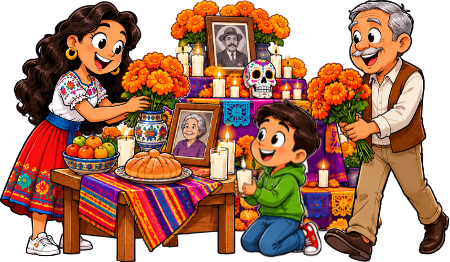
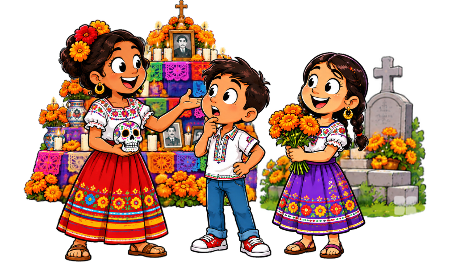
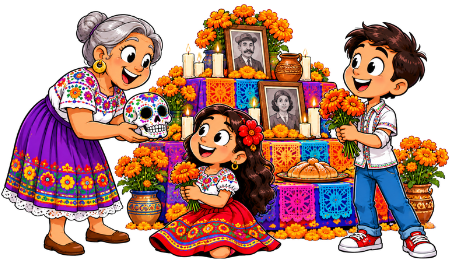
Imagine a family preparing to honor relatives who have died. Food is being made. Flowers are arranged, candles are lit, and offerings are placed where they belong.
Someone visits the cemetery; someone else prepares a dish associated with a loved one. Photographs, familiar objects, and memories bring particular people into the occasion.
These aren’t just rituals performed because a calendar says it’s time. They’re just ways of remembering specific people and keeping family ties alive. Yes! Even after death.
Not Every Family Celebrates the Same Way
The details vary from community to community, and not every Mexican family observes Día de Muertos in the same way. In some places, the celebration involves elaborate altars and public gatherings; elsewhere, customs take different forms.
The objects aren’t interchangeable decorations, and their meanings can’t always be understood simply by looking at them.
Nor should we invent one imaginary Mexican family and pretend it represents the entire country. Mexico is not one enormous household following a single set of instructions for remembering the dead.
Traditions Don’t Sit Still
Traditions survive because people keep practicing them, teaching them to their children, and adapting them as life changes.
Día de Muertos isn’t an archaeological specimen preserved under glass. It’s a living tradition, interpreted and transformed by communities over time.
And here’s where our investigation gets particularly more color de hormiga. Why? Because…
When the Historians Disagree
Well, well, well. Just when we thought we had the case figured out, the witnesses start disagreeing.
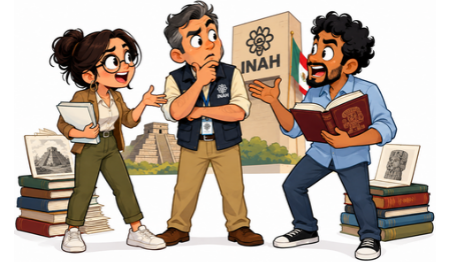
Mexico’s own National Institute of Anthropology and History, or INAH, has published two accounts that frame the historical relationship differently. You’d think the country’s national heritage institution might hand us one neat explanation. Apparently, history didn’t get that memo.
The Catholic Calendar Takes the Stand
In El origen del Día de Muertos, archaeologist Víctor Joel Santos Ramírez argues that the November 1–2 observances originated in medieval Europe.
He distinguishes those Catholic dates from earlier Mesoamerican funerary practices and argues that, strictly speaking, modern Día de Muertos is neither pre-Hispanic in origin nor the product of Indigenous-European syncretism.
In other words, ancient Mesoamerican practices involving the dead don’t automatically make today’s celebration pre-Hispanic. Santos Ramírez draws a firm line between those practices and the Catholic observances.
Then Comes the Plot Twist
Another INAH publication, Día de Muertos, un sincretismo religioso, tells a different part of the story.
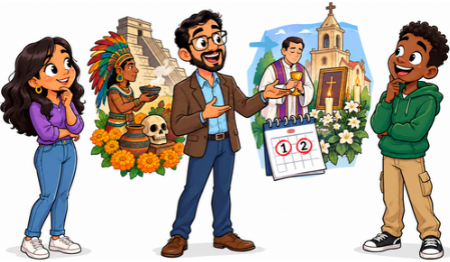
It describes the celebration as emerging during the colonial period through the interaction of medieval Catholic observances and pre-Hispanic autumn festivities honoring the dead. It identifies elements associated with both traditions.
So, wait a minute. One publication argues that syncretism isn’t an accurate description of the modern celebration’s origins; another presents religious and cultural interaction as central to its development.
¡Pónganse de acuerdo pues, carajo!
That’s not quite the tidy verdict our cultural courtroom was hoping for.
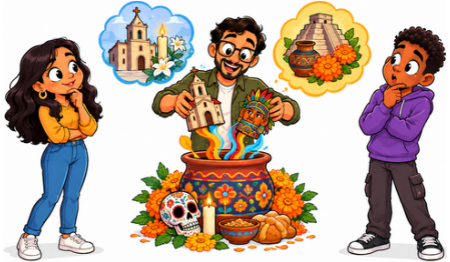
Are the Accounts Contradictory?
Not necessarily on every point. The authors may simply be using the word origin differently.
Where did the Catholic calendar come from?
How did a modern celebration develop in Mexican communities? Are we talking about formal religious observances or the customs people practiced around them? Those questions overlap, but they aren’t identical.
Still, there is a real difference in interpretation, particularly over whether syncretism accurately describes the celebration’s development. We shouldn’t pretend both publications say the same thing. Nor should we conclude that historians have no idea what happened simply because they disagree.
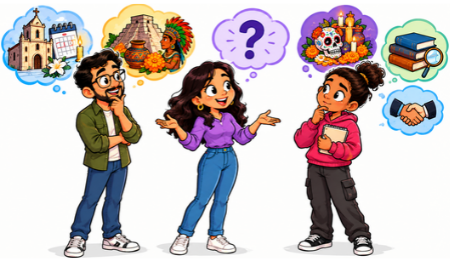
History Isn’t a Beauty Contest
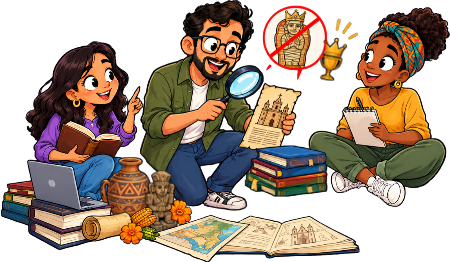
Before we declare a winner, we need to examine what each account actually says, what evidence it uses, and what part of the tradition it’s trying to explain.
That’s historical inquiry: evidence, definitions, arguments, and disagreements. It isn’t a beauty contest in which the country with the oldest-looking mummy automatically takes home the crown.
Colonialism Was No Tea Party
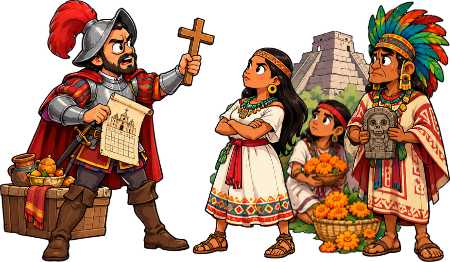
The colonial context deserves more than a polite mention. Spain didn’t arrive in the Americas with a calendar in one hand and a gift basket in the other.
Spanish rule involved conquest, exploitation, religious coercion, and efforts to suppress Indigenous practices. This was cultural interaction under unequal conditions, with one side wielding the power to dictate the terms.
Yet Indigenous communities were not simply waiting for Europeans to teach them how to remember their dead. They retained, adapted, and transformed traditions, often under circumstances they had never chosen.
The Calendar Was Only Part of the Story
So far, we’ve got several pieces of evidence on the table: the Catholic calendar, Indigenous traditions that existed long before the Spanish arrived, and centuries of colonial rule that changed the lives of the people who lived through it.
No single piece of evidence settles the case.
And we can’t simply pick the piece that makes our preferred country look like the rightful owner and send the rest back to the archives.
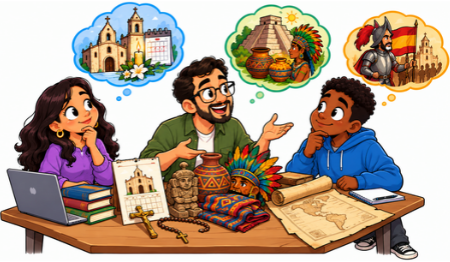
Was It a Family Picnic?
This wasn’t a neat cultural exchange in which Spain supplied the dates and Indigenous communities added a few colorful decorations.
There was power, there was resistance, and there were communities adapting to circumstances they hadn’t chosen.
History, unfortunately for anyone hoping for a quick verdict, rarely cooperates with a simple script.
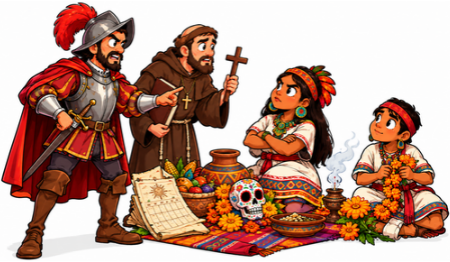
Who Gets to Own the Dead?
And there goes the prosecution’s dream of a quick conviction.
You can’t flatten centuries of history into a sentence declaring that one civilization invented the entire celebration and another simply stole it. That’s not historical analysis; that’s a national ownership claim dressed up as a verdict.
If finding an ancient tradition involving the dead gives a modern country exclusive rights to every later celebration that remembers them, we’d better prepare for a very crowded courtroom.
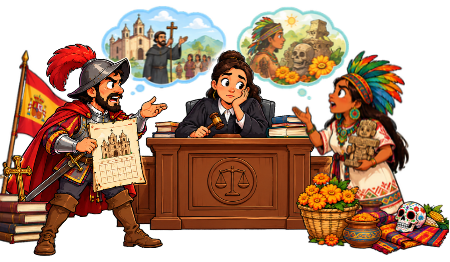
Death Is as Old as Life Itself
So, nobody gets to claim exclusive ownership of remembrance itself!
The witnesses would stretch back thousands of years, the evidence would cross continents, and the deceased might even have to take the stand.
And if even the history of one Mexican tradition resists a simple origin story, perhaps the whole idea that a country must own the practice of remembering the dead deserves a closer look.
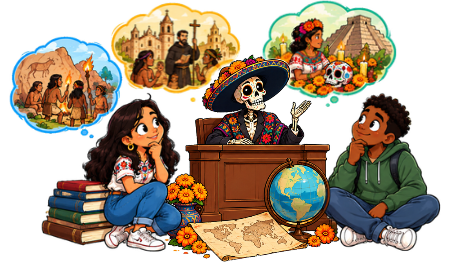
Does the Rest of the World Have Dead People Too?
Of course: People drop like flies everywhere.
An International Lineup of Ancestors.
Before Peru and Mexico take their dispute to the International Court of Cultural Copyright, we should probably invite the rest of humanity to testify.
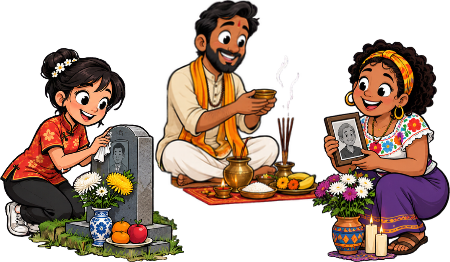
China, for instance, has Qingming, the Tomb-Sweeping Festival, when families visit graves and honor their ancestors. In India, many Hindu families observe Pitru Paksha, a period dedicated to rites for deceased relatives.
Apparently, Peru and Mexico aren’t the only countries with ancestors. Who knew?
When Other Suspects Get into the Room!
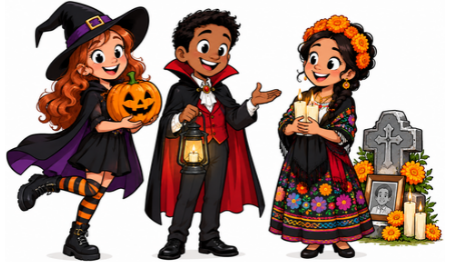
And Europe and North America? They have their own suspects to bring into the room: Halloween, All Saints’ Day, and All Souls’ Day.
Halloween itself is commonly associated with the Celtic festival of Samhain, Christian observances, and customs that developed over centuries.
Halloween Takes the Stand
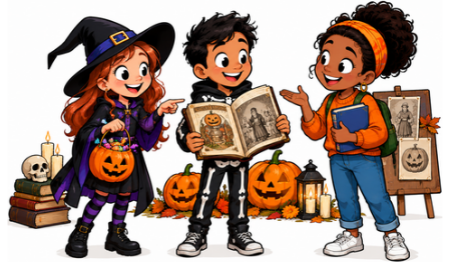
Halloween may look like costumes, candy, and spooky decorations today, but its history is considerably more complicated. Library of Congress offers useful historical context.
But before anyone starts shouting cultural theft, let’s remember that these traditions aren’t interchangeable.
Their dates, beliefs, rituals, and historical developments differ. Finding similarities doesn’t automatically prove that one culture copied another.
Death Doesn’t Need a Passport
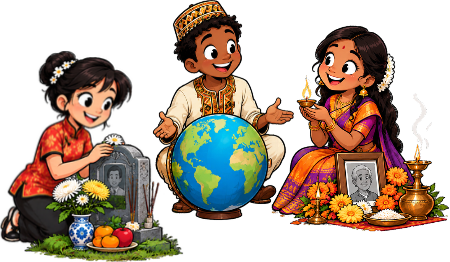
The point isn’t that everybody copied everybody else. It’s that people all over the world have found their own ways to remember their ancestors, honor their dead, and keep family ties alive after someone is gone.
Different places, different customs, different explanations for what happens after we die. One universal problem, though: sooner or later, somebody has to figure out what to do with the dead.
And no civilization had to import death from abroad.
Who Gets to Claim Remembrance?
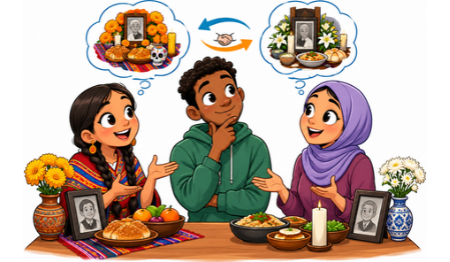
Just because two cultures have similar ways of honoring their dead doesn’t mean one stole from the other. Maybe they influenced each other. Maybe they arrived at similar practices independently. To establish that one borrowed from the other, we’d need more than a resemblance.
Otherwise, we may have to investigate whether every culture that prepares food for a funeral has infringed on somebody else’s intellectual property.
The Case of the Stolen Funeral
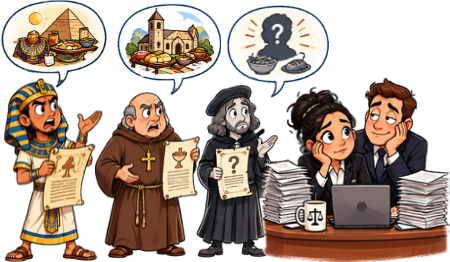
Imagine the paperwork.
The first complaint might arrive from an ancient civilization. The second would be filed by a medieval monastery. The third would accuse both of stealing an idea from somebody whose name has been lost to history.
At some point, the legal department would resign and open a funeral home.
Remembrance Isn’t Intellectual Property
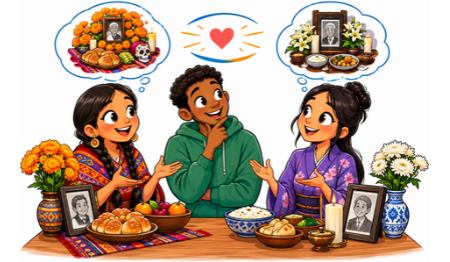
Jokes aside, there’s a serious point here: a tradition can be uniquely meaningful to one culture without that culture being the only one in the world to honor its dead.
Recognizing similarities does not diminish a tradition’s importance. And recognizing a tradition’s distinctiveness does not require us to pretend that no one else has ever done anything remotely similar.
No Need for a Dead Inventor
We can appreciate the specificity of Mexican Día de Muertos and the historical importance of Andean ancestor practices without making one the counterfeit version of the other.
Humanity does not need a single inventor of remembrance.
It needs better ways of understanding why remembrance matters.
