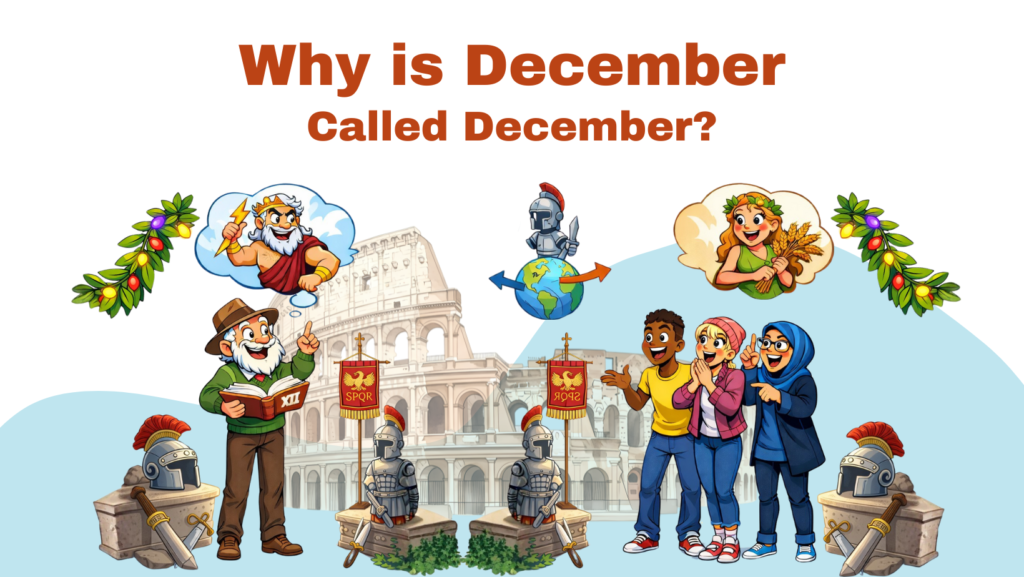
Why Call It Ten When It’s Twelve?
Because ancient Romans couldn’t do math.
That’s the short answer!
The longer one is a surprisingly chaotic story involving calendars that stopped halfway through the year, a deep dislike of winter, and a civilization that decided naming months was less urgent than surviving them.
December carries a number that no longer matches its position, and it’s not alone. So…
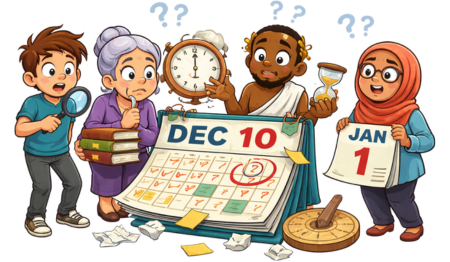
Why Is December Called December?
And why does Spanish keep the same name?
Several months are quietly out of place, leftovers from a calendar system that made sense once — and then didn’t.
Let’s unpack this small historical mess and see what it says about how humans organize time… and how language refuses to clean up after us.
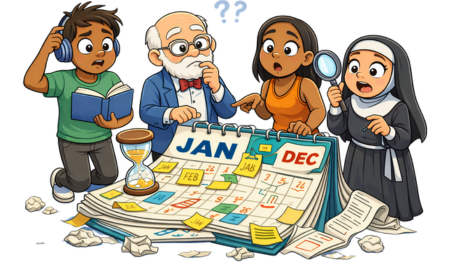
When Twelve Is Not Ten!
Diciembre: 10 es 12 — ¡Su Telenovela Favorita!
December means ten.
Which would make sense if it were still the tenth month.
It isn’t.
What follows is a long, unnecessary sequence of calendar tweaks, imperial decisions, and historical patches — all layered on top of an original system that treated winter as an inconvenience rather than a season.
The name survived.
The logic didn’t.

Romans Loved Romance!
Romans loved their traditions — even when they stopped making sense. They also loved spectacle, excess, and not fixing things once they were named.
That’s how we ended up with the so-called Romance languages: expressive, stubborn, and deeply committed to decisions made two thousand years ago.
December survived the same way — renamed by no one, adjusted by everyone.
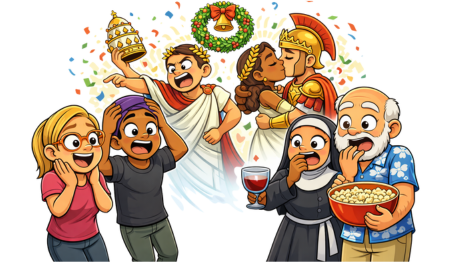
The Misnomer of the Millennium
December, as you probably know, comes from the Latin decem, meaning “ten.”
Which would be reasonable — if it were still the tenth month.
It isn’t.
So what happened?
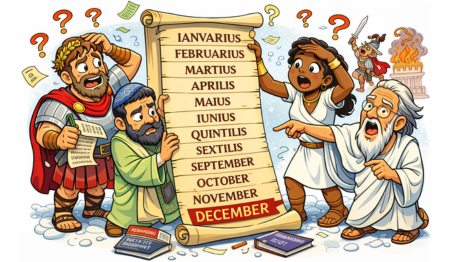
The Romans were working with a ten-month calendar and organized time as if winter simply didn’t count. Months were named, counted, and then left alone. When extra months were eventually added, no one bothered to fix the math.
The calendar changed.
The names stayed.
December is the result.
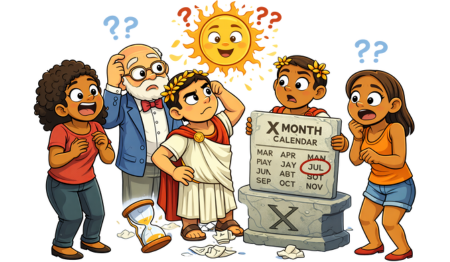
Roman Simplicity at Its Best
Early Rome used a calendar with ten months. It began with Martius (March) and ended with December — literally “ten.”
Winter wasn’t assigned months at all. It was treated as a pause, a gap in the year where nothing of interest happened and therefore nothing needed naming.
When spring returned, the calendar resumed.
Simple, if not especially precise.
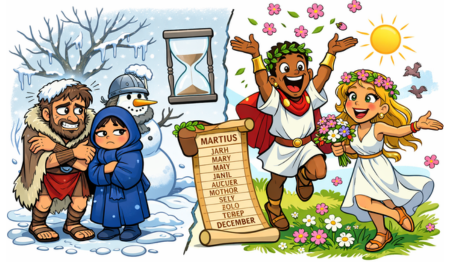
The Original Romulus Calendar
A Ten-Month Masterpiece (Sort of)
This early Roman calendar—often called the Romulan calendar—consisted of just ten months, totaling 304 days. Winter? Apparently the Romans decided that part of the year simply wasn’t worth naming.
The months of the Romulan calendar were:
| Month | Day | Month | Day |
|---|---|---|---|
| Martius | 31 days | Sextilis | 30 days |
| Aprilis | 30 days | September | 30 days |
| Maius | 31 days | October | 31 days |
| Junius | 30 days | November | 30 days |
| Quintilis | 31 days | December | 30 days |
Notice Anything Missing?
Yep—January and February weren’t even a thing yet. After December, Romans entered an unstructured void of winter days, patiently waiting for March to reset the cycle.
Time just… floated.
But this system wasn’t sustainable—especially when you’re trying to schedule things like taxes, military campaigns, or, you know, running an empire.
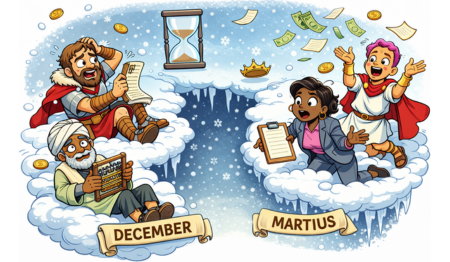
Numa Pompilius: The Calendar Overthinker
By 713 BCE, King Numa Pompilius realized that ignoring two whole months was… bad math. So he added Ianuarius (January) and Februarius (February) to fill the winter void.
Great!
Except now December was the twelfth month, and nobody bothered to rename it.
Why? The Romans were many things—engineers, warriors, philosophers—but rebranding experts they were not. Latin grammar was hard enough, and besides, they were busy conquering stuff.
And that’s how a month named “ten” has been confusing people for over two thousand years.
Numa’s Disclaimer
Fun fact: Even after Numa’s well-intentioned reform, the Roman calendar was still a hot mess. The year had 355 days, which meant it was constantly drifting out of sync with the seasons.
So every few years, the Romans fixed this by casually inserting an extra month called Mercedonius.
Not a day.
Not a week.
An entire surprise month.
Imagine planning your life—harvests, taxes, religious festivals—and suddenly being told, “Congrats, this year comes with a bonus February.” No warning. No consistency. Just vibes.
To make things even better, the decision of when to add Mercedonius was left to priests, who were definitely neutral and absolutely never influenced by politics. Want to extend your friend’s term in office? Add a month. Want elections sooner? Skip it.
Chaos, but make it official.

Julius Caesar Fixes (Most of) the Problem
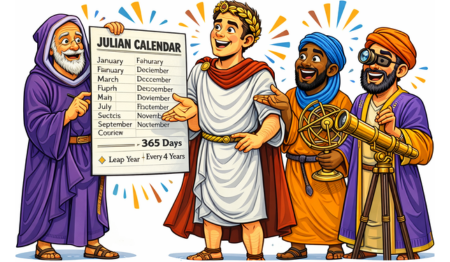
Fast-forward to 46 BCE. Julius Caesar, thoroughly fed up with a calendar that no longer matched reality, stepped in and did what Romans do best: impose order.
With the help of astronomers, he introduced the Julian calendar and:
- Standardized the year to 365 days
- Added a leap year every four years
- Finally locked December into its permanent role as the twelfth month
Problem solved.
Mostly.
Because despite all this cosmic housekeeping, Caesar left the name “December” exactly as it was. Renaming months would have been a bureaucratic nightmare—and besides, Caesar was a little busy with wars, politics, reforms, and the occasional assassination plot.
Let’s cut him some slack. Fixing time itself is already a full-time job.
The Gregorian Calendar: Tweaking Perfection
By the 16th century, the Julian calendar was drifting off course again. Even Caesar couldn’t make time behave forever.
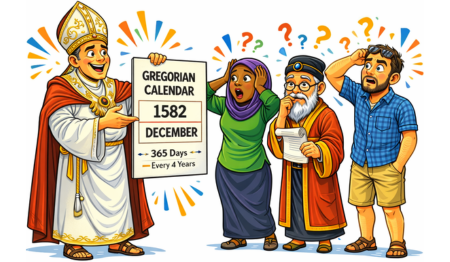
So in 1582, Pope Gregory XIII stepped in with the Gregorian calendar, fine-tuning leap years and realigning the calendar with the solar year. Fewer calendar errors. Fewer seasonal hiccups. Much better math.
And December?
Still the twelfth month. Still proudly named after the number ten.
Why change it? At that point, the name had already been confusing people for over a thousand years. Might as well commit.
What Did the Romans Do in December?
Saturnalia: Rome’s Favorite Holiday
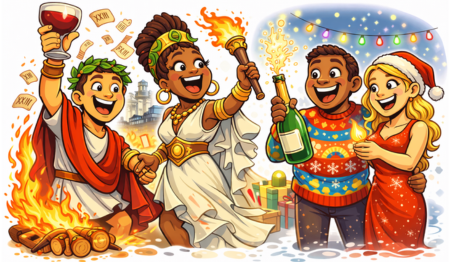
December wasn’t about quiet winter nights or deep reflection. It was Saturnalia—the wildest festival on the Roman calendar, officially dedicated to Saturn, the god of agriculture, but really just dedicated to chaos.
It began on December 17 as a one-day event. Then Romans did what Romans always did when something was fun: they turned it into a weeklong celebration.
Think Christmas meets Mardi Gras, with a strong nothing matters vibe.
Saturnalia was so rowdy that the Christian church later tried to tone it down by rebranding it as Christmas. Nice try, but the chaotic spirit lives on in-office holiday parties and ugly sweater contests.

When Rome Hit the Chaos Button
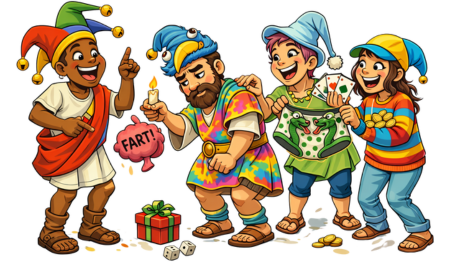
During Saturnalia, normal life was temporarily suspended.
Social roles flipped. Slaves were allowed to mock—or even command—their masters (though yes, they probably still cooked).
Gambling was encouraged.
Gifts were exchanged—cheap trinkets, candles, and deliberate gag gifts. Doesn’t remind you of present times?
People ditched their serious Roman look for colorful clothes and ridiculous hats.
The whole empire agreed to stop being respectable.
It worked.
Sort of.
The spirit lives on—in office holiday parties, awkward gift exchanges, and ugly sweater contests everywhere.
December Around the World
While the Romans were throwing Saturnalia ragers, other cultures had their own reasons to mark the month.
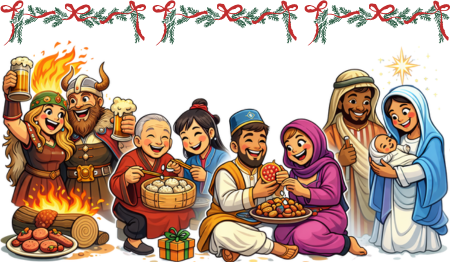
Yule (Northern Europe): The Norse celebrated Yule, a festival of fire, feasting, and family to welcome the winter solstice. A Yule log burned for 12 days straight, accompanied by roasted meats and generous ale. Many Yule traditions survived into Christmas, including the Yule log dessert (burning wood, now cake).
Dongzhi (China): Ancient Chinese marked the winter solstice with Dongzhi, celebrating balance and harmony. Families reunited to eat dumplings and warm themselves while waiting for the days to grow longer. No Netflix binges, but close enough.
Zoroastrian Midwinter Festivals: Ancient Persians observed Yalda, marking the longest night of the year. They stayed up all night eating pomegranates and nuts, celebrating the eventual triumph of light over darkness.
Christian Christmas (December 25): As Christianity spread, December 25 became the date to celebrate Christ’s birth, coinciding with pagan solstice festivals like Saturnalia. Why compete when you can borrow traditions—and add a nativity scene.
December’s Iconic Moments in History
December has a way of sneaking its drama into history. Some events were world-changing, some absurd, and some just… memorable for all the wrong reasons.
- December 25, 800 CE: Charlemagne was crowned Holy Roman Emperor. Imagine being handed an empire as a Christmas gift. No socks or ties for this guy.
- December 7, 1941: The attack on Pearl Harbor. A reminder that December isn’t all tinsel and joy.
- December 31, 1999: The world collectively panicked about Y2K. Spoiler: nothing happened.
- December 14, 1962: The first James Bond movie premiered in London. Spy chaos enters December

Why December Tops the Calendar!
Although it faces a numerical identity crisis, December has become a cultural heavyweight. It’s the month of hope (the new year ahead!), reflection (how did that happen this year?), and relentless holiday cheer.
Whether you’re lighting candles, decking halls, or strategically hiding from relatives, December has something for everyone.
And that’s why it’s called December: a weird, wonderful, misnamed month full of history, celebrations, and proof that humans have been improvising ever since.

December’s Legacy in Language and Culture
Despite centuries of calendar chaos and shifting civilizations, December’s name has survived. It’s a little time capsule of Roman life, carrying echoes of their numbers, festivals, and their “let’s-ignore-winter” attitude.
From ancient bonfires to modern fairy lights, December proves one thing: humans have always loved a good end-of-year party.
In December, the past and present collide, and humans keep proving that a little chaos, celebration, and improvisation never goes out of style.
Explore the Richness of December in Spanish
Looking back at history, it’s clear that our understanding of time, festivals, and traditions is deeply tied to language.
Curious how December—and other cultural holidays—come alive in the Spanish-speaking world? At Kasa de Franko, our classes turn language learning into an experience, mixing history, stories, and a little bit of festive chaos.
Join us, and discover that learning Spanish can be just as lively, surprising, and unpredictable as December itself.
Go Beyond December!
Our classes dive into the cultural richness behind every month, from Roman influences to today’s celebrations—all while immersing you in Spanish.
Curious about the names of other months or the story behind the Roman calendar? Explore our Leap Year and Days & Months sections on the Kasa de Franko Blog, and discover that timekeeping is far messier—and more fascinating—than it looks on a calendar.
What Do You Learn at Kasa de Franko?
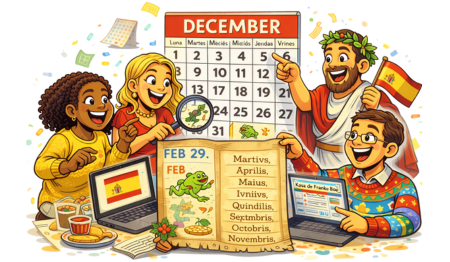
At Kasa de Franko, learning Spanish isn’t about memorizing grammar rules or drilling vocabulary. It’s about stepping into the stories behind the words, tracing the paths of history, and understanding the traditions that shape how people think, celebrate, and live.
When you explore December, for instance, you’re not just learning a month’s name—you’re uncovering centuries of human improvisation, chaos, and creativity. Language becomes a record of memory, culture, and humanity’s stubborn love for celebrations that refuse to make perfect sense.
Each lesson invites you to think like a historian, speak like a local, and smile at the absurdities that have survived the passage of time. At Kasa de Franko, Spanish becomes a doorway—not just to a language, but to the people behind it.
👉 Make sure to pay a visit to the KDF Blog for more stories where language and history collide.
Connect Language with Meaning!
At Kasa de Franko, we believe language is learned best when it’s experienced, questioned, and played with—not when it’s reduced to rules on a page. Our approach is flexible, human, and curiosity-driven, designed for learners who want to understand Spanish, not merely perform it.
We prioritize conversation, context, and critical thinking, adapting each class to the student instead of forcing the student to adapt to a rigid method. Mistakes are part of the process, questions are encouraged, and lessons evolve naturally—just like real language does.
Our philosophy is simple: language belongs to people, not textbooks. When students feel comfortable, engaged, and intellectually stimulated, Spanish stops being something you study and starts becoming something you live.

Immerse Yourself in Real-life Spanish?
If you’re ready to learn Spanish in a fun, immersive, and genuinely human way, join us at Kasa de Franko—where every month of the year becomes an excuse to explore history, culture, and the stories hiding between the lines.
And if you enjoy cultural deep dives that go a little further, take a look at Mike Cocke’s adventures. A KDF alum, he later joined our sister company in Peru, Koslache Tours, traveling through the jungle, Cusco, and exploring Peru’s huacos eróticos, among many other marvels. Along the way, language, desire, and history collide—revealing how civilizations expressed what was never meant to be polite, tidy, or easily explained.
Because at KDF, we believe Spanish isn’t just spoken.
It’s lived, questioned, laughed at—and occasionally a little uncomfortable (in the best way).

Want to Spice Up Your Spanish?
If you’re in the mood to explore the playful side of Spanish, start with fan favorites like “Things Spanish People Say in the Bedroom” and “El Sexy Chupacabras” — two series that mix real-life expressions, cultural context, and just the right dose of humor.
These collections aren’t about shock value. They’re about how Spanish actually sounds when people flirt, joke, tease, and cross the line between polite conversation and lived language. Perfect for real-life use—or simply for a good laugh.
Explore our full “Learning Spanish with Sexy Phrases” collection:
- Dancing with Words,
- Spanish is Sexy,
- Unleashing the Spanish Passion,
- Peru Pre-Hispanic Erotic Ceramics.,
- Learning Spanish is Hot: $9.50/hr! and
- Sexy Christmas in Japan!

Legends & Folktales!
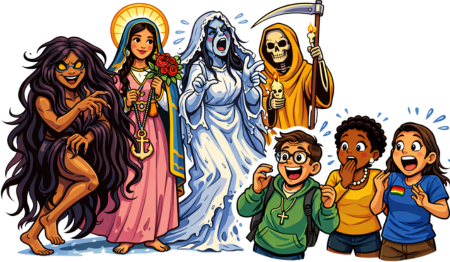
We also dive deep into folklore with characters like La Ciguapa, Sarita Colonia, “La Llorona”, “La Santa Muerte”, and Faith, Fire, & Flagellation: Extreme Easter Rituals — all explored with a fun (and slightly irreverent) twist.
These figures aren’t just spooky stories or religious icons; they’re mirrors of fear, faith, desire, and social tension across the Spanish-speaking world. By exploring them, students discover how language carries myth, belief, and collective memory far better than any vocabulary list ever could.
Laugh & Learn!
And for those who enjoy a good laugh, we’ve got hilarious Language Bloopers like Me gusta la chucha de tu madre”, ¨Feliz Ano Nuevo¨ and “Can I molestate you?” to keep the giggles coming.
They’re funny, yes—but they’re also perfect reminders that language is full of traps, false friends, and moments where meaning goes wildly off the rails. We laugh first, then we learn why it happened—because embarrassment is a surprisingly effective teacher.

Free Holiday Fun at Kasa de Franko
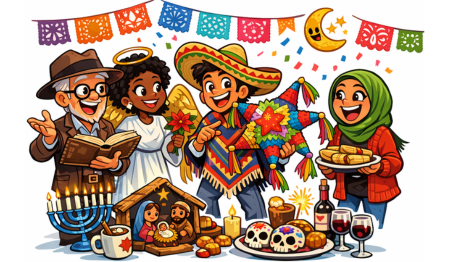
The holidays are a perfect excuse to slow down, connect, and learn something new—so we’re offering free Spanish lessons to celebrate the season together. From Feliz Navidad and próspero Año Nuevo to Feliz Santurantikuy, Bendito Solsticio, and Feliz Hanukkah, we like to honor the many ways people around the world mark the end of the year.
Join us for our Online Holiday Fiesta, where language, culture, and curiosity come together.
These end-of-year free Spanish classes for adults are relaxed, social, and designed to feel more like a gathering than a lesson.
Spots are limited, so if you’re curious, now’s the time to jump in and close the year learning something memorable.

Spanish Gift Certificates & More!
Looking for a holiday gift that doesn’t end up forgotten in a drawer? Give the gift of language with our Holiday Spanish Gift Certificates — a present that lasts longer than chocolate and sparks more conversation than socks.
From cultural deep dives to our playful, slightly cheeky lessons, Kasa de Franko offers learning experiences that are fun, meaningful, and anything but boring. It’s a gift that invites curiosity, connection, and just the right amount of spice.

Spanish Lessons at Just $9.50/hr?
Yes—really. At $9.50 an hour, our Learn Spanish Speaking program is designed to make language learning accessible, human, and actually enjoyable.
Whether you’re starting from zero or brushing up after years of “I used to speak Spanish,” these classes focus on real conversation, confidence, and using the language instead of overthinking it. No pressure, no gimmicks—just Spanish that makes sense in real life.

Learn Spanish from Your City or Anywhere!
From the San Francisco Bay Area to cities across the U.S., our online classes make expert Spanish instruction accessible wherever you are.
Find us in your city or join from anywhere and start learning Spanish in a way that fits real life—at around $10 an hour!

Red Means Free!
Click the red button to claim your holiday gift. At Kasa de Franko, we celebrate the end of the year the same way we teach Spanish—with curiosity, humor, and a willingness to question how things ended up the way they are.
Start with December, its strange name, and its even stranger history—and let that curiosity carry you into Spanish that’s lived, explored, and actually enjoyed. And always remember…..